
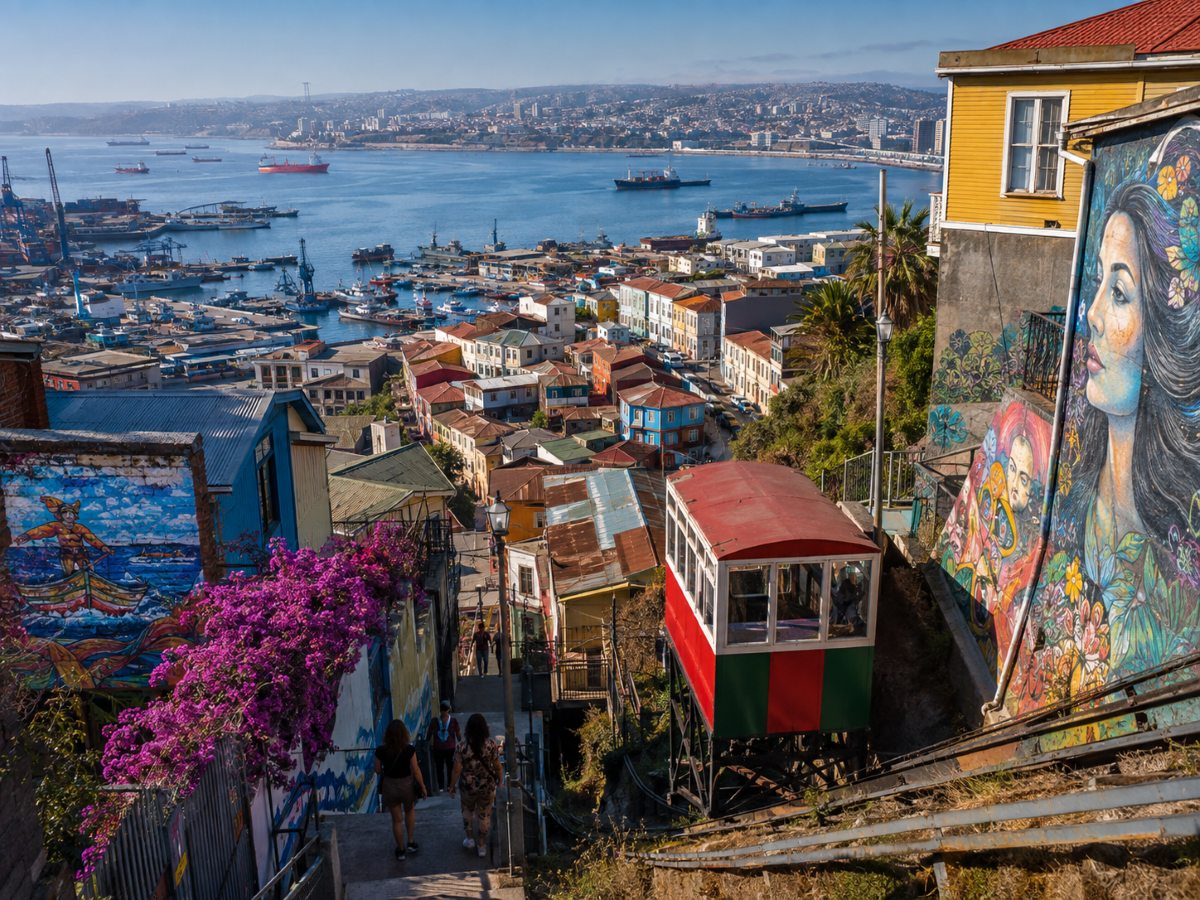
There is no good way to arrive in Valparaiso. The city refuses to present itself. You come over the coastal hills from Santiago and it appears all at once and sideways, an amphitheatre of some forty hills crowded with corrugated iron and paint, tipping down towards a working harbour of cranes and naval grey. Then you are in the flat strip they call el plan, five or six blocks wide in places, and the only way onward is up.
Up is the whole experience. Valparaiso is a city of staircases, blind alleys, dogs asleep on landings, murals that cover entire gable ends, and the ascensores: century-old funiculars that haul you and a handful of strangers up a slope in a wooden box that sounds, as one visitor put it, like a small orchestra of timber and metal. Nowhere else in Latin America feels like this, and the reason is a piece of economic history that most accounts get half right.
A City With No Founding Date
Start with something that surprises people. Valparaiso has no founding charter. Almost every Spanish American city can name the day a notary recorded its establishment, the plaza was paced out and the church plot assigned. Valparaiso cannot. Its origins are genuinely disputed among historians; the usual credit goes to Juan de Saavedra, an officer with Diego de Almagro, who reached the bay in 1536 and is said to have named it after his home village in Spain. But the settlement was never founded in the formal sense. It accumulated. It was the anchorage that served Santiago, and for three centuries it was treated as a warehouse with a beach.
What made it a metropolis was Cape Horn. Before there was a canal, every ship travelling between the Atlantic and the Pacific had to round the bottom of South America, and Valparaiso was the first serious harbour on the far side, the place to repair, resupply, refit and do business after the worst passage in commercial sailing. From the middle of the nineteenth century the money arrived in torrents, and with it the British, Germans, Italians and Croatians who built the mansions on Cerro Alegre and Cerro Concepcion, founded the banks, laid out the cemeteries and gave the city an accent it has never lost. This was the financial centre of Chile before Santiago was, and the commercial capital of the South Pacific.
The evidence is still on the newsstands. El Mercurio de Valparaiso, founded in 1827, is the oldest Spanish-language daily newspaper still in circulation anywhere in the world, and it was founded here rather than in the capital because this is where the business was.
The Myth of the Canal
Then, the story goes, the Panama Canal opened in 1914, ships stopped rounding the Horn, and Valparaiso died. It is the explanation you will hear from guides, read in travel features and find repeated on the city's own tourism pages. It is not wrong so much as radically incomplete, and the fuller version is more interesting.
The Chilean National Library's own account of commerce and finance in the port lists the causes in a very different order. The first and arguably deepest was the consolidation of Santiago as the political, commercial, financial and industrial centre of the country, which pulled companies, banks and wealthy families up to the capital in a steady drain that had begun before the canal was dug. The second was the earthquake of 16 August 1906, which levelled much of el plan, killed thousands and pushed still more capital inland. The third, in 1912, was the opening of a rival port at San Antonio, closer to Santiago by rail, which siphoned off traffic that had no reason to prefer Valparaiso. Only then comes the canal, in 1914, which rerouted the world's shipping lanes and left the city off the map of the new global economy. And the sequence closes with the collapse of the nitrate boom and the crash of 1929, which finished what the rest had started.
Note also that Valparaiso did not empty overnight. It remained Chile's leading port for imports well after 1914, handling the great majority of what the country brought in. What died was not the harbour but the city's role as the pivot of the Pacific, and that role had been slipping away from several directions at once.
This matters for more than accuracy. If you believe a canal killed Valparaiso, the city is a victim of geography. If you understand that Santiago drained it, a rival port undercut it and an earthquake broke it, then Valparaiso becomes something more familiar and more poignant: a place that lost an argument with its own capital.
Why the Decline Is the Attraction
And here is the paradox that every visitor benefits from without noticing. The stagnation preserved the city. There was no money for demolition, no boom to justify tearing down the nineteenth century and putting up towers, so the mansions, the tin-clad houses, the funiculars and the tangled street plan simply stayed, weathering in place. The Valparaiso that UNESCO inscribed as World Heritage in 2003 exists because nobody could afford to modernise it.
That inscription has been a mixed blessing, and honest travel writing should say so. Heritage status obliges the municipality to maintain what was listed, including the funiculars, without providing the money to do it. Owners cannot demolish protected buildings and often cannot afford to restore them, so some stand empty. Of the fifteen ascensores that survive from a network that was once far larger, only about half have been running in recent years, and UNESCO has pressed the authorities repeatedly over their deterioration. The city has degraded quarters, and visitors are sensibly advised to be discreet with phones and wallets in some of them.
What to Do
Take an ascensor, then walk. The oldest, Ascensor Concepcion, dates from 1883 and originally ran on steam. From the top of the hills, the miradores arrive without being looked for: Paseo Atkinson, Paseo Gervasoni, Paseo Yugoslavo, Paseo 21 de Mayo. Each gives you the same bay from a different angle, which is the correct way to see this city, repeatedly and from above.
Cerro Alegre and Cerro Concepcion hold the concentration of restored mansions, small hotels, cafes and the best-known murals, and they are the easiest introduction. Plaza Sotomayor at the bottom is the ceremonial heart, dominated by the headquarters of the Chilean Navy, whose presence has shaped the city's politics for two centuries. La Sebastiana, one of Pablo Neruda's houses, is up on Cerro Bellavista and worth the climb for the study window alone. And there is a lesson in the harbour itself: this is not a decorative port. It still works.
One more piece of history to carry with you. In March 1866, during a war with Spain, a Spanish squadron bombarded Valparaiso from the bay. The port was essentially undefended, the shelling burned a substantial part of the commercial district, and the episode is still remembered locally with considerable bitterness. The city has been knocked down by fleets, by earthquakes and by economics, and has rebuilt itself every time in the same improvised, vertical, brightly painted way.
Practical Notes
Valparaiso is about an hour and a half from Santiago by road, and buses run constantly, which makes the day trip tempting. Resist it if you can: the city changes completely in the evening, when the light comes off the water and the hills start to glitter. Wear shoes you can climb in and expect your calves to complain, because the gradients are relentless and the stairs are the shortest route between most points. New Year's Eve, when fireworks are fired across the whole bay, is the biggest night of the Chilean year here, and accommodation is booked far ahead.
Then find a bench on one of the paseos at dusk, with the containers stacked below and forty hills coming on like a slow switchboard, and consider that you are looking at a city that was made by the failure of an isthmus and preserved by its success.