
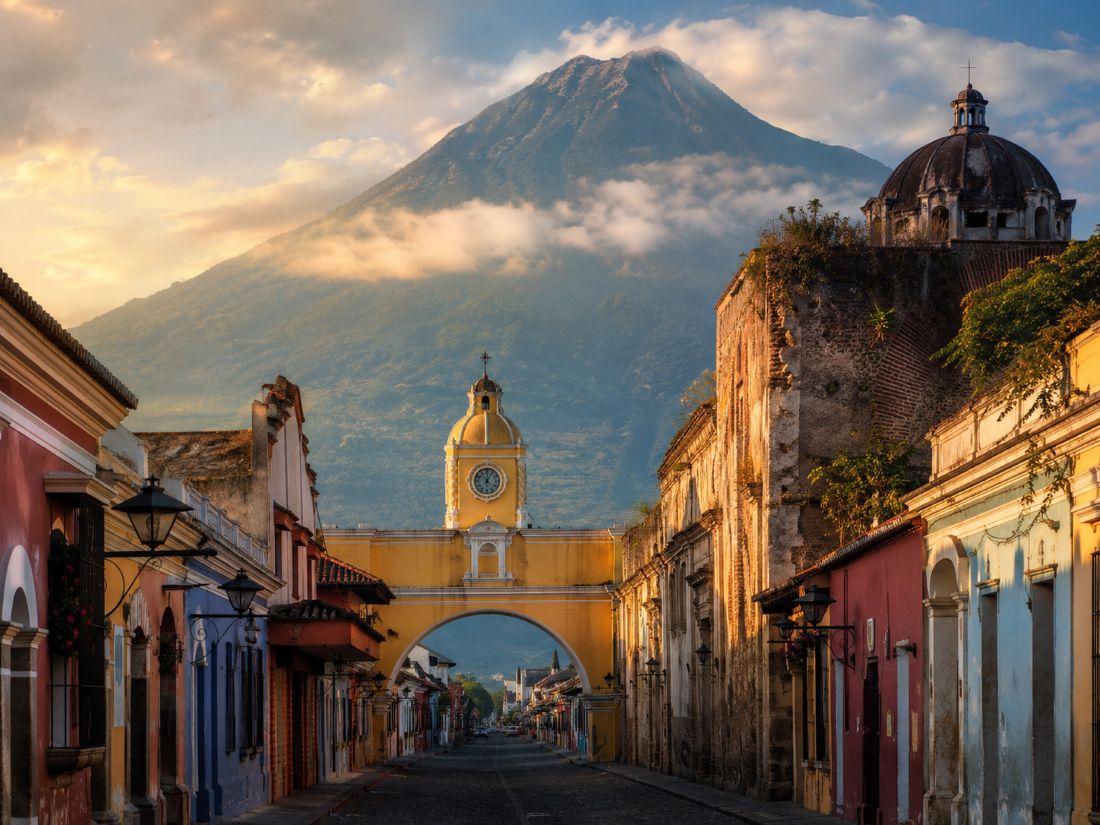
You notice the roofs first, or rather their absence. In Antigua Guatemala the churches are the size of cathedrals and most of them are open to the sky. You walk in past a baroque facade thick with saints and niches, and inside there is grass, a few fig trees, cracked vaults lying where they fell, and above all that the outline of the Volcan de Agua, a perfect green cone framed by a ruined arch. It is one of the most photographed views in Central America and one of the most misread.
The standard version, repeated on tour buses and travel sites, goes like this: the volcano destroyed the city, everyone fled, and the ruins were abandoned. Every element of that sentence is either wrong or badly incomplete, and the true story is a far better one. It involves three previous capitals, four centuries of earthquakes, a bitter fight between a governor and an archbishop, imperial politics reaching from Madrid, and a population that was ordered to leave and simply refused.
A Capital That Kept Having to Move
Spanish Guatemala could not sit still. The first capital was founded by Pedro de Alvarado in July 1524 at Iximche, in the heart of Kaqchikel territory, and was given up because holding it against the people whose city it had been proved impossible. The second, in the Almolonga valley on the flank of the Volcan de Agua, lasted until 1541.
What happened there is the origin of the volcano myth, and it deserves precision. The Volcan de Agua did not erupt. After torrential rain, water and mud burst from the crater and came down the mountainside in a devastating flood, obliterating the settlement. That is why the mountain is called the volcano of water. The site is known today as Ciudad Vieja, and it is a different place from the city visitors now call Antigua.
In 1543 the survivors moved a short distance to the Panchoy valley and founded Santiago de los Caballeros de Guatemala, the third capital. It stood for two hundred and thirty years, and it grew into something extraordinary: the seat of the audiencia governing Spanish Central America from Chiapas to Costa Rica, a university city, a printing centre, and by the reckoning of eighteenth-century observers the most splendid city in the Spanish Americas after Mexico City itself. Estimates of its population before the disaster run as high as sixty or seventy thousand.
It was also, from the beginning, in the wrong place. The record of destruction is relentless: damaging earthquakes in 1547, 1565, 1585, 1586, 1607, 1651, 1689, a catastrophic one in 1717, another in 1751, and eruptions of the neighbouring Volcan de Fuego, which poured lava for a full day in 1581. Anyone who reads the list understands that the events of 1773 were not a bolt from the blue. They were the third ruinous earthquake of that century alone.
The Santa Marta Earthquakes
The tremors began on 11 June 1773, mild at first, increasing in frequency and force. The catastrophic shock came on 29 July, the feast of Saint Martha, which is why the sequence is remembered as the terremotos de Santa Marta; its magnitude is usually estimated at around 7.5. Aftershocks continued for roughly six months, with further destruction in December, and that unending shaking is the crucial detail. It was not the ruin of a single day that decided the city's fate. It was the impossibility of rebuilding while the ground would not stop moving.
You will see the sequence garbled in print, with the earthquakes said to have begun on 29 July. The June date is the beginning; late July is the worst of it.
The Fight Over Whether to Leave
What followed was a political struggle, and this is the part the tourist narrative leaves out entirely. Two factions formed. The traslacionistas argued for moving the capital to a safer valley; the terronistas, from the word for one's native soil, insisted on staying and rebuilding. The captain general, Martin de Mayorga, drove the removal. The archbishop, Pedro Cortes y Larraz, fought it with everything he had.
Their quarrel was not really about seismology. It was about power. The second half of the eighteenth century was the age of the Bourbon Reforms, the Spanish Crown's long campaign to centralise authority and reduce the wealth and independence of the Church. In Santiago the religious orders held magnificent convents, enormous properties and enormous influence. Historians of the period argue that the civil authorities used the earthquakes as the pretext they had been waiting for: moving the capital forced the orders out of their ruined palaces and into flimsy temporary quarters in a new city where the government would set the terms. The earthquake was real. The opportunity it created was seized deliberately.
The move went through. A new capital, Nueva Guatemala de la Asuncion, was laid out in the Ermita valley, and its town council held its first session on 2 January 1776. That city is today Guatemala City. The old one was left to be known simply as la Antigua Guatemala, the old Guatemala, a name that is itself a leftover: it came into use only some years after everyone had gone.
Except That Everyone Did Not Go
Here is the correction that matters most. Antigua was never abandoned in the way the word suggests. The removal was official and it was pressed hard, and the city certainly emptied of government, clergy and much of its elite. But a substantial part of the population refused to move, stayed among the ruins, and kept the place alive. Guatemalan accounts are emphatic on this point, and the physical evidence supports them: a genuinely abandoned city of that size in the tropics would have been swallowed in fifty years. Instead the streets kept their grid, houses kept being lived in and repaired, and the great ruined churches were left standing as ruins rather than quarried away.
That accidental combination, a baroque capital frozen at its eighteenth-century high-water mark and continuously inhabited by people too stubborn to leave, is precisely what UNESCO recognised when it inscribed Antigua as World Heritage in 1979.
What to See
The pleasure of Antigua is that the ruins are not fenced-off curiosities; they are woven through a living town of cobbled streets, single-storey houses in ochre and indigo, and courtyards you glimpse through open doors.
Start with La Recoleccion, the most overwhelming of the ruined churches, where the collapse left colossal blocks of vaulting lying in the nave like a stopped avalanche. Las Capuchinas, the convent of the Capuchin nuns, is the most architecturally fascinating, built with earthquakes in mind and containing a strange circular tower of cells around a central courtyard. The church and convent of San Francisco holds the tomb of Hermano Pedro, Central America's first saint, and remains a pilgrimage site. The cathedral on the main square presents an intact restored front with an immense field of ruin behind it, which tells the whole story of the city in one building.
The Arco de Santa Catalina, the yellow arch that appears in every photograph of Antigua with the volcano behind it, was not built as an ornament. It was a covered bridge across the street, allowing cloistered nuns to pass between parts of their convent without being seen. For the classic view, walk up to the Cerro de la Cruz in the morning, when the volcanoes are usually clear; by afternoon the cloud has often come down.
If you can time your visit for Holy Week, do. Antigua's Semana Santa processions are among the most extraordinary religious spectacles in the Americas: enormous carried platforms, clouds of incense, and streets carpeted in intricate patterns of dyed sawdust and flowers made overnight and destroyed within hours by the feet of the procession that crosses them.
Practical Notes
Antigua sits about an hour from Guatemala City and its airport, at roughly 1,500 metres, which gives it a mild spring-like climate year-round and cool evenings; bring a layer. The rainy season runs roughly May to October, with afternoon downpours. The cobbles are brutal on wheeled luggage and ankles alike. The Volcan de Fuego, visible from town, is genuinely active and erupts frequently, and guided overnight hikes on the neighbouring Acatenango to watch it are now one of the region's best-known excursions; go with a reputable operator and take the altitude and the cold seriously.
And when you are sitting in a ruined nave at the end of the day, with swifts working the open vault above you, it is worth holding on to what those broken roofs actually commemorate. Not a volcano, and not a flight. An order to disappear, and a town that declined to obey it.