
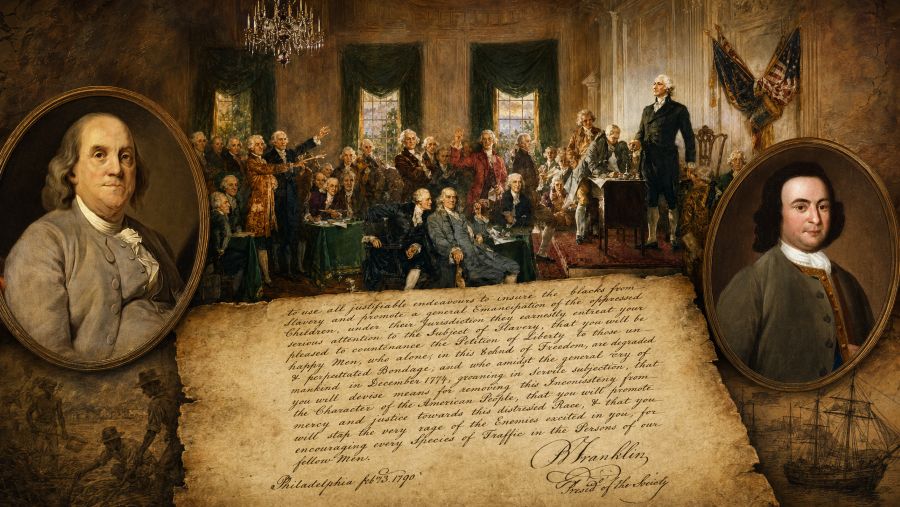
The Constitution of the United States runs to roughly 4,500 words, and not one of them is "slavery." The men who gathered in Philadelphia in the summer of 1787 went to careful lengths to avoid the term, reaching instead for euphemisms: "other persons," "such persons," "person held to service or labour." And yet the institution they would not name is stitched into the document in at least three places. The silence was deliberate, a kind of national embarrassment written in invisible ink. The framers knew what they were doing, and they knew how it would read to posterity.
How did a generation that had just proclaimed to the world that all men are created equal come to protect, in the same breath, the ownership of one human being by another? The answer is not that the founders failed to see the contradiction. Many of them saw it with painful clarity. The answer is that they chose union over conscience, and told themselves the reckoning could wait. It could not.
The Men in the Room
Of the fifty-five delegates who assembled for the Constitutional Convention, roughly twenty-five owned enslaved people. This was not a fringe presence; it represented about 45 percent of the room, and it included some of the most powerful voices in the hall. Yet the delegates were far from united in their views. George Washington would free his enslaved workers in his will. Benjamin Franklin had already freed the people he once held enslaved and would spend his final months pressing for abolition. Alexander Hamilton would become an advocate for ending slavery.
The convention was thus not a simple clash of a pro-slavery South against an antislavery North. It was a room full of men with tangled consciences and competing interests, many of whom agreed, at least in the abstract, that slavery was a moral stain, and almost none of whom were willing to blow up the fragile project of union to remove it. That gap between private disapproval and public inaction is the hinge on which the whole tragedy turns.
The Three-Fifths Myth
No part of the Constitution is more misunderstood than the Three-Fifths Compromise. It is often taught, and widely believed, that the clause declared enslaved people to be three-fifths of a human being, a grotesque arithmetic of the soul. That is not what the number meant, and the distinction matters.
The fight was about political power. Representation in the new Congress would be based on population, so the question became: whose population counts? Southern states wanted their enslaved people, who had no rights and no vote, tallied into the totals that determined how many seats a state received in the House of Representatives. Northern and smaller states objected that this would hand the South enormous power on the backs of people it refused to treat as citizens. The three-fifths figure was a bargaining formula, borrowed from an earlier tax debate in the Confederation Congress, that approximated the economic value attributed to enslaved labor. It was a measure of representation and taxation, not a philosophical claim that a person was a fraction of a person.
The irony is that the truth is arguably worse than the myth. By counting three-fifths of the enslaved population toward representation while granting those people nothing, the clause inflated the political muscle of the slaveholding states for decades. Historians call the result the "Slave Power": a Southern bloc in Congress and the Electoral College far larger than its free population warranted. That extra weight tilted presidential elections, shaped the Supreme Court, and made antislavery legislation nearly impossible to pass. The compromise did not just tolerate slavery; it rewarded it with power.
The Threat to Walk Away
If so many delegates disliked slavery, why did they not simply outlaw it? Because the delegates from the Deep South told them, in plain terms, that they would leave. South Carolina and Georgia made clear that their states would refuse to join the union if the Constitution restricted the transatlantic slave trade. This was not a bluff historians have inferred; it was stated openly on the floor.
The result was one of the ugliest bargains in American history. The convention agreed that for twenty years, until 1808, the federal government could not restrict the importation of enslaved people. In exchange, the South accepted a provision letting the federal government pass commercial and navigation laws that favored Northern shipping interests. Human beings and shipping tariffs were weighed on the same scale. On the same day, the delegates also approved a fugitive slave clause, requiring that people who escaped bondage be returned to those who claimed to own them, with federal backing. And elsewhere the Constitution empowered the federal government to suppress domestic insurrections, a promise that federal force could be turned against slave revolts.
Even some slaveholders were disgusted. Luther Martin of Maryland, who owned enslaved people himself, argued that the slave trade was "inconsistent with the principles of the Revolution and dishonorable to the American character." George Mason of Virginia, another slaveholder, warned the convention that slavery corrupted the enslaver as much as it crushed the enslaved: "Every master of slaves is born a petty tyrant," he said. "They bring the judgment of heaven on a country." Neither man could persuade the delegates from Charleston and Savannah, who held the ultimate card and knew it.
The Voices That Cried Out
The demand to end slavery did not arrive later in American history; it was present at the creation. The Quakers had been petitioning against human bondage for decades, condemning it as incompatible with Christian conscience, and they formed the backbone of the first organized abolition societies. Inside the convention, the Pennsylvania delegate Gouverneur Morris denounced slavery as a moral abomination and attacked the Southern delegates who defended it.
The most famous protest came from the oldest man associated with the founding. Benjamin Franklin, in his eighties and near death, served as president of the Pennsylvania Society for Promoting the Abolition of Slavery. In one of his last public acts, he signed a petition, dated February 3, 1790, urging the very first Congress to confront the institution. The petition asked the lawmakers to "devise means for removing the Inconsistency from the Character of the American People" and to "promote mercy and justice toward this distressed Race." It was introduced to the House on February 12 and to the Senate on February 15, and it detonated. Pro-slavery congressmen erupted in fury. The Senate declined to act. A House committee studied it and, on March 5, 1790, concluded that the Constitution barred Congress from touching the slave trade until 1808, then quietly shelved the petition. Six weeks later, Franklin was dead. The nation had heard the argument for abolition at its very first session of government, and had chosen to look away.
The Union That Might Not Have Been
This brings us to the question that haunts the whole story: if the framers had written abolition into the Constitution, would the young nation have shattered on the spot?
Here history gives way to informed speculation, and historians disagree. The dominant view takes the Deep South at its word. South Carolina and Georgia had threatened to walk out over a mere restriction of the slave trade; a constitutional ban on slavery itself would almost certainly have driven them, and probably other Southern states, out of the union entirely. In that reading, there would have been no United States as we know it in 1787, only a smaller Northern confederation and one or more separate Southern republics built explicitly on slavery, likely more entrenched and longer-lived for having no national antislavery pressure at all. By this logic, the compromise was the grim price of nationhood.
A competing tradition, voiced most fiercely by the abolitionist William Lloyd Garrison a generation later, insisted that a union purchased at that price was not worth having. Garrison famously branded the Constitution "a covenant with death and an agreement with hell." In this view, the founders faced a genuine moral choice and chose wrongly, and no calculation of political convenience can absolve them of writing bondage into the charter of a self-proclaimed free republic. Both positions can be held at once: that abolition in 1787 was politically almost impossible, and that its absence was nonetheless a catastrophe with a body count.
The Reckoning Deferred
What the founders postponed, they did not prevent. The compromises of 1787 did not settle the question of slavery; they armed it. The inflated power of the slaveholding states set off a chain of ever more desperate bargains: the Missouri Compromise of 1820, the Compromise of 1850, the Kansas-Nebraska Act. Each bought a few years of uneasy peace, and each made the eventual collision larger. The fugitive slave clause the delegates approved in an afternoon would not be broken in practice until 1861, when a Union general refused to send escaped men and women back into bondage in the opening year of the Civil War.
That war, the bloodiest in American history, was the reckoning the founders had waved into the future. It cost more American lives than any conflict before or since, and it ended only when the Thirteenth Amendment, ratified in 1865, finally wrote into the Constitution the word its authors had so carefully avoided seventy-eight years earlier, declaring that neither slavery nor involuntary servitude should exist in the United States. The stain the framers could not bring themselves to name was scrubbed out at last, but in blood, and by a generation that had to fight the war their grandfathers had chosen to defer.