
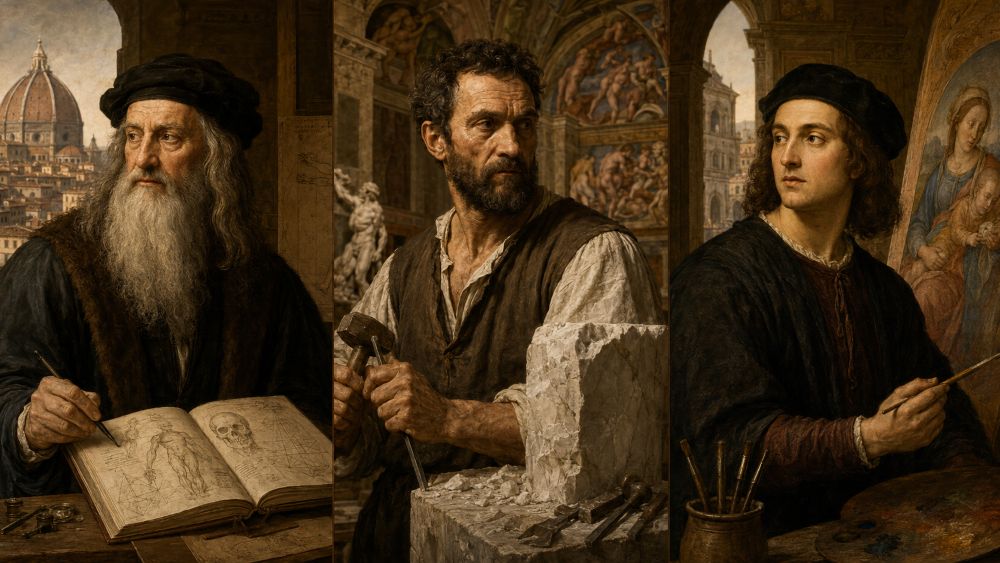
For a few short years at the start of the sixteenth century, three of the Renaissance's most celebrated artists were active in Rome at the same time: Leonardo da Vinci, Michelangelo Buonarroti, and Raphael Sanzio. It is the kind of coincidence that later ages have found irresistible, and it has often been romanticized into a golden fellowship of genius, three titans trading ideas beneath the same Roman sky.
The truth is sharper and more human. They were not friends, but neither were their relationships identical. Leonardo and Michelangelo had already crossed paths and clashed in Florence; Raphael closely studied both older masters; and Michelangelo later treated Raphael as a dangerous rival. Admiration and influence existed alongside competition, resentment, and the occasional insult preserved in later accounts. No reliable source records a gathering of all three together, but that is not the same as saying they did not know or meet one another.
A City Built for Envy
The stage was set by the popes. Julius II, the fierce warrior pope, had summoned leading artists to help restore Rome to its ancient glory, and his successor Leo X, a Medici, kept the commissions and the money flowing. Where there is that much patronage, there is that much competition, and the papal court became a pressure cooker of ambition. By the end of 1512 Michelangelo had just unveiled the ceiling of the Sistine Chapel, a four-year ordeal he had accepted reluctantly and that left him exhausted and in pain, as his own satirical poem about the posture required for the work attests. A short walk away, the young Raphael was painting the papal apartments, the rooms we now call the Raphael Stanze, and decorating the riverside villa of the banker Agostino Chigi. When Julius II died in early 1513 and Leo X took the throne, the deck was reshuffled, and into this charged atmosphere, in September 1513, came Leonardo, sixty-one years old, trailing his notebooks and unfinished panels, to take up rooms in the Belvedere of the Vatican.
For an overlap of roughly three years, all three were active in the same city. But proximity is not friendship, and to understand their relationships, you have to go back to Florence.
The Older Quarrel: Leonardo and Michelangelo
The tension between Leonardo and Michelangelo was already old by the time their careers overlapped again in Rome. Twenty-three years apart in age, they had markedly different temperaments and public images. Leonardo cultivated a polished, courtly manner and pursued questions far beyond painting; Michelangelo was known for bluntness, solitude, and fierce intensity. Near-contemporary accounts present their encounters as abrasive, although some of the vivid details come from anecdotes recorded later.
The friction has a documented setting. On 25 January 1504, Leonardo sat on the Florentine committee convened to decide where Michelangelo's colossal new David should stand. He recommended placing it under the Loggia della Signoria. The surviving record gives his proposal, not his motive; claims that he wanted to protect the marble or hide a masterpiece he envied are later interpretations. Around the same period, the Florentine republic set the two men against each other more directly, commissioning enormous battle scenes for the council hall of the Palazzo Vecchio: Leonardo's Battle of Anghiari and Michelangelo's Battle of Cascina. Neither mural was completed, but their preparatory cartoons became a school for a generation of artists, including the young Raphael.
The most vivid episode comes from a Florentine manuscript of the 1530s known as the Anonimo Gaddiano. As the story goes, a group of gentlemen near the church of Santa Trinita were debating a passage of Dante and called on Leonardo, passing by, to interpret it. Seeing Michelangelo approach, Leonardo deferred: let Michelangelo explain it to you. Michelangelo, certain he was being mocked, wheeled on the older man and threw his greatest failure in his face, that he had designed a bronze horse for the Sforza in Milan and had never been able to cast it, abandoning it in shame, and that the credulous Milanese had been fools to believe in him. Then he turned his back and walked off, leaving Leonardo, the chronicle says, red in the face.
Later interpreters disagree about Leonardo's remark. Some treat it as a genuine courtesy, given Michelangelo's deep love of Dante; others read it as mockery. The manuscript itself is terse and does not settle the question. What is clear is the wound Michelangelo's reply targeted: the unmade horse, the great project left incomplete, and the reputation for unfinished work that followed Leonardo.
Leonardo, for his part, criticized anatomical excess in painting, comparing overdeveloped figures to sacks of nuts. The passage is often read as a veiled swipe at Michelangelo's muscular nudes, but Leonardo did not name him, so the target cannot be established with certainty.
A word of caution belongs here, because the popular story runs ahead of the evidence. There is no private confession proving that the two men hated each other. What survives is a scatter of testimony: the Florentine competition, Vasari's remark that there was great disdain between them, the Anonimo Gaddiano anecdote, and Leonardo's possibly related criticism of exaggerated musculature. It is a persuasive pattern, but the sources do not justify turning every disagreement into a documented feud.
War in the Vatican: Michelangelo and Raphael
The Roman rivalry between Michelangelo and Raphael is better documented, although the clearest direct evidence tells us above all what Michelangelo thought. The architect Bramante, a fellow native of the region of Urbino, promoted Raphael, while artists such as Sebastiano del Piombo became close to Michelangelo. These alliances were fluid, but papal patronage gave them unusually high stakes.
Michelangelo believed, and said, that the other camp was out to destroy him. In a surviving letter he blamed the interruption of his cherished tomb for Julius II squarely on his rivals, writing that all the discord between the pope and himself sprang from the envy of Bramante and Raphael, who schemed to ruin him, and adding a barb that doubled as a boast: Raphael had good reason for envy, because whatever he had of art, he had gotten from Michelangelo. It is one of the few places where Michelangelo's contempt survives in his own hand, and it is unmistakable.
The most famous visual expression of the rivalry hangs on a Vatican wall. Raphael's School of Athens, painted around 1509–1511, gathers the philosophers of antiquity and includes several likenesses traditionally associated with contemporary artists. Plato is often said to resemble Leonardo and Euclid to resemble Bramante, although those identifications are not universally accepted. The Vatican Museums identify the brooding Heraclitus in the foreground as a portrait of Michelangelo and the figure at the far right as Raphael himself. Heraclitus does not appear in Raphael's surviving preparatory cartoon and was added to the fresco at a later stage. According to a story derived from Vasari, Raphael saw the still-unfinished Sistine ceiling and then incorporated his rival into the School of Athens. Whether the figure is homage, competition, or both remains open to interpretation.
The street-level version of the rivalry is more comic, and more fragile as history. A chronicle relates that the two crossed paths near Saint Peter's, Raphael sweeping along richly dressed and surrounded by a crowd of pupils and admirers. Michelangelo, alone as always, needled him: there goes a captain with his retinue. Raphael, so the story goes, shot back that Michelangelo went about alone, like an executioner. It is a perfect encapsulation of their opposite temperaments, the courtier and the hermit, and it should be enjoyed as the traditional anecdote it is rather than trusted as verbatim record.
The competition even shaped altarpieces. Toward the end of 1516 Cardinal Giulio de' Medici commissioned two great panels, one from Raphael, which would become the Transfiguration, and one from Sebastiano del Piombo, the Raising of Lazarus. Michelangelo supplied drawings and advice for Sebastiano's figures. The paired commissions became, in effect, a proxy contest between Raphael and Michelangelo's circle.
The Sidelined Sorcerer
And what of Leonardo, living in the Belvedere while the younger men dominated Rome's great public projects? At sixty-one he was already a legend, but he did not receive a monumental papal commission comparable to theirs. He continued investigations into anatomy, optics, hydraulics, and mirrors, while refining paintings such as the Mona Lisa and Saint John the Baptist, works he would later take to France.
That reputation caught up with him in a story Vasari tells. Given a commission by Leo X, Leonardo supposedly began distilling oils and herbs to make the varnish before he had painted a stroke. The pope is said to have complained that a man who thought about the end before beginning would never finish anything. The anecdote is revealing of Leonardo's reputation, even if it cannot be treated as a verbatim transcript. A notebook entry from these years—often translated as "The Medici made me and the Medici destroyed me"—has frequently been read as a bitter verdict on his patrons, although its context and wordplay make the meaning less certain than that translation suggests. By 1516 Leonardo had accepted an invitation from Francis I, packed his notebooks and panels, and left Italy for good. He died in France in 1519.
A Gathering We Cannot Document
For all the ink spilled on the three geniuses of Rome, no reliable source records Leonardo, Michelangelo, and Raphael gathering together on a particular occasion: no documented dinner, studio visit, or three-way conversation. Absence of a record does not prove that such a meeting never happened. More important, it does not mean they were strangers. Leonardo and Michelangelo had crossed paths in Florence; Raphael studied both men's work and moved in the same artistic world; and Michelangelo explicitly named Raphael as a rival. The School of Athens offers a powerful symbolic conjunction: Raphael included himself and a recognizable portrait of Michelangelo, while many scholars also see Leonardo's features in Plato.
Their awareness of one another became part of the creative pressure of the age: Leonardo's study of light and nature, Michelangelo's monumental human bodies, and Raphael's extraordinary ability to absorb both older masters and transform their lessons into something new. They spanned three generations—Leonardo born in 1452, Michelangelo in 1475, Raphael in 1483—and their overlap in Rome was as brief as it was dazzling. Within a decade, Leonardo died in 1519 and Raphael, at just thirty-seven, in 1520. Michelangelo outlived them both by more than forty years and continued reshaping art and architecture until his death in 1564.