
When the Earth Betrayed Heaven
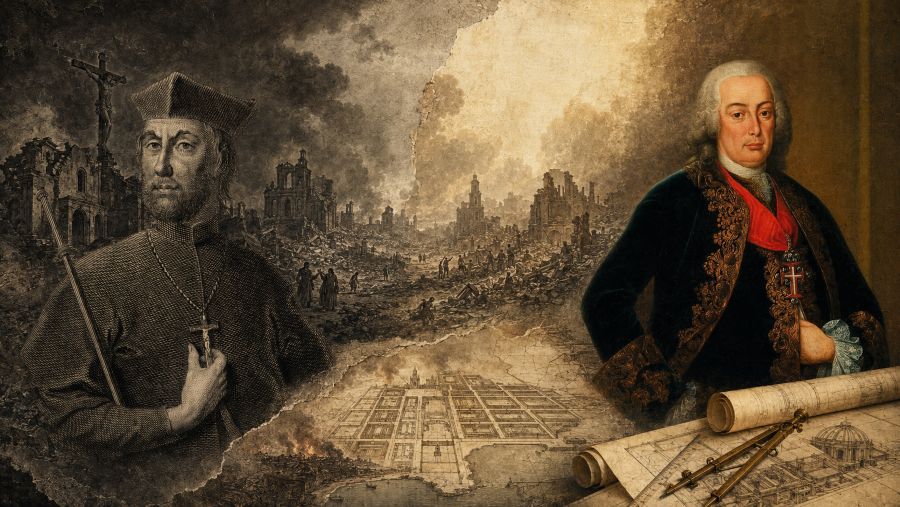
On the morning of 1 November 1755 — All Saints' Day — Lisbon was at prayer. In a city of some two hundred thousand people the churches were full and candles burned by the thousand on the altars. At around 9:40 the ground convulsed for what survivors described as three to six minutes, opening fissures in the streets and bringing down stone vaults across the capital. Forty minutes later the sea drew back from the Tagus and returned in a series of waves; where the water did not reach, the toppled altar candles had already set the ruins alight, and the fire burned for the better part of a week. Modern seismologists put the quake at a magnitude between 8.5 and 9.0, its epicentre in the Atlantic southwest of the city.
That it struck on a holy day, while the faithful were gathered and the churches themselves collapsed on them, seemed to many contemporaries to carry an unmistakable message. The catastrophe demanded an interpretation, and two men supplied opposing ones. Their quarrel would outlast the rubble.
For generations the dead were counted at sixty thousand, even a hundred thousand. Those are eighteenth-century figures, and modern historians regard them as inflated: the more sober estimates put the toll in Lisbon at perhaps thirty to forty thousand, with several thousand more along the coasts of Spain and Morocco, where the tsunami also struck.
The minister: bury the dead, question the priests
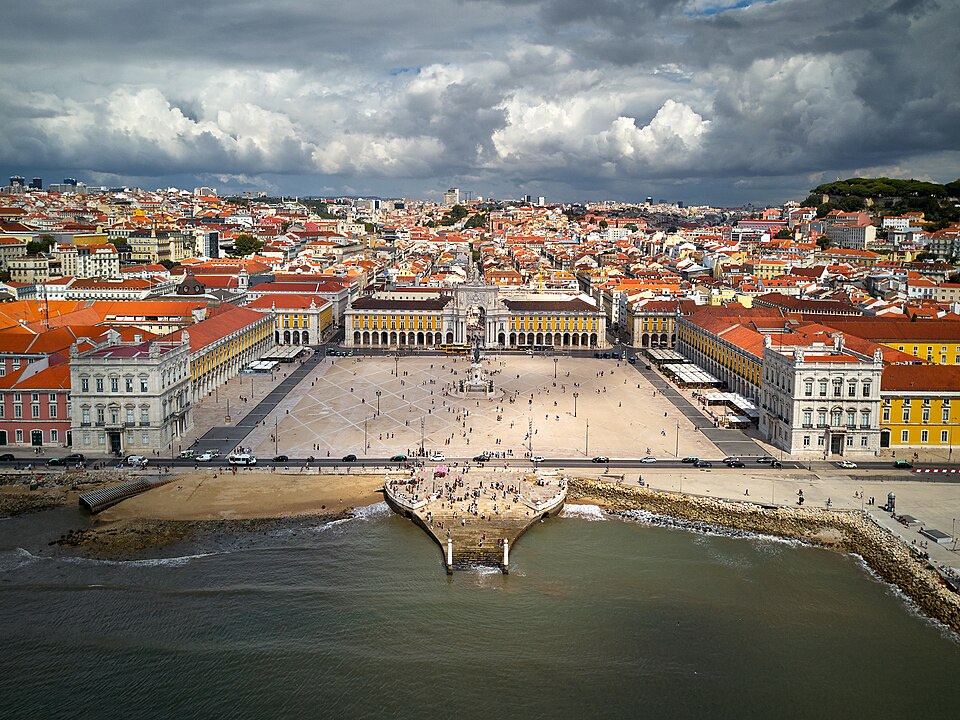
Portugal's response fell to Sebastiao Jose de Carvalho e Melo, the secretary of state who would later be titled Marquis of Pombal. Tradition credits him with a terse instruction — bury the dead and feed the living — and while the exact phrase is almost certainly apocryphal, it captures the spirit of what he did. He imposed martial law against looters and ordered corpses collected and cast into the sea to forestall epidemic, a measure that ran against Catholic burial custom and hinted, from the first days, at the priorities to come. Within weeks his chief engineer, Manuel da Maia, had drafted plans for reconstruction; Pombal chose the most radical, razing the medieval lower town and rebuilding it on a grid of wide, regular streets. Its buildings were framed with an internal timber cage, the *gaiola pombalina*, designed to flex and hold in a tremor — one of the earliest deliberate attempts at earthquake-resistant construction.
But Pombal's most quietly revolutionary act was a piece of paper. In 1756 he sent to every parish in the kingdom, through the bishops, a printed questionnaire — thirteen questions, with a month to answer. How long did the shaking last? How many aftershocks? What happened to the sea, the rivers, the springs and the wells? Where did the earth crack? Did the tide ebb or flow first, and how high did the wave rise? Which animals had behaved strangely beforehand? The replies, gathered from across Portugal, amounted to one of the first systematic empirical surveys of a natural disaster — an attempt to describe the event rather than to moralise it.
It is often called the birth of seismology. That is generous: seismology as a science, with instruments and wave theory, belongs to the nineteenth century, and a similar survey was carried out at the same time in Spain under Ferdinand VI. Pombal's inquiry is also frequently confused with the broader parish census he launched in 1758, the *Memorias Paroquiais*, a sixty-question survey of geography and local history that had little to do with earthquakes. Still, the instinct behind the thirteen questions — that a disaster is a phenomenon to be measured — marked a genuine shift.
The prophet: the wages of sin
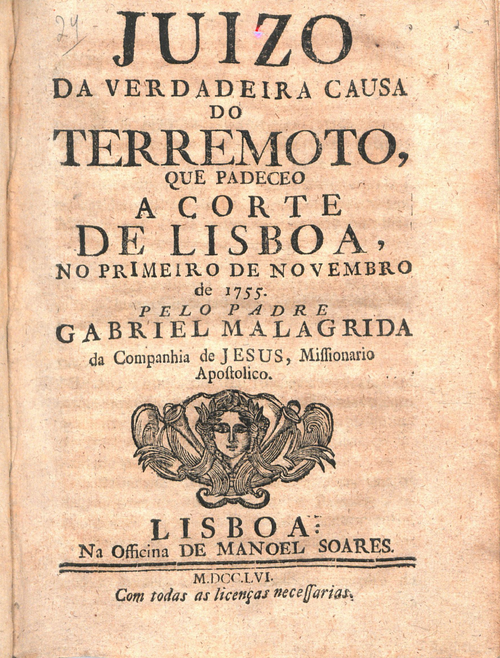
Against this stood Father Gabriel Malagrida, an Italian Jesuit then in his sixties who had spent nearly three decades as a missionary in Brazil and had arrived at the Lisbon court trailing a reputation for visions and holiness. To Malagrida the cause of the disaster was not geological but moral. In a pamphlet written in January 1756 — *An Opinion on the True Cause of the Earthquake* — he argued that the tremor was divine punishment for the spiritual laxity of the Portuguese and their court, and that the proper response was not mortar and survey but penitence, retreat and prayer. To rebuild while unrepentant was to miss the point entirely.
What is striking, reading the pamphlet, is how modest the sins turn out to be. For all the thunder of divine wrath, the concrete failings Malagrida could name were the vanity of young people who came to Mass to be seen rather than to worship, and the passing of amorous notes. Nor was the providential camp united: an exiled Portuguese convert to Protestantism blamed the very opposite fault — too much Catholic devotion to images. The lesson was less that heaven had spoken clearly than that everyone heard in the ruins an echo of their own convictions.
Europe argues with God
The tremor was felt far beyond Lisbon, and the argument it provoked reached every corner of the Enlightenment. Voltaire composed his *Poem on the Lisbon Disaster* within weeks, a hundred and eighty lines that tore into the fashionable optimism of Leibniz and Pope — the doctrine that all is for the best in the best of all possible worlds — and he would sharpen the attack three years later in *Candide*. Rousseau answered him in a long letter of August 1756, defending Providence but with a move that pointed forward rather than back: nature, he noted, had not chosen to pile twenty thousand tall houses on that spot; had the people of Lisbon lived more dispersed and more lightly, the death toll would have been far smaller. The fault, in other words, lay partly in human choices — an early argument that catastrophe is something societies build.
Further north, in Konigsberg, a young Immanuel Kant published three essays on the earthquake in early 1756, reaching for purely physical explanations — subterranean gases and cavities igniting beneath the crust — and setting the question of divine vengeance deliberately to one side. The particulars were wrong; the method was the future.
The last fire
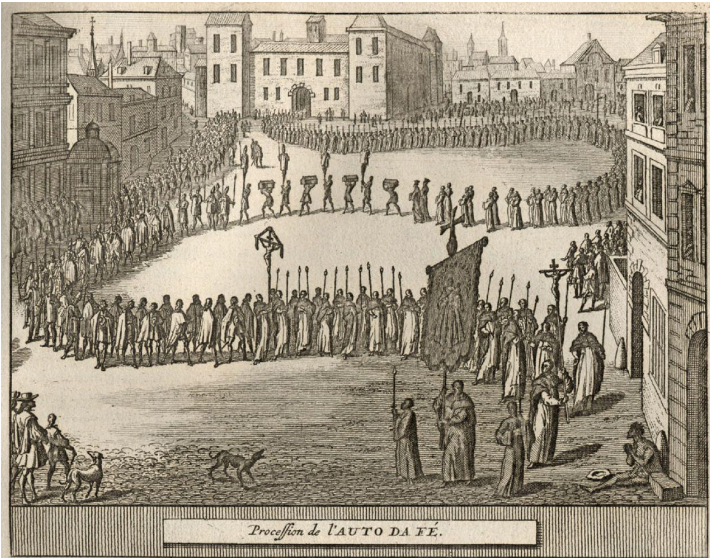
Malagrida's pamphlet gave Pombal the opening he needed. The Jesuit was exiled to Setubal, and when, in 1758, an attempt was made on the life of King Jose I, Pombal folded the priest into the sprawling conspiracy known as the Tavora affair. Here the honest account matters, because the popular version — that Malagrida was burned for preaching that the earthquake was God's punishment — is not quite true. He was declared guilty of high treason, but as a priest he could not be executed without the Inquisition's consent, and the case for treason was thin. So Pombal had his own brother installed at the head of the Inquisition, and Malagrida was condemned instead for heresy, on the strength of two rambling books of prophecy said to have been written during his years in prison — texts whose authorship was disputed even at the trial, and which read like the work of a mind broken by confinement.
On 21 September 1761, after a ceremony that had begun the previous day, the seventy-two-year-old was garrotted and his body burned in Lisbon's Rossio square. It was the last auto-da-fe held in Portugal, and Malagrida the last person the Portuguese Inquisition put to death. Voltaire, watching from abroad, was appalled — and pinned the killing on the Inquisition, missing the irony that its true author was an Enlightenment minister who would soon bring that same tribunal firmly to heel.
There is a final, mordant twist. In 1772 the royal censorship board condemned Malagrida's pamphlet to the flames — eleven years after it had burned its author.
What actually changed
It would be too neat to call this a victory of science over faith. Many educated Portuguese spent decades trying to reconcile natural philosophy with theology, and Pombal's war on the Jesuits was driven at least as much by raw political ambition as by any love of reason. What shifted was subtler and more durable: the reflex of *what to do* when the earth moves. Before Lisbon, the answer had been to read the disaster as a verdict and to appease it. After Lisbon — in Pombal's questionnaire, in Rousseau's tall houses, in Kant's caverns — the answer increasingly became to describe it, to explain it, and to build against the next one. Malagrida was the last man Portugal burned for insisting otherwise, and something of the old world went up with him.