
A Birth Without a Name
On May 25, 1912, in Seoul's Changdeok Palace, a girl was born who would go without a name for five years. Her father was Emperor Gojong, the last monarch of the Joseon dynasty, which had ruled Korea since 1392 for over five centuries. Her mother, Yang Gwi-in, was a palace concubine, and that circumstance alone was enough for the newborn to be treated, in the first years of her life, as if she barely existed.
During that time, the girl was called simply Agi, meaning "baby" in Korean. Only in 1917, when she was five years old, did her father manage to persuade the Japanese Government-General — which had controlled the country since the annexation of 1910 — to register her officially as a member of the imperial family. That is how Princess Deokhye came into being, late and against the current.
She was, in every sense, a princess on paper. The dynasty she represented held no real power. Korea had been formally annexed by the Empire of Japan two years before her birth, and Gojong's title was nothing more than a formality the occupiers allowed to maintain some semblance of continuity. In that world of hollow ceremonies and foreign control, the last princess of Korea grew up.
The Love of a Father, the Threat of an Empire
Despite the grim political backdrop, Deokhye's early years were relatively happy, thanks to the deep affection her father held for her. Gojong, already 59 when she was born, made her the apple of his eye. Aware of the danger the Japanese occupation posed to the royal family, the aging emperor did everything in his power to protect his daughter.
In 1916 he founded a kindergarten at Deoksugung Palace specifically for her, determined to deny the Japanese authorities any pretext to send her to Japan, as had already happened to her older brothers. But his defensive measures did not stop there. In 1919, hoping to anchor his daughter firmly to Korean soil, Gojong attempted to arrange a marriage for Deokhye with Kam Jang-han, nephew of a senior court chamberlain. The Japanese authorities blocked the union.
Just days later, on January 21, 1919, Gojong died suddenly. He had not been ill. Suspicions of poisoning were never dismissed and remain a serious historical possibility to this day, especially in light of the matrimonial maneuvers the emperor had been conducting in secret. With his death, Deokhye was left fatherless and, in practice, under the guardianship of the Japanese occupation government.
The Forced Exile
After her father's death, Deokhye's life continued for a time with some degree of normalcy. She attended the Hinodae School in Seoul and lived alongside her mother. But in 1925, at just thirteen years old, the colonial government compelled her to move to Japan under the official pretext of continuing her education.
It was a political measure, not an educational one. Japan had for years been relocating members of the Korean royal family to its territory as a means of control and forced assimilation. Deokhye was enrolled in the Gakushuin School in Tokyo, an elite institution founded in 1923, where she learned sewing and Japanese culture. She was far from her home, far from her language, and far from everything she had ever known.
In 1930 she was briefly permitted to return to Korea to attend her mother's funeral. It was the first time in five years she had set foot on her homeland, and it would be the last for more than three decades. The emotional impact of that fleeting return marked the beginning of her mental health decline. Back in Japan, she began to sleepwalk, and her behavior grew increasingly erratic in the months that followed. Doctors of the era diagnosed her with "precocious dementia," an obsolete term then applied to any deteriorating psychotic disorder. By modern standards, Deokhye's condition would be recognized as schizophrenia, characterized by frequent episodes of psychosis.
A Forced Marriage, a Broken Family
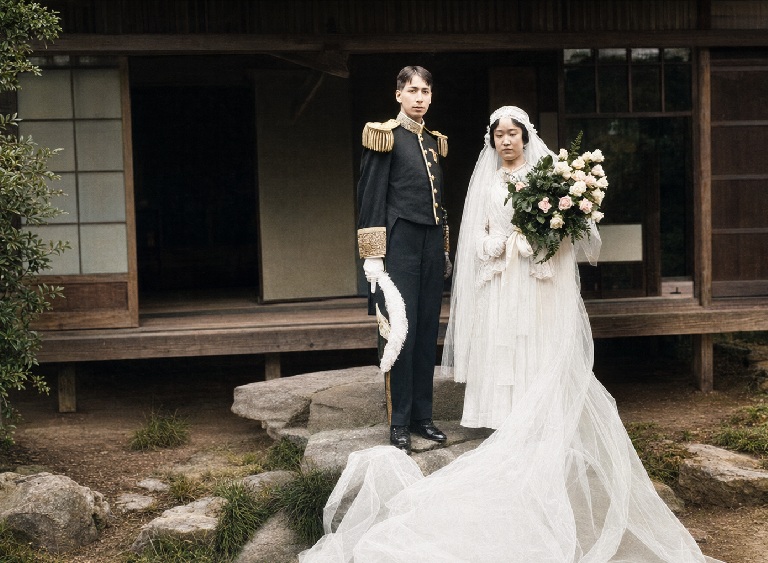
Illness did not halt the Japanese government's plans. Despite her deteriorating mental state, the imperial authorities decided Deokhye must marry a Japanese nobleman. The choice fell on Count So Takeyuki, a descendant of the So clan — a family that had governed the island of Tsushima, a strategic outpost between Japan and the Korean peninsula, for centuries, and had long served as intermediary in relations between the two countries.
The wedding was held on May 8, 1931, on Tsushima Island. Neither party had chosen the other freely. He was a mid-ranking nobleman equally steered into the union by political circumstance. Despite everything, based on available accounts and the poems the count dedicated to his wife and daughter, Takeyuki appears to have been a considerate and affectionate man.
On August 14, 1932, their only child was born, named Masae in Japanese and Jeonghye in Korean. Stability, however, was short-lived. By 1933, Deokhye's condition had worsened significantly, and she was admitted to a psychiatric hospital for the first time. Over the years that followed, through the Pacific War and its aftermath, she alternated between periods of hospitalization and brief returns to family life, always with a fragile mental state.
With Japan's defeat in 1945, Korea regained its independence and the Japanese peerage system was abolished, stripping the count of his title. The marriage, worn down by years of illness, poverty, and tension, ended in 1955.
The final blow came the following year. On August 26, 1956, her daughter Masae disappeared in the mountains of Yamanashi Prefecture, leaving behind a note with every hallmark of a suicide letter. She was never found. It is assumed she took her own life. The loss of her only daughter plunged Deokhye into the darkest chapter of her illness.
The Impossible Return
For years, Deokhye languished in Japanese psychiatric institutions, almost entirely forgotten by the world. Korea, divided after the war into two antagonistic states, was governed in the South by the authoritarian Syngman Rhee, who systematically refused to allow the surviving members of the royal family to return, fearing any monarchist symbolism.
It was journalist Kim Eul-han who changed the course of events. After tracking the princess down in a Japanese hospital, he launched a public campaign demanding her repatriation. His efforts — not without personal risk given the political climate — ultimately succeeded. On January 26, 1962, at fifty years of age and after thirty-seven years of absence, Princess Deokhye stepped off a plane at Gimpo Airport. Her former ladies-in-waiting and her childhood wet nurse, now elderly, were there to receive her on the tarmac. They wept. She wept too, seeing her homeland for the first time in decades.
But the return was no triumph. The South Korean government made clear that Deokhye was returning as an ordinary citizen, not as a princess. The journalists who surrounded her on arrival quickly noticed her cognitive decline. She answered no questions and stared into the distance. One major newspaper headline captured the moment without mercy: "Princess Deokhye Returns Home, Immediately Admitted to University Hospital."
The Final Years in the Palace
Despite everything, Deokhye's final years were spent in her childhood home. She was housed in Changdeok Palace in Seoul, reestablished as a residence for the surviving members of the Joseon dynasty. She lived there alongside her sister-in-law Yi Bangja and her nephew Yi Ku, supported by a small government stipend.
She continued to receive psychiatric treatment at Seoul National University Hospital, with periodic admissions over the years. She died on April 21, 1989, aged seventy-six. In her final years she suffered from aphasia, a neurological condition that robs a person of the ability to understand or produce language. The woman who had been proclaimed princess across languages, who had crossed oceans and survived wars, died unable to speak or understand a single word.
She was buried at Hongneung Royal Tomb, south of Seoul, beside her father and the Empress Consort Myeongseong.
The Legacy of a Forgotten Story
Deokhye's story remained largely unknown for decades, even within Korea. Japanese author Yasuko Honma published the first serious biography about her, later translated into Korean in 1996. Novelist Kwon Bi-young turned her life into a bestseller in 2009, bringing the princess back to the heart of popular culture. In 2016, the film The Last Princess, starring Son Ye-jin, grossed over 40 million dollars worldwide, presenting her story to a new generation.
Today a monument stands on Tsushima Island commemorating her marriage. Her ceremonial garments are preserved at the National Palace Museum of Korea. And her name — Deokhye, meaning "virtue and grace" — endures as that of someone to whom history owes, at the very least, the debt of memory.
She was a princess without a kingdom, a mother without a daughter, a woman without a voice at the end. But above all, she was the last living witness to an empire that Japan buried and that Korea took far too long to rescue from oblivion.