
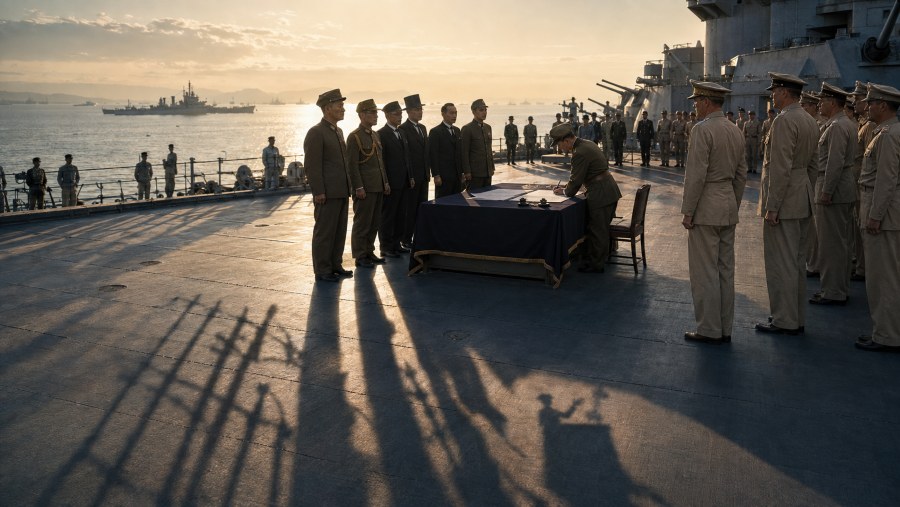
On 14 August 1945, by Washington time, the world learned that Japan was surrendering to the Allies. The next day, 15 August, Emperor Hirohito announced the decision to his subjects. The formal capitulation would be signed on 2 September aboard the battleship USS Missouri. So ended the most destructive war in history: between seventy and eighty-five million dead, whole cities reduced to rubble, and Hiroshima and Nagasaki razed by the first — and so far only — use of nuclear weapons in war.
The victory was not only military. Nazism and Fascism had been defeated, and the Western democracies presented that outcome as the confirmation of an idea: that no state should ever again place the will of a leader, a race, a nation or a doctrine above liberty and human life. The Charter of the United Nations, approved in June 1945, and the Universal Declaration of Human Rights, adopted three years later, tried to turn that promise into an international order.
The Soviet Union had made a decisive human sacrifice to defeat Nazi Germany, but it never claimed to embody liberal democracy. The contradiction that would run through the postwar years belonged above all to the Western victors: the United States, the United Kingdom and France proclaimed political freedom, pluralism and individual rights while they maintained, backed or tolerated systems that denied those very principles beyond their borders.
Eighty-one years after the Japanese surrender, that incoherence is still essential to understanding the world born in 1945. The victory over fascism produced sturdier democracies and an extraordinary peace among the great Western powers. But it did not abolish domination, torture, or the right some states arrogated to themselves to decide which peoples deserved freedom and which could be sacrificed in the name of order.
Democracy for the Center
The system built after the war achieved things it would be absurd to deny. The United States avoided repeating the punishment imposed on Germany after the First World War. The Marshall Plan helped rebuild Western Europe; the institutions born at Bretton Woods organised the international economy; and NATO turned the defence of much of the continent into a collective commitment backed by American power.
The Federal Republic of Germany became a prosperous democracy. Japan, subjected during the occupation to deep political and institutional reform, went from devastation to become the world's second-largest economy. Countries that had fought one another for generations formed the European Coal and Steel Community and, in time, the European Union. At the centre of the new system, war between former rivals ceased to seem inevitable.
The historian John Lewis Gaddis called "the Long Peace" the era in which the United States and the Soviet Union confronted each other on almost every terrain except an open war between them. Fear of nuclear destruction helped restrain them, and the Soviet threat kept the West cohesive for four decades. But that peace had borders. In Korea, Vietnam, Afghanistan, Angola, the Horn of Africa and Latin America, the Cold War was fought with live fire. The great powers avoided attacking each other directly and shifted the confrontation to territories where millions died. Liberal democracy became the political identity of the West, but not always the principle that guided its decisions abroad.
The United States: Democracy Subordinated to Anti-Communism
The American contradiction did not begin with Nixon or the late Cold War. Long before the dictatorships of the Southern Cone, Washington had lived comfortably with bloody governments in the Caribbean so long as they were stable, protected its interests and declared themselves anti-communist.
Rafael Leónidas Trujillo ruled the Dominican Republic from 1930 to 1961 through police terror, torture, the murder of opponents and an extravagant cult of personality. His regime was also responsible for the massacre of thousands of Haitians in 1937. The United States knew its nature perfectly well; even so, Washington kept up its cooperation as long as it judged Trujillo a useful ally, and distanced itself only at the end, when his crimes and instability turned him into a problem.
In Cuba, Fulgencio Batista seized power in a 1952 coup and set up a dictatorship sustained by the army, the police and repression. His government persecuted, tortured and killed opponents, but it protected American investment and kept a close relationship with Washington. Military aid continued through much of his rule and was suspended only when his fall began to look likely.
The criterion was clear: the democratic nature of a government mattered less than its alignment. In Guatemala, the CIA operation PBSUCCESS helped overthrow the elected president Jacobo Árbenz in 1954 and install Carlos Castillo Armas. In Brazil, Washington backed the 1964 coup and prepared logistical support for the rebel military. The defence of the "free world" could include the destruction of a democracy if its social or economic reforms were read as a doorway to communism.
Chile showed the contradiction in its best-known form. The administration of Richard Nixon and Henry Kissinger funded opposition parties and media, exerted economic pressure, and worked first to prevent Salvador Allende from taking office and then to undermine his government. The declassified documents do not prove that the CIA directed the military coup of 11 September 1973, but they do prove that Washington intervened against Chile's constitutional order and welcomed the dictatorship that rose from its destruction.
Nixon and Kissinger were not ignorant of the nature of Augusto Pinochet's regime. They knew of the executions, the torture, the detention camps and the disappearances. Kissinger assured Pinochet in 1976 that the United States understood his situation and voiced more concern about international condemnation than about demanding accountability. That same year he told the foreign minister of the Argentine dictatorship that, if there were things that had to be done, it was better to do them quickly, and he wished the regime success.
Operation Condor carried that logic beyond national borders. Chile, Argentina, Uruguay, Paraguay, Bolivia and Brazil coordinated their intelligence services to hunt, kidnap and murder opponents inside and outside their countries. The State Department knew in 1976 that the operation envisaged international assassinations. Kissinger initially authorised a diplomatic warning, then ordered it halted. Five days later, agents linked to the Chilean secret police killed the former minister Orlando Letelier and his colleague Ronni Moffitt with a car bomb in Washington.
These were not, then, democratic allies committing excesses unknown to Washington. They were dictatorships and military regimes of a fascist cast that turned the political opponent, the trade unionist, the student, the journalist or the mere suspect into an "internal enemy" who could be jailed, tortured, disappeared or killed. From Santo Domingo to Argentina, anti-communism served to present state violence as a defence of Western civilisation.
The fascist character of that conception does not depend on the number of corpses. Fascism does not begin when a regime reaches a million victims. It is present when the state divides society between legitimate citizens and enemies stripped of rights; when security is placed above the law; and when torture, murder and disappearance become acceptable instruments of government. Latin America's dictatorships had different origins, structures and dimensions, but they shared that authoritarian essence. The United States did not create them on its own: each country had its own elites, armed forces and responsibilities. What Washington did was to encourage, sustain or tolerate them when it judged that they protected its interests.
France: Liberty in Europe, Empire Overseas
France emerged from the war identified with the Resistance and with liberation from Nazi occupation. Yet almost at the same moment it recovered its own freedom, it tried to restore by force its dominion over peoples who were claiming theirs.
On 2 September 1945 — the very day Japan signed its surrender aboard the USS Missouri — Ho Chi Minh proclaimed the independence of Vietnam. France refused to accept the loss of Indochina and tried to rebuild a colonial order weakened by the Japanese occupation. The confrontation gave way in 1946 to the First Indochina War, a conflict that lasted eight years, caused hundreds of thousands of deaths and ended with the French defeat at Dien Bien Phu and the Geneva Accords of 1954.
France was not the sole cause of the later Vietnam War. Vietnamese internal divisions, great-power rivalry and the decisions of Hanoi, Saigon and Washington were also decisive. But the attempt to restore an already untenable colonial rule precipitated the war and militarised the region. The United States, which presented itself as a nation born of an anti-colonial struggle, ended up financing much of the French effort because it believed independence led by Ho Chi Minh would favour the communist bloc.
The contradiction was even deeper in Algeria, a territory France considered part of the Republic, though its Muslim majority had lived for generations without the same political and social rights as the population of European origin. On 8 May 1945, while France celebrated the defeat of Nazism, nationalist demonstrations in Sétif turned into attacks that left around a hundred Europeans dead. The colonial reprisal in Sétif, Guelma and Kherrata was far larger and caused thousands of Algerian deaths.
Between 1954 and 1962, France waged a new war to prevent independence. The response to the insurrection included summary executions, disappearances, collective displacements, internment camps and the systematic use of torture. The National Liberation Front also killed civilians and Algerian rivals, but that violence does not erase the particular responsibility of a state that proclaimed itself democratic while turning torture into an instrument of government. The republic of liberty, equality and fraternity denied those principles to millions of human beings in order to keep an empire. Having suffered foreign occupation did not stop France from imposing its own elsewhere.
The United Kingdom and the Limits of Imperial Liberty
The United Kingdom had fought Hitler since 1939 and held out when much of Europe was occupied. Its defence of freedom was real, but it coexisted with an empire built on political inequality. The promise that peoples could choose their form of government was not applied automatically to the British colonies.
In Kenya, the Mau Mau rebellion led the colonial authorities to declare a state of emergency in 1952. The government banned political organisations and confined tens of thousands of Africans without trial in a vast network of camps and detention centres. There, torture, sexual abuse, forced labour and other degrading treatment were documented. Many detainees were never tried and, in many cases, their link to the insurgency could not even be proven. The Mau Mau also killed civilians, most of them Kenyans. Acknowledging their crimes does not absolve the colonial power nor make indiscriminate repression legitimate. A democracy has an added responsibility: it cannot defend the rule of law within its borders and suspend it in the territories it dominates.
Decades later, the British government itself acknowledged that members of the colonial administration had tortured and mistreated Kenyans. In 2013 it agreed to compensate 5,228 survivors and to support the building of a memorial in Nairobi dedicated to the victims. The recognition came when most of those responsible had died and after decades of silence.
The British experience, like the French and the American, reveals the central limit of the order born in 1945. The victorious democracies helped create international institutions, rebuilt devastated countries and established an unprecedented space of freedom and prosperity. But they applied those principles selectively. Democracy was a right for the center and, too often, a conditional possibility for the periphery.
The Question of 1945, in 2026
Eighty-one years on, liberal democracy is again threatened by authoritarian states that cooperate to weaken it. Russia tries to change borders through the invasion of Ukraine; China combines economic power, internal surveillance and military pressure to contest the international order; Iran projects influence through allied forces and has supplied military technology to Moscow; and North Korea has delivered weapons, missiles and troops to sustain the Russian war. They do not form an alliance identical to NATO, nor do they share a single doctrine, but they are united by their rejection of a system that limits the power of states through rules, institutions and universal rights. Their advance shows that the victory of 1945 was not final: authoritarianism changed its language, its symbols and its alliances, but did not give up placing force above law.
The threat also projects from within the very power that for decades presented itself as the chief defender of the liberal order. The second term of Donald Trump has concentrated power in the presidency, weakened institutional checks and normalised a personalist rhetoric that identifies the leader's will with the state's. In its March 2026 report, the V-Dem Institute downgraded the United States from a liberal to an electoral democracy for its performance in 2025 — the country retains free elections but has lost the liberal components: strong checks and balances and constraints on executive overreach. Freedom House still rates the United States as free, but its score fell to 81 out of 100, the lowest since the index adopted its 100-point scale, and it was the free country with the sharpest decline. Trump has floated a third term barred by the Constitution and compared himself to a king; official White House accounts circulated an AI-generated image of him crowned, styled as a fake Time magazine cover with the slogan "Long live the king." And his government has launched military operations — in Iran and in Venezuela, where an incursion captured and deposed Nicolás Maduro in January 2026 — without a specific authorisation from Congress, which voted down the resolutions meant to limit those war powers.
Honesty demands nuance. Not every move of this administration is authoritarian: some of its policies are conventional Republican ideas, and executive overreach at the expense of the legislature did not begin with Trump. And the diagnosis, even among those who share it, insists that the decline is reversible: the opposition's victories in the November 2025 elections show that democratic channels remain open. The comparison with the autocracies of the other camp is a warning, not an equivalence.
There is an image that captures the vertigo of this anniversary. In September 2025, to mark the eightieth anniversary of the end of the Second World War, a military parade in Beijing brought together for the first time the leaders of China, Russia and North Korea. The very ending we commemorate today — the defeat of fascism, the dawn of the American peace — was reappropriated as backdrop by those who now challenge the order that victory founded.
From the rubble of 1945 a better world was born for the West and for the defeated who knew how to join it: freer, richer, more peaceful than anyone dared hope among the ruins. That world is still, as a whole, the most prosperous in history. But the threat has returned, and this time it comes from outside and also, in its most uncomfortable reflection, from within. The question left open on that 14 August — whether humanity had learned anything — remains, eighty-one years later, without a settled answer.