
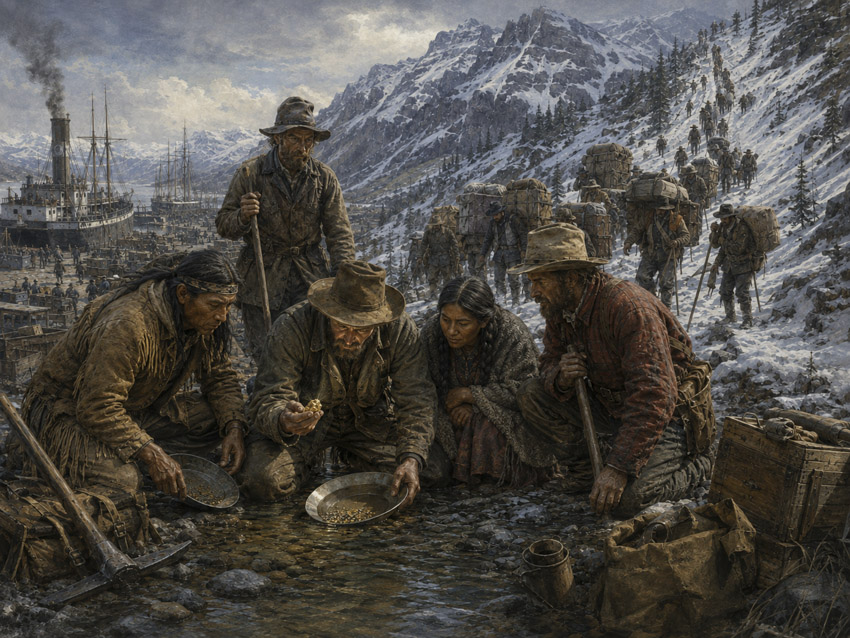
On the afternoon of August 16, 1896, four prospectors stopped to rest on the banks of a shallow stream called Rabbit Creek, a tributary of the Klondike River in Canada's Yukon. One of them noticed a shiny object in the water. It was gold. That modest scene, in a remote and nearly roadless corner of the North, set in motion the last great gold rush of the nineteenth century — though the world would not hear of it for almost a year.
The event commemorated each August 16 is often misremembered. It did not happen in Alaska, and it had nothing to do with California, whose own gold rush had peaked half a century earlier. The Klondike strike took place on Canadian soil, about 17 kilometres south-southeast of what would become Dawson City, and it would transform two places at once: the Yukon interior and a then-modest port called Seattle.
A discovery on Rabbit Creek
The party that day belonged to the world of the Yukon's seasoned prospectors. It included the American George Carmack; his Tagish wife, Shaaw Tláa, known to settlers as Kate; her brother Keish, called Skookum Jim; and their nephew Káa Goox, or Dawson Charlie. All three Indigenous members belonged to the Carcross/Tagish First Nation. They had come to the creek on the suggestion of another prospector, the Canadian Robert Henderson.
Who actually spotted the gold has never been settled. Carmack insisted he saw it first; Jim and Charlie maintained it was Jim, and some accounts credit Kate. The reason the record bears Carmack's name is itself part of the story: Carmack reportedly argued that Canadian mining regulations would not recognize an Indigenous man as a legitimate discoverer, so he signed the discovery claim. The group staked their claims the next day and renamed the stream Bonanza. A nearby tributary, later called Eldorado, would prove even richer.
A year of silence, then a stampede
News moved slowly out of the subarctic. For months the rush was a local affair, as the roughly one thousand people already in the Yukon abandoned their camps to stake the best ground. The wider world only caught fire in July 1897, when two ships reached the American coast carrying miners and their winnings. The steamship Excelsior arrived in San Francisco with about half a million dollars in gold; days later, on July 17, 1897, the Portland docked in Seattle bearing, in the words of the Seattle Post-Intelligencer, "more than a ton of gold."
The effect was electric. An estimated 100,000 prospectors set out for the Klondike; only 30,000 to 40,000 completed the journey. Most were ordinary people — clerks, farmers, tradesmen — with no mining experience and little idea of what lay ahead.
The hardest mile: the Chilkoot and the "ton of goods"
The route north was punishing. Most stampeders sailed to the Alaskan ports of Dyea and Skagway, then climbed the coastal mountains on foot — the Chilkoot Trail being the most notorious — before building boats to run the Yukon River to Dawson. At the border, the North-West Mounted Police imposed a rule that saved lives and defined the journey: each person had to bring a year's worth of supplies, roughly one ton of goods, hauled up the passes load by load.
The toll of all this was measured in time. Contending with the terrain and the cold, most of those who persisted did not reach the goldfields until the summer of 1898 — by which point the richest claims had long been staked, and many arrived to find little opportunity and left disappointed. At the confluence of the Klondike and Yukon rivers, a boomtown rose to meet them. Dawson City grew from a population of 500 in 1896 to roughly 17,000 by the summer of 1898, a wooden, isolated, and unsanitary city plagued by fire, epidemics, and famous prices.
Who actually got rich
The enduring lesson of the Klondike is that the surest fortunes were made selling to the miners, not by mining. A few prospectors did strike it rich, and some, like Carmack, left with sizeable sums. But most did not, and the reliable money flowed to those who supplied the stampede: the merchants who ran Dawson's saloons, stores, banks, and restaurants made their fortunes off the never-ending arrival of gold-hungry newcomers.
Two figures capture the pattern:
- Belinda Mulrooney: — Rather than pan for gold, she bought supplies to resell and went on to build hotels and restaurants, becoming known as the "richest woman in the Klondike."
- Joe Ladue: — A failed prospector, he staked a townsite instead of claims, floated his sawmill down the river, and founded Dawson City itself, profiting from every lot and plank the boom required.
It was the same logic that had governed the California rush of 1849, where the outfitter Sam Brannan, not the diggers, became the region's first millionaire — proof that the "sell the shovels" maxim was already old by the time the Klondike began.
Seattle's golden decade
No city gained more than Seattle, which reinvented itself as the gateway to the goldfields. The transformation shows in the ledgers: Seattle merchants sold an estimated 25 million dollars in goods between July 1897 and March 1898, up from roughly 325,000 dollars in all of 1896, and about 70,000 of the 100,000 stampeders passed through the city to buy their outfits and book passage north.
This was no accident. A former newspaperman named Erastus Brainerd ran a relentless promotional campaign, taxing local merchants to fund a bureau of information and buying advertisements in national newspapers and magazines to convince the country that Seattle was the only sensible place to prepare for the Klondike. Coming amid the economic depression of the 1890s, the trade helped lift the city — and the region — into a new era of growth.
How much gold came out
Figures vary by period and source, and the distinction matters. During the rush years, roughly 29 million dollars in gold was pulled from the ground around Dawson City between 1896 and 1899, the annual haul climbing sharply as machinery arrived — from about 2.5 million dollars in 1897 to 10 million in 1898 and more than 22 million in 1899. Over the longer term, the fields kept producing well after the crowds left: by one account, around 14 million ounces of gold had been taken from the area by 2013, half of it from Bonanza Creek and a quarter from Hunker Creek.
The rush itself ended almost as abruptly as it began. In the summer of 1899, news of gold on the beaches of Nome, Alaska, drew the restless crowds away, and large-scale corporate dredging soon replaced the individual prospector.
The Klondike today
The stampede lasted only a few years, but its afterlife is long. Dawson City, which served as the Yukon's capital until 1952, is today a heritage town of about 1,600 residents, its wooden boardwalks and gold-era buildings drawing travelers rather than prospectors — though placer miners still work the creeks.
In September 2023, the region earned a new distinction. Tr'ondëk-Klondike was inscribed on the UNESCO World Heritage List, a serial site of eight locations around Dawson City that together tell the story of colonialism, the Klondike Gold Rush, and the experiences of the Tr'ondëk Hwëch'in First Nation, on whose homeland the strike occurred. It became the Yukon's first cultural World Heritage site, a recognition that places the Indigenous story — long overshadowed by the legend of the lone prospector — at the center of the landscape.
That reframing is fitting. The Klondike endures in the novels of Jack London, the verse of Robert Service, and a century of photographs, but its most accurate lesson is quieter than the myth. A single nugget in a cold creek could indeed change the world — just rarely for the person who found it.