
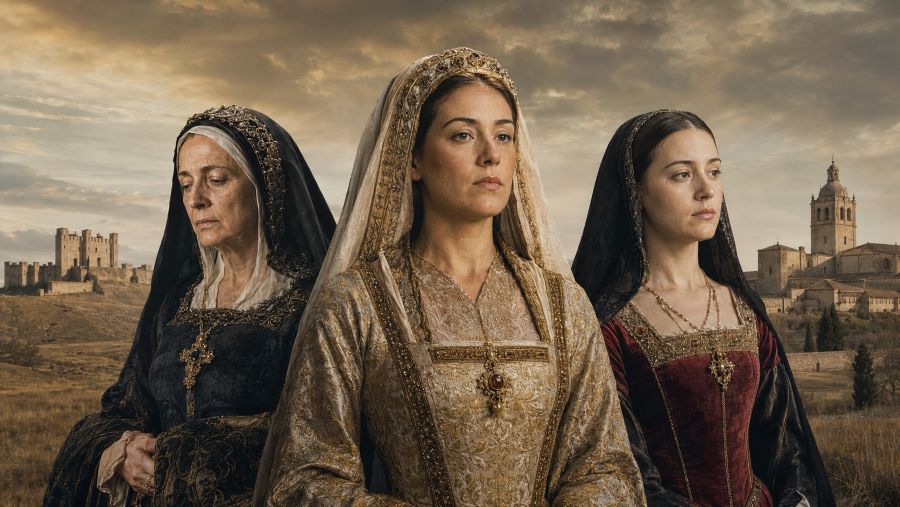
Two Castilian residences became joined by a disturbing dynastic echo. At Arévalo lived Isabel of Portugal, the mother of Isabella the Catholic, remembered by later generations as a widowed queen who had lost her reason. At Tordesillas, half a century later, Isabella's daughter Joanna I of Castile was confined under a similar accusation and passed into history as “Joanna the Mad.”
Between them stood one of the most formidable sovereigns in European history. Isabella I had spent part of her childhood beside an ailing mother. Near the end of her reign, she made formal provision for what should happen if her own daughter proved unwilling or unable to govern.
The pattern is tempting: a grandmother and granddaughter in the same royal house, both associated with mental illness and withdrawal from court. Some writers have therefore treated their stories as evidence of hereditary disease. Yet the surviving record does not support so simple a conclusion. It describes grief, isolation, anger and periods of withdrawal, but it was also produced within courts where powerful men stood to gain from declaring a royal woman incapable.
The queen before Arévalo
Isabel of Portugal was born in 1428 and married John II of Castile in 1447. She was about nineteen; the king was in his early forties. Their daughter Isabella was born in 1451 and their son Alfonso in 1453.
Before Isabel became known as the afflicted widow of Arévalo, she was a political actor. Her intervention was decisive in the fall of Álvaro de Luna, the constable who had dominated John II's court and government for years. Contemporary Castilian chronicles credited the queen with helping persuade her husband to order Luna's arrest. He was executed at Valladolid in June 1453.
French-language scholarship has helped restore this earlier Isabel. Ghislaine Del Vecchio's study of the queens around John II emphasizes that the Portuguese consort achieved what leagues of Castilian nobles had repeatedly failed to do: she broke the favorite's hold over the king. The woman who emerges from those events is determined, politically alert and capable of sustained influence—not the passive figure created by the later legend of the “mad queen of Arévalo.”
John II died in July 1454, leaving Isabel a widow at twenty-six. Later accounts connected the deterioration of her health with childbirth, bereavement and perhaps guilt over Luna's execution. Modern writers have proposed postpartum depression, severe depressive illness or psychosis. None of those diagnoses can be established. Medieval and early modern sources did not make clinical observations in the modern sense, and words translated as madness, melancholy or alienation carried moral, religious and political meanings as well as medical ones.
A retirement that was not complete disappearance
After the king's death, Isabel settled at Arévalo with the young Isabella and Alfonso. The future Catholic Queen lived there from 1454 until about 1461, amid financial uncertainty and the instability of Henry IV's reign. When the children were summoned to court, they were separated from their mother.
Traditional biographies portrayed the widowed queen as enclosed at Arévalo for the rest of her life, almost entirely detached from reality. Archival evidence complicates that picture. Isabel retained a household, managed revenues, defended the property rights of her children and intervened through agents in disputes concerning her estates. Documents show her representatives still protecting her interests in 1494, when she was approximately sixty-six.
Those actions do not prove that she was well. She may have suffered serious and recurring episodes. They do show that it is inaccurate to describe four decades of total, uninterrupted incapacity. Arévalo was also not the equivalent of the prison later imposed on Joanna. Isabel possessed income, servants and a measure of patrimonial authority, even if her access to the political center remained restricted.
She died at Arévalo on August 15, 1496. Her daughter later arranged for her remains to be placed beside John II in the magnificent alabaster tomb carved by Gil de Siloé at the Charterhouse of Miraflores.
Joanna becomes indispensable
Joanna was born at Toledo in 1479, the third child of Isabella of Castile and Ferdinand of Aragon. Nothing in the records of her childhood clearly identifies serious mental disorder. She received the demanding education expected of a Castilian infanta and, as a younger daughter, was prepared for a diplomatic marriage rather than government.
In 1496 she married Philip of Habsburg, known as Philip the Fair, and moved to the Burgundian Netherlands. Joanna was sixteen, separated from her language and family, and placed within a court whose interests did not always coincide with those of her parents. Philip's infidelities and long absences contributed to a volatile marriage.
Then a succession of deaths transformed her political value. Her brother John died in 1497; her elder sister Isabella died in 1498; and that sister's infant son, Miguel da Paz, died in 1500. A princess who had not been expected to rule suddenly became heir to Castile.
From that moment, every report about her behavior carried constitutional weight. An angry outburst was no longer merely a marital incident. Withdrawal, jealousy or refusal could determine whether Joanna governed personally, whether Philip ruled through her, or whether Ferdinand retained control of the kingdom he had governed with Isabella.
The gate at Medina del Campo
One of the best-known crises occurred in 1503. Philip had returned to the Low Countries while the pregnant Joanna remained in Castile. Desperate to rejoin him, she attempted to leave the castle at Medina del Campo. When the gates were closed, she remained near them for hours and confronted those who barred her departure, including her mother.
The episode was alarming, but its meaning is not self-evident. It may reveal psychological crisis, marital dependence and emotional dysregulation. It may also show a royal woman resisting confinement and asserting the right to return to her own household. Later chroniclers increasingly explained such actions through a single formula: Joanna loved Philip to excess.
Another story from the Burgundian court told how she attacked or cut the hair of a woman suspected of being Philip's lover. Pedro Mártir de Anglería and Alonso de Santa Cruz helped give this scene its long life. Yet Pedro Mártir revised letters before publication after Joanna had already been removed from power, while Santa Cruz wrote as an official historian under her son Charles V. Neither account can be read as a neutral medical record.
What Isabella's testament actually said
When Isabella the Catholic died in November 1504, she recognized Joanna as the legitimate heir to Castile. Her testament nevertheless provided that Ferdinand should administer the kingdom if Joanna was absent or, while present, “would not or could not” attend to its government.
That clause is often described as Isabella's diagnosis of her daughter. It was not. The language covered absence, unwillingness and inability; it did not name an illness. It was also a political safeguard. Philip wanted effective authority in Castile, while Ferdinand wished to preserve the position he had held for three decades. Both men could benefit from presenting Joanna as incapable.
The Treaty of Salamanca of 1505 employed the cautious language of “indisposition and impediment.” The ambiguity was useful. It allowed government to be transferred without resolving whether Joanna was temporarily unwell, permanently incapable or being deliberately marginalized.
The chronicle and the emperor
Clara Kalogérakis, in a study published by the French journal e-Spania, compared royal chronicles with diplomatic correspondence and Burgundian travel narratives. Her work shows how the same conduct could acquire different meanings according to the political loyalties of the writer.
Chronicles composed during Charles V's reign had a delicate task. Charles ruled Castile while his mother, the kingdom's queen regnant, remained alive. The official story therefore had to explain her exclusion without weakening the legitimacy he inherited through her.
Kalogérakis identifies another revealing difficulty. Late medieval and sixteenth-century Europeans already entertained the belief that madness could run in families. Joanna's maternal grandmother, Isabel of Portugal, had been accused of precisely that affliction. To emphasize a hereditary connection would have cast an uncomfortable shadow over Charles himself. The imperial chroniclers instead placed extraordinary weight on Joanna's supposedly excessive love for Philip. Passion offered an explanation that disqualified the mother without contaminating the son.
A widow, a coffin and a durable legend
Philip died unexpectedly at Burgos on September 25, 1506. Joanna was pregnant with their sixth child. Her decision to accompany his coffin on the intended journey toward Granada became the central image of her legend.
Later versions claimed that she repeatedly opened the coffin, spoke to the dead man and barred women from approaching the body. Contemporary evidence is less consistent. Some witnesses depicted a queen overcome by grief; others described her response as controlled. Even Alonso de Santa Cruz wrote that she received Philip's death with striking moderation, while Ferdinand reported that her attachment to the body obstructed burial.
The contradiction matters. It does not prove that Joanna was healthy. It demonstrates that her mourning was interpreted, selected and reshaped. The grief of a pregnant widow became a political argument and, centuries later, a Romantic spectacle.
Ferdinand resumed control of Castile and in 1509 established his daughter in the palace at Tordesillas. She remained there until her death on April 12, 1555. After Ferdinand died in 1516, Charles claimed royal authority, but Joanna was never legally stripped of her crown. Official acts continued to use her name because her son's legitimacy depended upon hers.
Illness, captivity and political usefulness
The historical debate began long before modern psychiatry. In 1889, the scholar Aloïs Heiss addressed the French Académie des Inscriptions et Belles-Lettres to challenge Gustav Bergenroth's argument that Joanna's madness had been invented by Ferdinand and Charles. Heiss maintained that unmistakable symptoms were present by 1503. The dispute established two positions that still shape popular accounts: a perfectly sane victim of conspiracy, or a wholly incapacitated queen.
The evidence points toward a more difficult middle ground. Joanna may have experienced genuine and at times severe mental illness. She was also isolated, coerced and politically exploited by people whose authority benefited from her exclusion. Real suffering and political manipulation are not mutually exclusive.
The same caution applies to Isabel of Portugal. Her documented administration does not erase reports of illness; those reports do not erase her periods of competence. Most importantly, no surviving evidence can prove that grandmother and granddaughter had the same disorder or that it passed genetically through Isabella the Catholic, for whom there is no comparable record of mental incapacity.
What can be demonstrated is the repetition of a political language. At Arévalo and Tordesillas, female distress was translated into judgments about fitness to rule. Madness could be an illness, but it could also become a moral verdict, a dynastic danger and a legal instrument.
Perhaps what traveled most clearly across the generations was not a diagnosable disease, but a method of making inconvenient royal women governable: remove them from court, describe withdrawal as proof, and let the men who ruled in their names write the history.