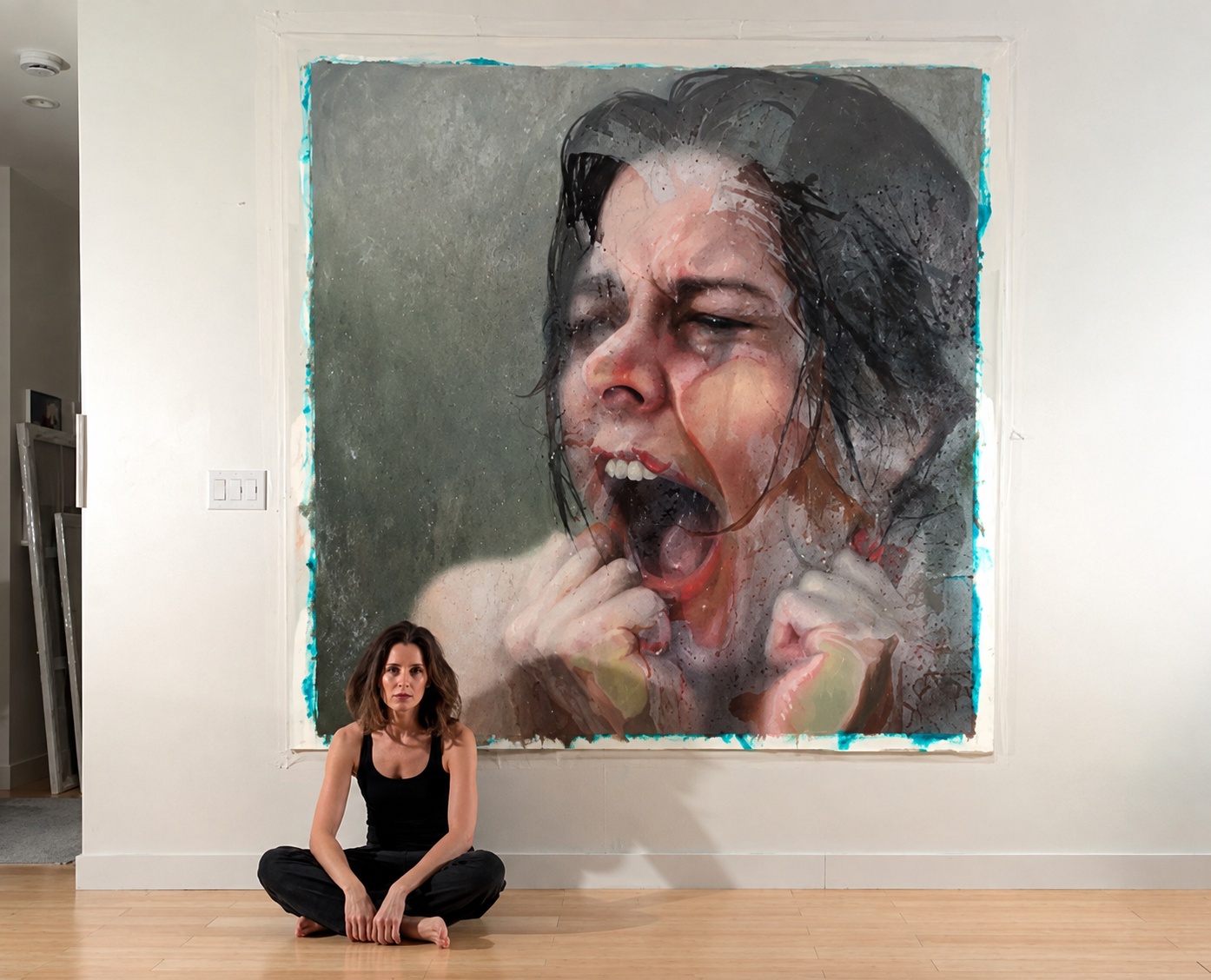
Alyssa Monks is an American realist painter whose work occupies the narrow, charged territory where photographic precision begins to break apart into abstraction, and where the human body is at once fully present and slipping out of reach. Born in Ridgewood, New Jersey, in 1977, she was the youngest of eight children and grew up in a household where making art was ordinary rather than exceptional; her mother, a painter and potter, set her to work in oils at the age of eight. That early apprenticeship matured through a rigorous academic path: studies at The New School in New York, a degree from Boston College in 1999, a period of study in Florence at the Lorenzo de’ Medici institute, and a master of fine arts from the New York Academy of Art in 2001, an institution known for its intensive training in figurative drawing, anatomy, and traditional painting techniques. A residency at Fullerton College in California followed in 2006. She has lived and worked in the Williamsburg neighborhood of Brooklyn throughout her professional life, and from that base she has built one of the more distinctive bodies of figurative painting to emerge from her generation.
The Body Behind a Veil
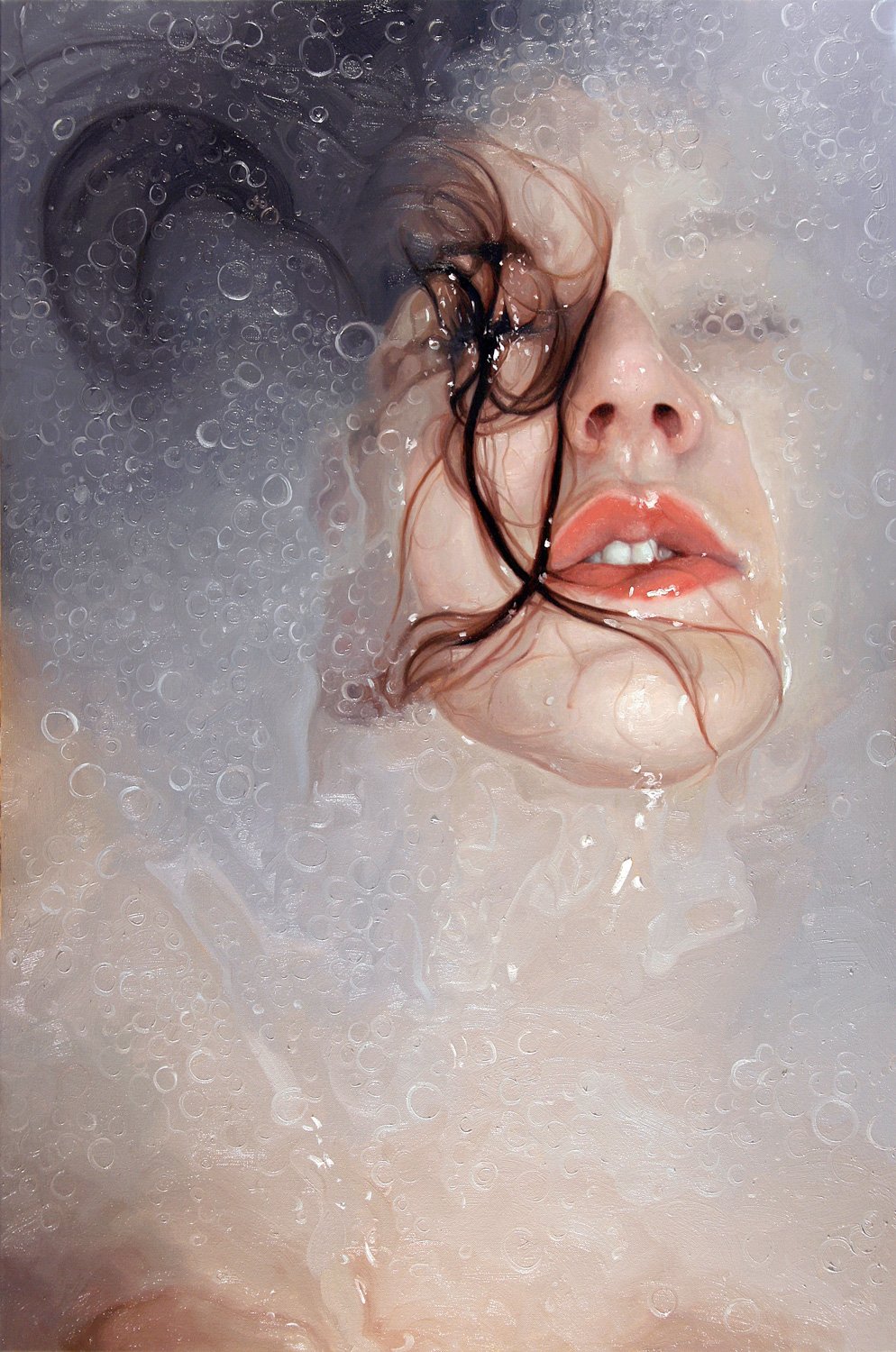
To understand Monks it helps to separate what she paints from how she paints it, because the friction between the two is the real subject of the work. What she paints, for most of her career, has been the intimate, unguarded body: figures, frequently the artist herself, seen bathing, showering, submerged, or pressed against glass. These are not the idealized nudes of the classical tradition but bodies caught mid-gesture, softened, flushed, ordinary and therefore disarming.
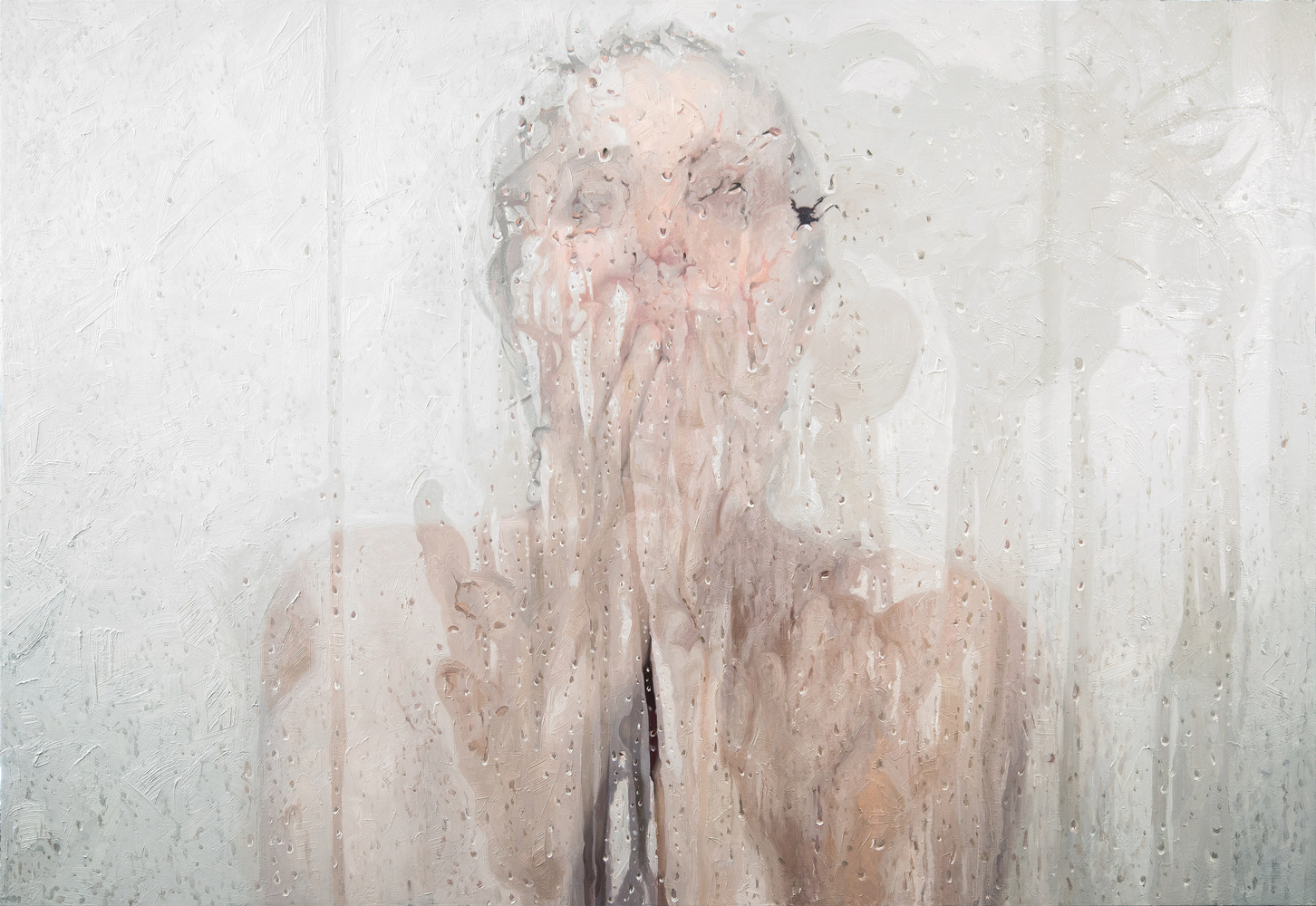
How she paints them is where the ambition lies. Between the viewer and the figure Monks interposes a physical membrane: a layer of water, steam, fogged glass, translucent vinyl, or, in later work, foliage. It is this membrane that carries the meaning. Light forced through water or condensing on a cold pane refracts, smears, and dissolves the information the eye expects. A shoulder becomes a bank of pale color, a droplet magnifies and warps an eye, and a wall of steam turns a familiar face into a spectral suggestion. In these passages the picture crosses, almost imperceptibly, from description into pure paint, so that a canvas can read as a tightly observed portrait and as an abstract field of marks at the same time.
Realism Under Pressure
That doubleness is what distinguishes Monks from the photorealist lineage her technique might superficially recall. Where the classic photorealists of the 1960s and 1970s sought a cool, machine-smooth fidelity to the photograph, Monks works from photographic reference precisely in order to exceed it. Her surfaces are frankly handmade, built from thick, gestural strokes and generous impasto that keep the touch of the brush visible; the abstraction is not an effect applied over a realist image but something the realism turns into under pressure.
Her work can also be placed within a longer painterly conversation about the bather and the veiled figure that runs through Degas and Bonnard, and within a contemporary tendency often described as disrupted realism, which treats optical interference as a legitimate expressive tool rather than a flaw to be corrected. The veil, in her hands, becomes an argument about perception itself: we never see another person plainly, only through the distortions of distance, memory, desire, and our own limited vantage. The fogged glass makes that condition literal.
Monks has spoken about the emotional stakes of this obscuring, and critics have read her veiled subjects as figures that are simultaneously exposed and protected, offered to the viewer and withheld. The tension between revealing and concealing gives even her most sensuous paintings an undertow of unease. It is also what allowed her work to shift so naturally from a study of physical intimacy toward larger questions of vulnerability, grief, and the instability of the self.
Grief and the Uncontrollable Exterior
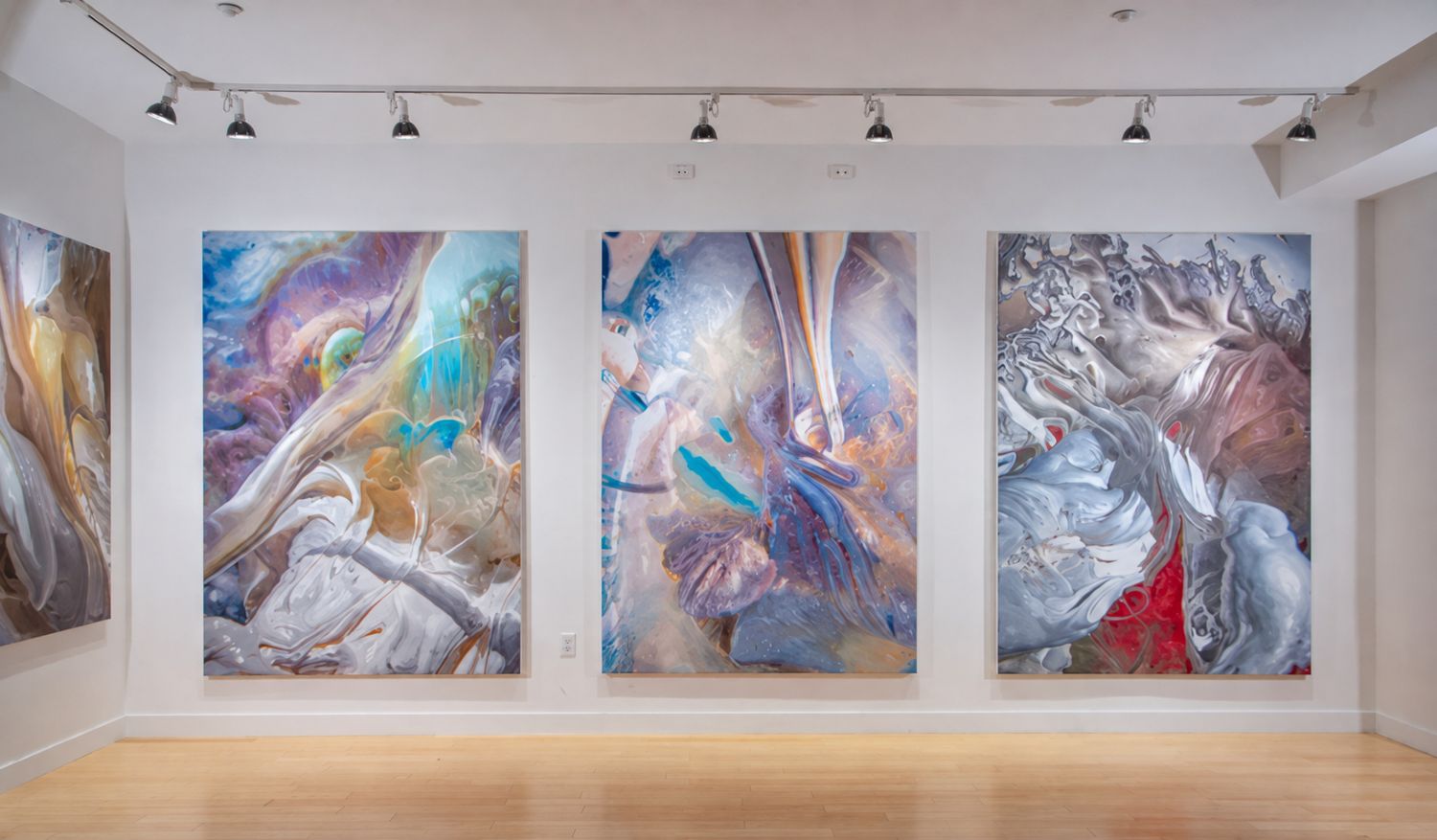
The pivot came in 2012, when her mother died of lung cancer. Until then her settings had been controlled interiors, bathrooms and pools, environments in which every variable could be managed. Afterward she opened the paintings to landscape, foliage, and weather, embracing contingency to the point of leaving canvases outdoors overnight so that chance could mark them. The controlled interior gave way to the uncontrollable exterior, and the metaphor was unmistakable: painting as a way of rehearsing the loss of control that grief imposes.
In a 2015 TEDxIndianaUniversity talk she described this movement outward, from a self fused with its surroundings toward a broader sense of connection and impermanence, as the animating idea of her mature work. The change did not mean abandoning the veil. Instead, branches, leaves, weather and the uncertain spaces of landscape assumed the role once played by shower glass and water. Nature became another surface through which the figure could appear and disappear.
Teaching and The Americans
Her influence extends well beyond her own canvases. Monks is an active and sought-after teacher, giving workshops, lectures, and mentorships at the New York Academy of Art and at institutions across Europe and North America. She has become a reference point for younger figurative painters trying to move past mere photographic copying toward something more searching.
Her work has also reached a wide public through unexpected channels. For the sixth and final season of the FX series The Americans in 2018, Monks created the paintings and drawings attributed on screen to Erica, the terminally ill artist played by Miriam Shor. The works were designed to hold a charge of repressed feeling and to function as a hinge in the drama. Rather than serving as decoration, the paintings became part of the series’ emotional language, expressing what its characters struggled to articulate.
Her paintings belong to notable private collections, including those of the painter Eric Fischl and the entrepreneur Luciano Benetton, as well as public and institutional collections such as those of Fullerton College and the Savannah College of Art and Design. Her work has also been exhibited at institutions including the Kunstmuseum Ahlen in Germany.
Be Perfectly Still
In 2022 the San Luis Obispo Museum of Art in California mounted her first museum retrospective, Be Perfectly Still, bringing together a wide-ranging selection of paintings spanning roughly fifteen years, from her earlier water-based works to pieces created during the pandemic. Among them was It's All Under Control, a spectral figure behind shower steam that turned her long-standing language of the veil into a precise image of collective anxiety and the human hunger for command over events.
The title of the exhibition captured a central contradiction in her work. Stillness is necessary for observation, for the posed body and for the photograph that may become the basis of a painting. Yet nothing in a Monks canvas is truly still. Water shifts, condensation gathers, foliage trembles, paint asserts its material presence, and the person behind the membrane seems to move between visibility and erasure.
Where Longing Meets Limits
Monks remains a steady presence on the international circuit, and her recent activity confirms both her productivity and her reach. Her most recent solo exhibition, Where Longing Meets Limits, was shown in 2023 at MM Fine Art Gallery in Southampton, New York, while her paintings appear regularly in group shows at Forum Gallery in New York, the gallery that represents her, including Spring Forward in 2024 and 25 New Works for the New Year in 2025.
In 2026 her work is included in a group exhibition at Rarity Gallery in Mykonos, Greece, scheduled from June through October. Disrupted Realism will follow at Werring Contemporary in Devon, Pennsylvania, from September 12 through October 28, 2026, while Hope & Resilience is scheduled for Galerie Rother in Wiesbaden, Germany, from January through April 2027.
Taken together, these shows suggest an artist still pressing at the same fertile problem she set herself two decades ago. In a moment pulled between abstraction and an ever-expanding machinery of digital images, Monks offers a distinctly contemporary answer: to deploy the full authority of realist technique not as an end but as a means of painting exactly what cannot be seen clearly—the parts of another person, and of ourselves, that remain forever behind glass.