
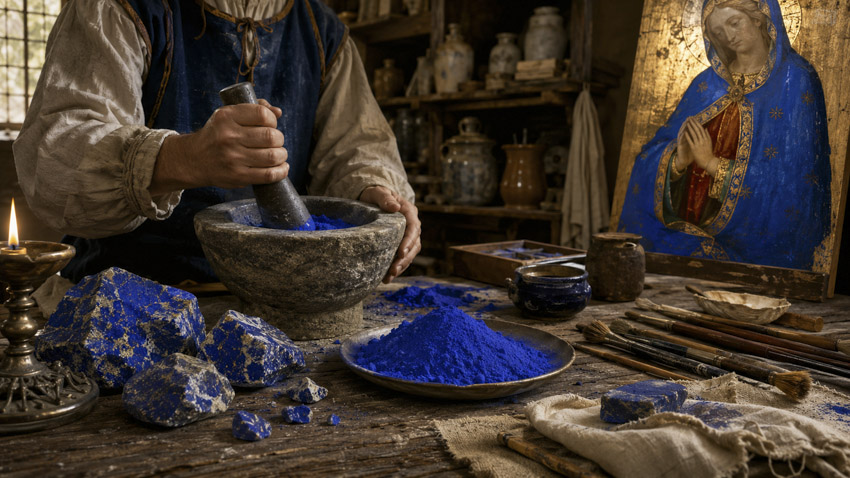
<p>To make Europe’s most prized blue, a Renaissance painter first needed a stone carried from far beyond Europe.</p>
<p>For centuries, the finest natural ultramarine came chiefly from lapis lazuli mined in Badakhshan, in what is now northeastern Afghanistan. The stone moved west through long-distance trade networks, crossing mountains and deserts before reaching Mediterranean ports and workshops in cities such as Venice and Florence. Its European name reflected that journey: <em>ultramarine</em>, from the Latin <em>ultramarinus</em>, meant “beyond the sea.”</p>
<p>Distance, however, was only part of the cost. Lapis lazuli is a rock composed of several minerals. Its blue comes mainly from lazurite, while pale calcite and metallic-looking pyrite can also be present. Grinding the stone alone produced a dull, grayish powder, so craftsmen developed an elaborate extraction process to separate the valuable blue component.</p>
<h2>How lapis lazuli became natural ultramarine</h2>
<p>Medieval and Renaissance pigment makers ground selected lapis lazuli and worked the powder into a paste made with wax, resin and oil. The paste was then kneaded in a diluted alkaline solution. This released fine blue lazurite particles into the water while much of the unwanted material remained trapped in the paste. Repeated extractions produced different grades: the earliest washes yielded the richest blue, while later ones were paler and less valuable.</p>
<p>Only a fraction of the original rock became the finest grade of pigment. The labor, the loss of material and the distance traveled all contributed to its extraordinary price. At certain times and places, the best natural ultramarine could cost more by weight than gold.</p>
<h2>A Renaissance pigment with a price tag</h2>
<p>Ultramarine was too expensive to be treated like an ordinary studio supply. Patrons sometimes purchased it separately, supplied it themselves or specified its quality in a contract. A celebrated 1515 agreement for Andrea del Sarto’s <em>Madonna of the Harpies</em>, for example, required ultramarine valued at no less than five gold florins per ounce for the Virgin’s blue clothing.</p>
<p>The painter Cennino Cennini praised ultramarine as “illustrious, beautiful, and most perfect, beyond all other colors.” Its high price encouraged careful planning. Artists could reserve it for the most important passages, apply it over a less costly underlayer or use a cheaper blue elsewhere in the composition.</p>
<p>Azurite, a copper-based mineral pigment, was the principal alternative. It was less costly and often somewhat greener in tone. Under certain environmental conditions, azurite can also alter or darken, although that is not the inevitable fate of every azurite passage. Natural ultramarine was admired for its saturated color and generally strong stability, but it was never simply a universal replacement for every other blue.</p>
<h2>Why the Virgin Mary wears blue</h2>
<p>The frequent use of deep blue for the Virgin Mary grew from several artistic and devotional traditions. Ultramarine’s expense added another powerful layer of meaning. Allocating the most precious pigment to Mary could signal both reverence and the patron’s willingness to honor the sacred figure materially.</p>
<p>The association became one of the most recognizable conventions in Western art. In many altarpieces, true ultramarine could emphasize a figure’s importance, but it was not an inflexible ranking system. Workshop practice, a patron’s budget, regional taste and the availability of materials all shaped where and how the pigment was used.</p>
<p>An unfinished painting by Michelangelo shows how strongly ultramarine has become attached to this history. In <em>The Entombment</em>, begun around 1500 and now in London’s National Gallery, the area intended for the kneeling Virgin remains blank. One hypothesis is that Michelangelo was waiting for the costly blue needed for her mantle. The museum presents this as a possibility, not a proven explanation: other parts of the panel were also left unfinished, and the artist’s departure for Florence may better explain why the work was abandoned.</p>
<h2>The furnace that transformed blue</h2>
<p>Natural ultramarine remained a luxury until chemistry made a convincing substitute possible. Blue deposits had been found in a soda kiln at the Saint-Gobain glassworks in France. In 1814, the chemist Nicolas Vauquelin published an analysis showing their similarity to lapis lazuli. The discovery suggested that the color could be recreated from inexpensive raw materials.</p>
<p>In 1824, the <em>Société d’Encouragement pour l’Industrie Nationale</em> offered a prize of 6,000 francs for a practical synthetic ultramarine. The French chemist Jean-Baptiste Guimet developed a successful process in 1826 and received the prize in 1828. At nearly the same time, Christian Gottlob Gmelin, a professor at Tübingen, independently developed and published a related method.</p>
<p>The new pigment, often called French ultramarine, was more uniform, reproducible and vastly cheaper than pigment extracted from stone. It brought a formerly exclusive color within reach of far more artists and manufacturers. The market for lapis-derived artists’ pigment contracted sharply, but the wider lapis lazuli trade did not disappear: the stone remained valuable for jewelry, carving and ornamental objects.</p>
<h2>From sacred luxury to everyday color</h2>
<p>Synthetic ultramarine changed the economics of blue. Artists no longer had to reserve every strong passage for a patron’s most important figure, while manufacturers adopted the pigment for printing, paper, textiles, paint and laundry products. A color once measured out with exceptional care became an industrial material.</p>
<p>The natural and synthetic pigments are closely related chemically, but they are not identical in every visual respect. Natural ultramarine can contain mineral variations that give it a complex appearance; the synthetic version offers consistency and affordability. Specialist pigment makers and conservators therefore continue to distinguish between them.</p>
<h2>Why old ultramarine can turn gray</h2>
<p>Ultramarine is generally stable, yet some painted passages develop a dull gray appearance known as “ultramarine sickness.” Conservators have documented the phenomenon in important works, but its precise causes remain under investigation. Changes in the paint binder, moisture, pollutants and the complex interaction of the pigment with its environment may all play a role.</p>
<p>Today, most tubes labeled ultramarine contain the inexpensive synthetic pigment born from nineteenth-century experiments. Natural lapis lazuli, meanwhile, still carries a separate artistic, cultural and ornamental value. The invention of synthetic ultramarine did not erase the stone’s history; it divided that history into two paths—one leading to an accessible modern color, the other preserving the material that once crossed continents to illuminate the most revered figures in European art.</p>
<p>The next time a deep blue mantle draws the eye in a Renaissance painting, it is worth remembering that the color was also a record of geology, trade, chemistry and belief. Ultramarine was never merely blue: it was distance, labor and devotion made visible.</p>
<p><strong>Sources and further reading:</strong> National Gallery, London; CAMEO Materials Database, Museum of Fine Arts, Boston; University of Amsterdam research on historical ultramarine production; National Gallery of Art studies of pigment alteration; and the Gemological Institute of America’s research on lapis lazuli from Badakhshan.</p>