
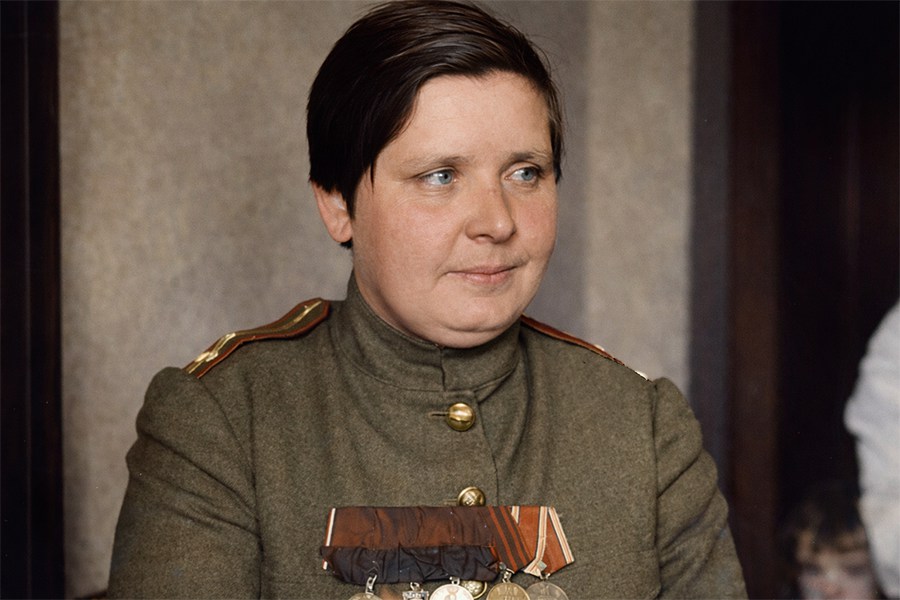
She did not arrive in history with a manifesto. Maria Leontyevna Bochkareva arrived with mud on her boots, scars on her body, and a reputation that men at the front could not easily dismiss. In the Russia of the First World War, that alone was a kind of miracle. By 1917, miracles were in short supply. The empire had cracked, the army was fraying, and politics had seeped into trenches that were already drowning in blood and fatigue. In that moment of national unravelling, Bochkareva became both a person and a symbol: a woman soldier whose very existence was meant to accuse the men around her of surrendering before the battle was over.
Born in July 1889 to a poor peasant family, Bochkareva grew up far from the salons where revolutions are theorized. Biographies and memoir traditions describe an early life marked by hardship, violence, and the kind of daily endurance that does not read as heroic until it is placed beside catastrophe. When war came in 1914, she did something that looked irrational in a society built on strict gender roles: she insisted on enlisting as a combat soldier. The question that follows her is always the same: how did she get in. The simple answer is persistence. The deeper answer is that wartime systems, even rigid ones, sometimes open a seam for the fiercely determined, especially when bodies are needed and legends are useful.
The important point is what happened after she entered. Bochkareva was not a decorative exception. Accounts consistently place her in real fighting, wounded more than once, repeatedly returning to the line. She earned decorations and, more importantly, earned credibility among soldiers who did not hand out respect lightly. If later propaganda helped amplify her story, it did not invent the basic fact that she had done what most people only talk about: she survived combat and returned for more.
Many readers, especially modern ones, get stuck on the question of presentation: did she dress like a man. In the trenches, the answer is practical rather than philosophical. She wore the standard soldier uniform because that was the uniform issued to a soldier. She kept her hair short because lice and hygiene were not abstract concerns, and because discipline in a collapsing army was enforced through visible sameness. To read those choices as a statement about identity is to forget what war does to the body and to time. In 1917, a uniform was not a costume. It was permission to exist in a forbidden space, and it was a tool for survival.
Why, then, did she become famous. The turning point was the spring and summer of 1917, when the Russian Provisional Government tried to keep fighting Germany while the home front exploded politically. Discipline eroded. Desertion soared. Units debated orders. The front, in many places, had become a place where men were armed but no longer convinced. Bochkareva offered a harsh remedy: a womens combat battalion that would shame the army into remembering its duty.
The unit she helped create became known as the First Womens Battalion of Death. The name was meant to sting. It implied that death had become acceptable again, even noble again, and it dared male soldiers to prove they were still worthy of their weapons. Thousands reportedly volunteered at the start, drawn by patriotism, grief, adventure, or an urgent desire to act rather than wait. What they met was not a romantic sisterhood. They met Bochkareva.
Her training regimen was famously severe. Heads were shaved. Rules were strict. Any hint of performative femininity was stripped away. The battalion was designed not only to fight but to be seen fighting, which meant it had to look disciplined in a way the broader army no longer did. Many recruits quit or were dismissed. The number shrank drastically, leaving a hardened core that could plausibly be deployed as a serious unit, not a parade piece.
This is where the story becomes morally complicated, and therefore more interesting. The battalion was empowering in one sense: it broke a barrier and put women in a role reserved for men. But it was also a propaganda instrument. The Provisional Government wanted an image of unity and courage. Bochkareva wanted obedience and sacrifice. Neither goal required tenderness. The battalion was built to be a mirror held up to a demoralized army, and mirrors are not gentle when the face is collapsing.
When the battalion went to the front during the 1917 offensives, it reportedly fought bravely. Yet bravery could not repair a strategic situation rotting from within. A single disciplined unit cannot rescue an army that no longer believes in its commanders or its cause. Accounts of the battalion emphasize both its courage and its isolation, describing how surrounding male units sometimes failed to follow through or refused to advance. The story, at that point, stops being a triumph and becomes a tragedy of context: the women could fight, but they could not force the rest of the front to become coherent again.
This is where the story becomes morally complex. The battalion was an example of empowerment: it demonstrated that women could perform roles that had previously been denied to them. But it was also a tool of war propaganda. The Provisional Government under Kerensky sought a symbol that would boost morale and project an image of unity in the army. Bochkareva, for her part, sought something more: to restore discipline on a demoralized front through rigorous training and the women's willingness to sacrifice. She didn't see her battalion as a group of women to be put on display, but rather as a fighting force.
Some historians believe that Bochkareva's women's battalion was created to shame the Russian soldiers who were deserting the army in droves or refusing to fight, preferring imprisonment instead. These women did not retreat like their male counterparts; they fought with determination and pride in their gender.
After 1917, her life moved from the trench to the international stage. She traveled to the West, including the United States and Britain, seeking support for anti Bolshevik efforts and speaking to audiences fascinated by the Russian collapse. Her memoir, often known by the title Yashka, was produced in this period for an English speaking readership. It is a gripping narrative of a peasant woman turned soldier, but it is also a text shaped for a particular audience, one eager for moral clarity and dramatic arcs. Reading it well requires both empathy and caution: it is testimony and it is product.
The questions that modern readers ask about her private life, including sexuality, usually reveal more about modern assumptions than about Bochkareva. There is no firm, widely accepted evidence that supports definitive claims that she was lesbian. What is better supported in mainstream biographical treatments is that she had relationships with men, including a marriage. But the larger point is that her public life was not built around romance or identity labels. It was built around an obsession with duty in a moment when duty was evaporating.
Her end was as stark as the era. Returning to a Russia consumed by civil war, she was arrested by Soviet security, interrogated, and executed in May 1920. She was about thirty years old. The brevity of that conclusion is almost insulting after such an improbable rise, but it is also characteristic of revolutionary time: the story of a person can be cut off not by fate or illness, but by a file, a signature, and a bullet.
What remains, a century later, is not a neat heroine. Bochkareva is unsettling because she does not fit comfortably into any single modern narrative. She is not simply a feminist icon, because her battalion was also a weapon of shame aimed at men. She is not simply a reactionary symbol, because her very existence shattered a traditional order. She is not simply a propaganda figure, because she actually fought. She is, instead, a reminder that history sometimes advances through people who are both admirable and severe, who break barriers not by asking politely but by demanding to be tested in the harshest arena available.
In the end, the Womens Battalion of Death did not save Russias war effort, and it did not stop the political avalanche that followed. But it did something else, something quieter and more durable. It proved, in the most unforgiving laboratory imaginable, that the boundaries many societies call natural are often just habits reinforced by fear. Bochkareva forced the front to look at that truth, even if only for a moment. And in a year when almost everything was falling apart, that moment was enough to make her unforgettable.