
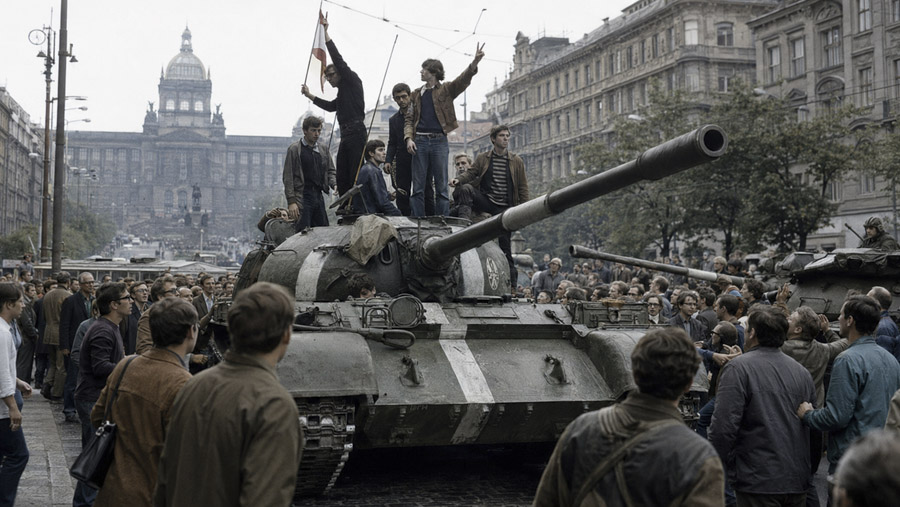
Just after midnight on August 21, 1968, the sky over Czechoslovakia filled with the drone of transport planes and the grind of tank treads. Roughly half a million soldiers from the Soviet Union and four of its Warsaw Pact allies poured across the borders to extinguish an experiment the Kremlin found intolerable: a Communism that had begun to open itself toward democracy. The Prague Spring—the hopeful reform movement led by Alexander Dubček under the slogan of “socialism with a human face”—was finished within hours. The occupation left dozens dead and hundreds wounded, and it delivered a message that outlived the tanks.
Fifty-eight years later, on the same August anniversary, tanks are again grinding across a European border in the name of Moscow’s security. The temptation to draw a straight line from Prague to Kyiv is powerful, and a real thread connects them. But pull on that thread and the differences turn out to be as revealing as the similarities—and they say a great deal about what Vladimir Putin actually wants.
The night the tanks came
The invasion of 1968 was not a war so much as an act of discipline. Czechoslovakia was already a loyal member of the Soviet bloc; the crime of its reformers was to loosen censorship, tolerate debate and imagine a socialism that answered to its own citizens. Moscow answered with overwhelming force—on some counts twice the manpower used to crush the Hungarian uprising of 1956—precisely to avoid a drawn-out fight.
The Czechoslovaks did not oblige. Rather than take up arms, they took down street signs to confuse the columns, argued with the soldiers and staged symbolic strikes. Dubček was seized and flown to Moscow, where he was made to sign the humiliating protocol that began the “normalization” of his country. A few months later a student named Jan Palach set himself on fire in Wenceslas Square, a protest against the resignation settling over the nation. The reform was dead, and the men in the Kremlin had shown what they were prepared to do to keep their neighbors in line.
A doctrine of limited sovereignty
Out of the rubble came a formula. In the autumn of 1968 the Soviet press articulated what the West would call the Brezhnev Doctrine: the socialist countries enjoyed sovereignty, but a sovereignty that could never be used to leave the socialist camp. If the system was judged to be in danger anywhere, the whole bloc—meaning Moscow—had the right to intervene. It was the sovereignty of a house whose doors only opened inward.
The echo in today’s Russia is unmistakable. When Vladimir Putin insists that Ukraine has no authentic right to choose its alliances, that its turn toward Europe is really a Western plot staged on Russia’s doorstep, he is reviving the same instinct: that certain nations are not fully free to decide their own direction. The vocabulary has changed—there is no talk now of protecting socialism—but the underlying claim, that Moscow holds a veto over its neighbors’ futures, is remarkably durable.
What has changed is the glue. Brezhnev’s bloc was held together, at least officially, by a shared ideology. Putin has no comparable creed to offer. In its place he has assembled something older and vaguer: the idea of a “Russian world,” a civilization with its center in Moscow whose reach is measured in language, faith and memory rather than party membership. It is less a program than a mood, and it asks not for conversion but for submission.
The reversal Putin cannot forgive
Here the analogy with 1968 begins to strain, because the map has been turned inside out. The countries that once supplied the tanks for the Warsaw Pact—Poland, Czechoslovakia’s successor states, Hungary, Romania, Bulgaria, and the Baltic republics that were part of the Soviet Union itself—are today members of NATO. The alliance that Brezhnev built to hold Eastern Europe has almost entirely defected to the other side.
That reversal is the wound at the center of Putin’s worldview. His description of the collapse of the Soviet Union as “the greatest geopolitical catastrophe” of the twentieth century is usually quoted as nostalgia; it is better read as a statement of intent. Where Brezhnev was defending an empire he already possessed, Putin is trying to rebuild one that has already slipped away. That is a far harder task, and it explains the difference in method. Disciplining a wayward member of your own club is one thing; dragging back a sovereign state that left three decades ago, and wants nothing to do with you, is another. It cannot be done with a bloodless occupation and a signed protocol. It requires a war.
Why it is not a new Warsaw Pact
This is why the popular shorthand—that Putin dreams of resurrecting the Warsaw Pact against NATO—captures the mood but misses the substance. The Warsaw Pact was a formal, multilateral alliance of ideologically aligned states, however coerced their loyalty. Putin commands nothing of the kind. His attempts at bloc-building—the Eurasian Economic Union, the Collective Security Treaty Organization—are thin and fraying; the latter conspicuously failed to rally to Russia’s cause and has been shedding relevance. There is no roster of client governments waiting to send divisions, no ideology binding them, no second superpower behind them.
There is also the matter of who is who. Ukraine was never a member of a Russian-led alliance to be disciplined; it has been an independent state since 1991 trying to get further away, not a satellite trying to reform from within. In 1968 Moscow was closing a door on its own side of the wall. In 2022 it kicked down a door on someone else’s house. The distinction matters, because it reframes the war not as a show of strength but, in the view of many analysts, as a confession of weakness: influence that has to be imposed by force is influence that could no longer be sustained by anything else.
Belarus, the last satellite
If you want to see what a classic satellite looks like in the twenty-first century, there is really only one example left, and it is Belarus. Alexander Lukashenko, politically dependent on the Kremlin since the mass protests against his rule in 2020, has folded his country ever deeper into Moscow’s embrace: a nominal “Union State,” a staging ground for the 2022 invasion, and, as of this year, a host for Russian nuclear weapons, their deployment rehearsed in joint drills that Putin and Lukashenko oversaw together. Minsk has surrendered much of the sovereignty that the Prague reformers died trying to expand.
But Belarus is the exception that underlines the rule. It is bound to Russia not by a shared and freely embraced project but by the personal survival of an isolated ruler who has run out of other patrons. That is not the Warsaw Pact reborn; it is its palest imitation—a single dependent client, held by coercion rather than conviction, standing in for a lost constellation of allies.
An empire rebuilt, not preserved
None of this settles the argument over the war’s deeper causes, and honesty requires acknowledging the competing account. Russia’s government, and a strand of Western realist thinking, insist that the enlargement of NATO toward Russia’s borders was itself a provocation, and that Moscow’s reaction is a defensive response to encroachment rather than an imperial project. Others counter that the newly free nations of Eastern Europe chose NATO precisely because they remembered 1968, and that treating their choices as a Western imposition simply repeats the old denial of their agency. The debate is genuinely open, and this summer’s brief, faltering ceasefire—announced with fanfare, gone within days—suggests how far any resolution still lies.
What the anniversary illuminates is not an equation but a continuity of mentality. From the Prague of 1968 to the Kyiv of today, one great power has insisted, again and again, that its neighbors’ freedom is negotiable while its own security is not—that a nation on Russia’s border holds its sovereignty only on loan. Brezhnev sent his tanks to keep an empire from opening. Putin sends his to force one back together. The tragedy that links the two Augusts, across fifty-eight years, is the same conviction—that a country beside Russia is never quite entitled to choose its own way—and the same discovery, made again in Ukraine, that people are willing to die rather than concede the point.