
Agra Fort: The Unconquered Red Citadel of the Mughal Empire
The Agra Fort, often overshadowed by the nearby magnificence of the Taj Mahal, stands as a formidable and essential monument, a testament to the military and political might of the Mughal Empire. Designated a UNESCO World Heritage Site, this vast walled palatial city—a term some historians prefer—is strategically situated on the banks of the Yamuna River in Agra, Uttar Pradesh, India. For over a century, it was the primary residence, seat of government, and treasury for the most celebrated Mughal emperors: Babur, Humayun, Akbar, Jahangir, Shah Jahan, and Aurangzeb. It was from within these monumental walls that they ruled the vast Indian subcontinent.
The fort’s current glory is due largely to the ambitious architectural visions of the Mughals, but its history stretches back much further.
From Brick Stronghold to Red Sandstone Citadel
The site was originally occupied by a simple brick fort belonging to the Sikarwar Rajput clan. Its first documented mention dates to 1080 AD when it was captured by the army of Mahmud of Ghazni.
* The fort gained political prominence when Sikandar Lodi (1487-1517), the first Sultan of the Delhi Sultanate to visit Agra, repaired the structure around 1504 and later made it his capital in 1506. He died here in 1517.
* His son, Ibrahim Lodi, ruled from the fort for nine years, constructing several palaces, mosques, and wells, until his defeat and death at the First Battle of Panipat in 1526.
Following Panipat, the Mughals captured the fort and, crucially, seized the immense wealth stored within, which included the famous Koh-i-Noor diamond. Babur, the first Mughal emperor, took residence, built a baoli (stepwell), and it was here that his son, Humayun, was crowned in 1530. Humayun lost the fort later that year to Sher Shah Suri, marking five years of Afghan control until the Mughals regained it after the Second Battle of Panipat in 1556.
Seeing its central location, Emperor Akbar decided to make it his capital, arriving in 1558. His historian, Abul Fazl, recorded that the dilapidated brick fortress, known as Badalgarh, needed complete reconstruction. Akbar ordered the fortress to be rebuilt using massive red sandstone sourced from Dholpur, Rajasthan.
* The foundation was laid by master architects, with the interior constructed of brick and the exterior clad in red sandstone.
* The monumental construction involved over fourteen lakh (1.44 million) workers and laborers and took eight years to complete, finalizing in 1573.
* Akbar's architectural style, often described by Abul Fazl as incorporating about five hundred beautiful buildings in the Bengali and Gujarati styles, featured a harmonious blend of Islamic and Hindu influences.
The White Marble Transformation Under Shah Jahan
Akbar's grandson, Shah Jahan, gave the site its present appearance. Known for his love of white marble adorned with gold and precious stones—a passion exemplified by the Taj Mahal—Shah Jahan was determined to transform the fortress.
* He tore down many of the older structures and buildings to erect his own pristine white marble palaces.
* The architectural style during his reign featured white marble, often intricately decorated with stone and glass inlays (Pietra Dura), and small wall niches reminiscent of Persian designs.
Ironically, in the final years of his life (starting in 1658), Shah Jahan was imprisoned by his own son, Aurangzeb, within the very fort he had helped transform. Though a prisoner, the confinement was softened by the luxury of the fort's palaces. It is said that Shah Jahan died in the Musamman Burj, a beautiful octagonal tower, gazing upon the Taj Mahal through its marble jharokha (window) .
Layout and Defensive Architecture
The fort features a semi-circular layout, with its straight side running parallel to the Yamuna River. Its towering seventy-foot-high walls boast double ramparts with massive equidistant bastions, gun embrasures, and defensive watchtowers.
* The fort has four gates on its four sides, one of which—the Khizri Gate—opens towards the river.
* The two most important gates were the Delhi Gate and the Lahore Gate (the latter also known as the Amar Singh Gate or Dakhinai Darwaza).
The Delhi Gate, facing the city, was the most majestic of the four and served as the Emperor's formal, ceremonial entrance. It featured an inner gate, the Hathi Pol (Elephant Gate), guarded by two life-sized stone elephants and their riders. Due to its use by the Indian Army (Parachute Brigade) for its northern cantonment, the Delhi Gate is not open to the public. Tourists enter via the Amar Singh Gate (formerly the Lahore Gate), which was so named because it faced Lahore (now in Pakistan). The sophisticated defensive measures, including a deep moat and a drawbridge, made the fort impregnable.
Notable Palaces and Halls
Today, only about thirty buildings remain, concentrated on the southeastern side. Many others were demolished by the British between 1803 and 1862 to construct barracks. Akbar's representative buildings include the Delhi Gate, the Akbar Gate, and the Bengali Mahal. The Akbar Gate was later renamed the Amar Singh Gate by Jahangir, matching the Delhi Gate in its red sandstone construction.
The interior layout showcases the fort’s dual function as a military base and a royal residence:
- Diwan-i-Aam (Hall of Public Audience): Erected by Shah Jahan in 1628. This pillared hall was the setting for the famous Peacock Throne (Takht-i-Taus) and where the Emperor met with the general public to hear petitions.
- Diwan-i-Khas (Hall of Private Audience): Used for meetings and consultations with high-ranking officials. It featured the Black Throne of Jahangir.
- Anguri Bagh: An 85 square meter geometrically arranged garden.
- Jahangiri Mahal: Built by Akbar for his son, Jahangir.
- Khas Mahal: A white marble palace, a prime example of marble artistry and color work.
- Macchi Bhavan: A large enclosure with pools and fountains used for Zenana (women's quarters) festivities.
- Sheesh Mahal (Palace of Mirrors): The royal dressing room, decorated with small, inlaid mirrors.
- Nagina Masjid: A small mosque built adjacent to the balcony for the court ladies, which overlooked the Zenana Mina Bazaar, where only women sold goods.
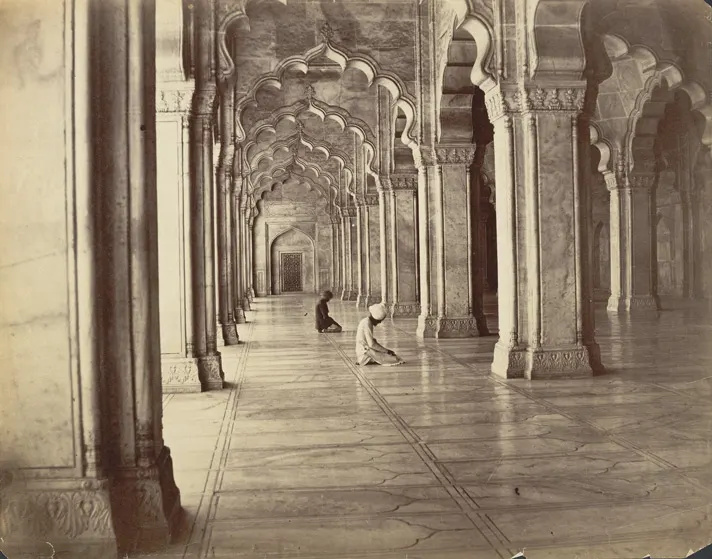
- Moti Masjid (Pearl Mosque): Shah Jahan's private mosque.
Historical Encounters and Cultural Legacy
Agra Fort has been the stage for several key historical and cultural events:
- Shivaji Maharaj: In 1666, Chhatrapati Shivaji Maharaj came to Agra under the Treaty of Purandar with Mirza Raja Jai Singh and met Aurangzeb in the Diwan-i-Khas. In an act of deliberate insult, he was assigned a seat far below his status. Shivaji stormed out of the court in protest and was later placed under house arrest in Jai Singh's quarters on May 12, 1666. A spirited equestrian statue of him stands outside the fort.
- Agha Khan Award: In 2004, Agra Fort was given the prestigious Agha Khan Award for Architecture, and the Indian Postal Department issued a stamp on November 28, 2004, to commemorate this.
- Literature and Media: The fort features prominently in Sir Arthur Conan Doyle's Sherlock Holmes mystery novel, The Sign of Four, and was shown in Egyptian pop singer Hisham Abbas's album, Habibi Da.
- Architectural Style: The fort is a perfect example of Mughal architecture, clearly demonstrating how North Indian fort construction (often inland) differs from South Indian forts, which are mostly built along the sea.
The comparison with the much smaller Red Fort in Delhi is noteworthy; the Mughals never called the Delhi structure a fort, but rather the Lal Haveli (Red Mansion). The Agra Fort, however, remains the true symbol of Mughal imperial power and architectural evolution from red sandstone to white marble.
Restoration and Visiting Today
While parts of the fort are still used by the Indian Army, public access is permitted through the Amar Singh Gate. The intricate carvings, the purity of the marble, and the breathtaking views of the Yamuna River and the Taj Mahal from the pavilions—especially the Musamman Burj—continue to mesmerize visitors, solidifying the Agra Fort's reputation as a vital stop on India's historical itinerary. Visitors are encouraged to explore the complex to appreciate the shift in architectural styles from Akbar’s solid red sandstone to Shah Jahan’s delicate white marble artistry.