

Carlo Ancelotti's invitation arrived after a youth match. He was playing for Parma, had not yet turned sixteen and lived with the Salesians at San Benedetto. A club acquaintance, the elder Pedraneschi, told him he would collect him the following morning for something at the Cittadella. Two film directors were putting together a football match. Decades later, Ancelotti would tell journalist Andrea Schianchi that their names had meant nothing to him. He agreed to play anyway.
The date was Sunday, March 16, 1975. Bernardo Bertolucci was turning thirty-four, and the birthday entertainment brought together the crews of two films being made in northern Italy: his 1900, known in Italian as Novecento, and Pier Paolo Pasolini's Salò, or the 120 Days of Sodom. On the Cittadella pitch in Parma, cinema workers became opposing elevens. Fifty-one years later, the fixture has a score, photographs, moving images and an unusually distinguished controversy over team selection.
A birthday between two film sets
These were colleagues with a history. In 1961, Bertolucci had abandoned his university studies to assist Pasolini on Accattone. The older director was a family friend and neighbour in Rome; Bernardo's father, the poet Attilio Bertolucci, had supported his literary work. By 1975, the former assistant had become an internationally prominent filmmaker. Their relationship also accommodated disagreement, including Pasolini's criticism of Last Tango in Paris. Later accounts describe actress Laura Betti as the intermediary who helped turn a birthday into an opportunity to bring them together.
Novecento was a vast undertaking. Released in 1976, its complete version runs 315 minutes and follows the friendship of a landowner's heir, Alfredo Berlinghieri, and a peasant's son, Olmo Dalcò, across the upheavals of the first half of the twentieth century. Robert De Niro and Gérard Depardieu play the men as adults. Socialism, agricultural labour, fascism and liberation reshape their relationship. Vittorio Storaro's photography and Ennio Morricone's music accompanied a production whose months together became part of its own mythology.
Pasolini's film pursued a different scale and a far more enclosed world. Drawing on the Marquis de Sade, Salò placed its action in northern Italy under fascist rule in 1944–45. Four powerful men imprison young people and subject them to a system of degradation, sexual violence and torture. The title refers to Mussolini's German-backed Italian Social Republic, often called the Republic of Salò. Pasolini presented the film as an attack on the exercise of absolute power. Its severity would provoke bans, seizures and years of controversy.
The costume department takes the field
Both films had producer Alberto Grimaldi behind them, but their crews experienced very different working worlds. In testimony collected for the later documentary Centoventi contro Novecento, editor Ugo De Rossi remembered the rivalry through the contrast between the modest Salò production and its wealthy neighbour. Betti, a close friend of Pasolini, was acting in Novecento. The match crossed professional and personal loyalties: her film's crew faced the director whose work she would spend years defending and preserving.
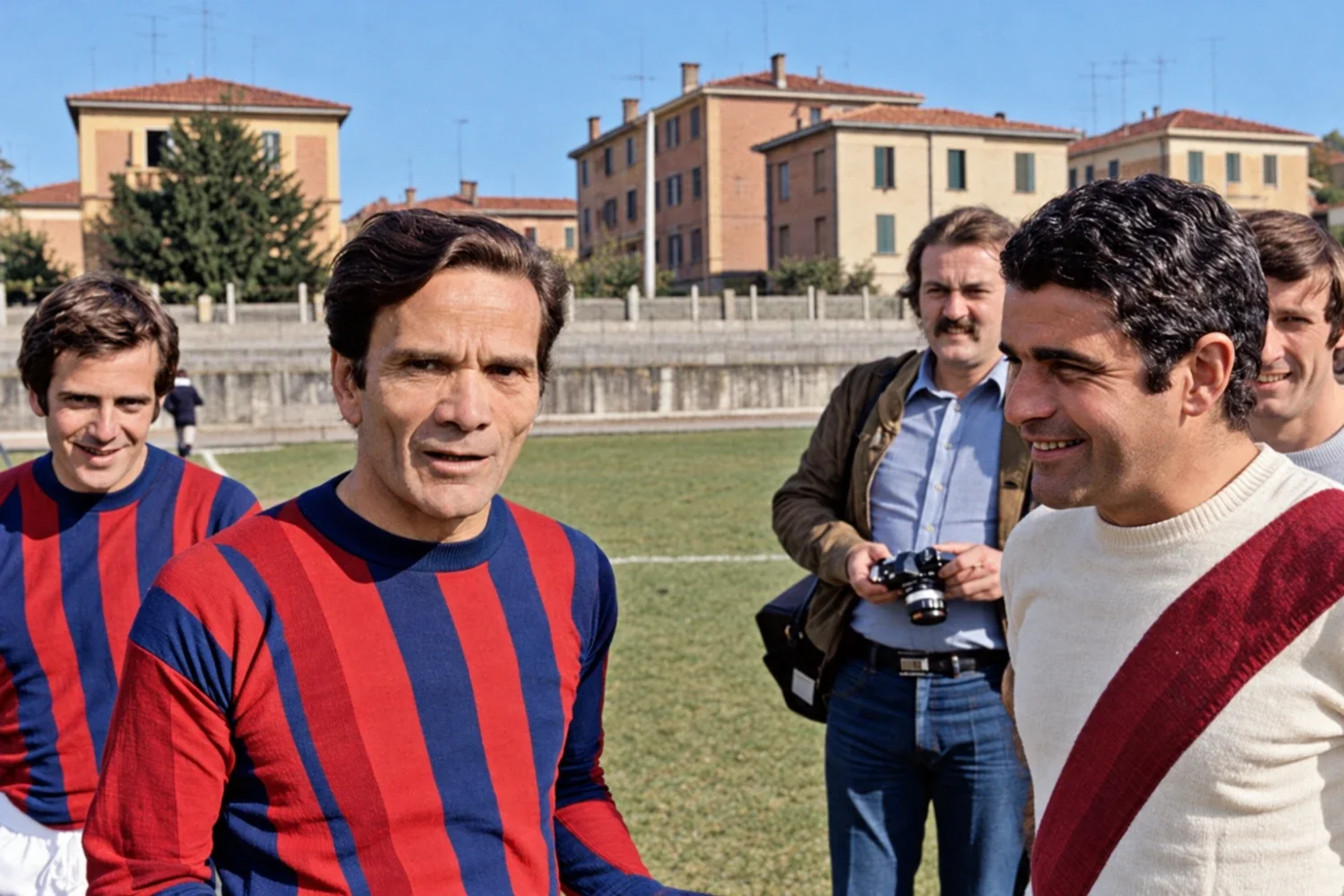
Novecento arrived dressed for the occasion. Costume designer Gitt Magrini supplied purple shirts with yellow lettering and multicoloured socks. Contemporary reporting made a joke of their supposedly disorienting effect on opponents watching the ball. Pasolini's side wore Bologna's red and blue, the colours of the team he supported. The contrast was memorable enough to survive in Ancelotti's recollection: Bertolucci's shirts struck him as extravagantly bright; the opposition looked more elegant. The costume department had created a football kit worthy of a film set.
The more consequential advantage was inside those shirts. Sound technician Decio Trani, captain of Novecento, later described his team's alarm at the opponents' ability. Reinforcements were found among Parma's youth players and presented as members of the film crew. Ancelotti was one of them. The term used in the 2021 interview was attrezzista: a worker responsible for props and equipment. The supposed technician was really a youth centre-forward. Bertolucci's side had recruited for footballing ability, and the difference would show on the pitch.
A goal without a reliable replay
Pasolini played; Bertolucci supported his team from the sidelines. For the poet and filmmaker, football was a lifelong practice, from Friuli to Rome's outlying neighbourhoods. His essay on the game treated passing and collective organisation as forms of prose, with dribbling and the goal belonging to poetry. That Sunday he also faced a youth centre-forward who, according to his later recollection, could shoot with either foot. Ancelotti recalled that Pasolini noticed the deception but was too eager to play to let it stop the match.
Novecento won 5–2. La Gazzetta di Parma's account that March jokingly credited the psychedelic socks. The result is also supported by the film record, although later recollections enlarged the score into something much less plausible. Ancelotti confirmed to Schianchi that he scored. He could remember celebrating, but not how the ball went in. His account preserved the pleasure of a boy who dreamed of reaching Serie A and Italy's national team, even as the details of his goal had escaped him.
The reasons for Pasolini's early departure are less settled. Later witnesses variously emphasised his dislike of losing, the questionable reinforcements or rough treatment on the field. His anger takes different forms in different memories; his determination to win runs through them. The suspicion about the recruits outlived the match. The identity of one young player would remain uncertain even when filmmakers returned to the photographs decades afterwards, looking for the future Ancelotti among the unfamiliar faces.
The birthday cake and the photograph
There was a trophy and a birthday cake afterwards. Clare Peploe filmed the occasion in Super 8; her footage is catalogued by the Cineteca di Bologna as Salò vs Novecento. The cake celebration survives in the moving images, alongside the football. Deborah Beer, the still photographer on Salò, also photographed the gathering. These records gave the match a life beyond its participants' memories, preserving the faces that would eventually make its most famous selection dispute possible to resolve.
Pasolini was murdered at Ostia on November 2 that year. When Salò had its first public screening in Paris on November 22, Bertolucci and Betti were among those speaking against its censorship. The football rivalry belonged to a relationship much larger than the score. Decades later, Alessandro Scillitani and Alessandro Di Nuzzo revisited the match in the documentary Centoventi contro Novecento, circulating in 2019; their research subsequently became a book published by Aliberti in 2023. In the 2019 reconstruction, the young Parma player's identity still needed confirmation.
On March 19, 2021, La Gazzetta dello Sport published Schianchi's interview. Shown the old photograph, Ancelotti recognised himself: yes, that boy was him. He asked for a copy. The confirmation gave a name to the alleged outsider without settling every grievance or disputed memory. In March 1975, the future football champion had been an adolescent willing to join a Sunday game, unaware of the directors' stature. Forty-six years later, a picture from their film crews' day off became a keepsake from his own beginnings.
Sources: La Gazzetta dello Sport, 19-03-2021; Lo Slalom: Ancelotti / Schianchi; Centro Studi Pasolini; Avvenire: Pasolini vs Bertolucci; Fondazione Bernardo Bertolucci; Cineteca di Bologna: Novecento; Pasolini: Salò, 25-03-1975; Cineteca di Bologna: Salò e censura; Emilia-Romagna: Il Novecento; Cineteca di Bologna: Salò vs Novecento; Valerio Curcio: Il calcio secondo Pasolini (estratto); Di Nuzzo / Scillitani: libro, 2023.


