The first broadcast of what audiences now call Saturday Night Live began on October 11, 1975, with an announcement that named a different show: NBC’s Saturday Night. George Carlin hosted from Studio 8H in New York. Billy Preston and Janis Ian supplied the music; a young ensemble billed as the Not Ready for Prime Time Players shared the stage. The hour was live, unruly in places and still searching for its shape. The anniversary offers more than a look at an origin story. It shows how a television institution was assembled before anyone knew what it would become.
The title was still unsettled
The name on the first program matters because “Saturday Night Live” is now so familiar that it can make the beginning seem inevitable. It was not. The Paley Center for Media catalogs the premiere as “NBC’s Saturday Night (Saturday Night Live),” preserving both the title used at the time and the one by which the series is remembered. NBC’s official episode listing identifies Carlin’s October 11 appearance as the first episode and lists Preston and Ian as the musical guests.
The title changed during the show’s early years. A rival ABC program hosted by sportscaster Howard Cosell had already used “Saturday Night Live,” creating a naming conflict. Contemporary and later accounts describe NBC’s show as “NBC’s Saturday Night” before the shorter “Saturday Night” and, eventually, “Saturday Night Live.” The name associated with the series today therefore arrived after its premiere, once the competing program was gone. The chronology is a reminder that the brand was not a polished blueprint waiting to be unveiled; it developed under the ordinary constraints of broadcast television.
A late-night experiment, not a finished formula
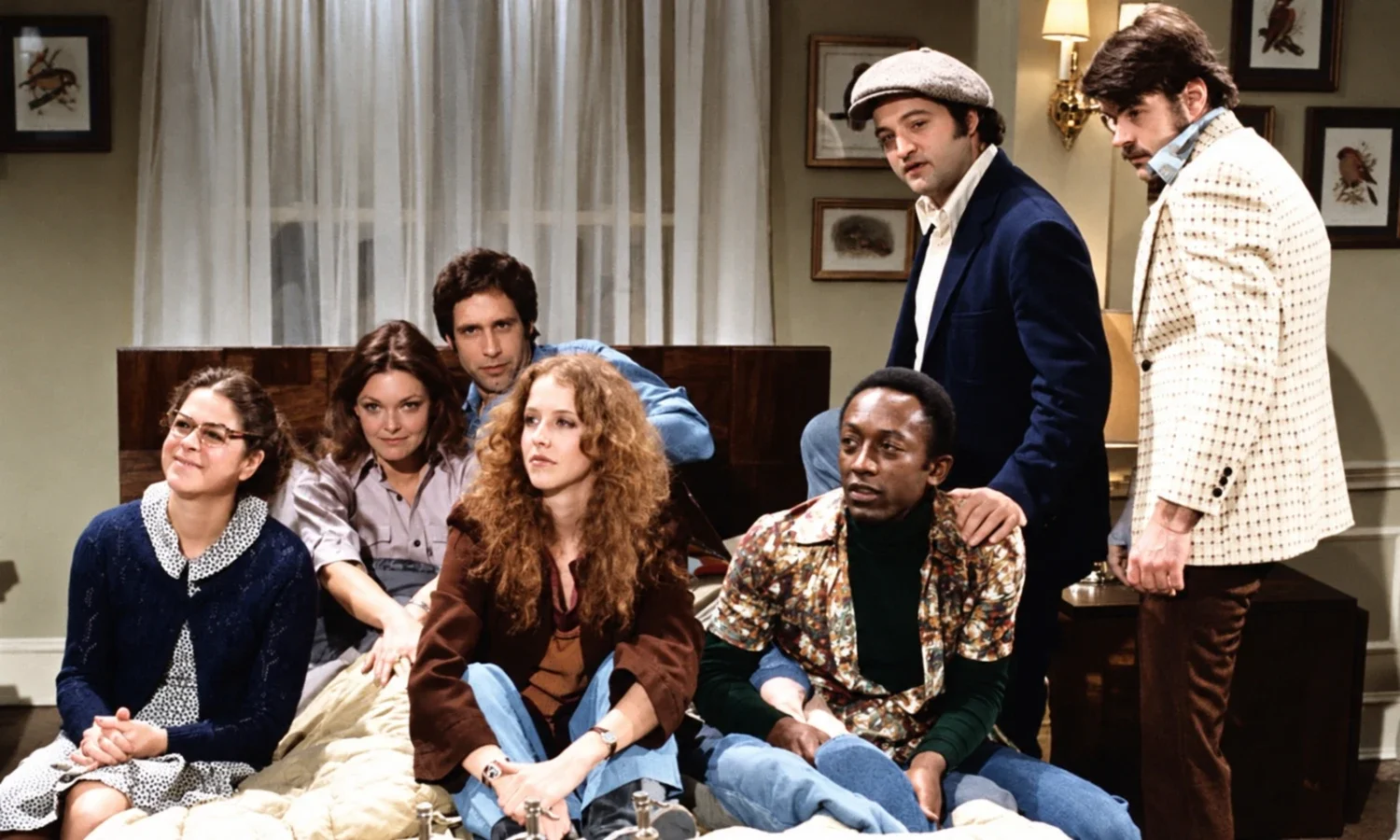
NBC had hired producer Lorne Michaels to build a Saturday late-night program, a new assignment in a medium whose schedules were built around established hosts and familiar variety formats. The result was a live weekly show that gathered comedians, writers and musicians in one studio. Its original cast included Chevy Chase, John Belushi, Dan Aykroyd, Jane Curtin, Gilda Radner, Garrett Morris and Laraine Newman. George Coe and writer-performer Michael O’Donoghue also appeared in the premiere-era ensemble, though the cast would soon change.
The first episode’s contents resist the neatness of hindsight. Carlin hosted but, unlike many later hosts, did not participate in the sketches. His stand-up gave the program a recognizable anchor, while the cast moved through comic bits and characters. Preston performed with his band, and Ian sang songs including “At Seventeen.” The mix of stand-up, sketches and music was not yet the seamless machine audiences came to expect. It was a broadcast testing what could hold together after 11:30 p.m.
That uncertainty is visible in the episodes that followed. In the second program, Paul Simon served as host and musical center; later broadcasts gave the performers more room to establish recurring characters and a shared comic voice. The show’s early structure changed as its writers and cast learned how to use the live format. The familiar rhythm—opening monologue, sketches, music and a closing sign-off—was not simply handed down fully formed on premiere night.
Why live television mattered
Live performance gave the series a distinct risk. A sketch could run long, a set could fail, or a performer could break character in front of a national audience. The possibility of error was part of the appeal: viewers were not watching a carefully polished sitcom, but a weekly event whose parts were assembled under deadline. That form also gave the program a way to respond to current language, politics and popular culture, though it did not make every sketch topical or every joke daring.
The show’s production identity was tied to New York. Studio 8H, the cast’s pace and the mix of theater-trained performers, improvisers and writers helped distinguish it from a conventional network variety hour. Its audience was younger than the viewers many advertisers expected in late-night television, and its sensibility drew on comedy clubs, alternative publications and the counterculture of the previous decade. That combination helped bring a different voice into a national broadcast, while the show still worked within NBC’s commercial and standards limits.
Michael J. Arlen’s 1975 review in The New Yorker, quoted by the Associated Press, recognized the ambition: television entertainment in a more human, less celebrity-centered voice, willing to examine show-business culture. The judgment was a critic’s interpretation, not a guarantee of influence. What the program eventually proved came over time, through seasons of uneven experiments, cast turnover and changes in how Americans watched television.
A beginning that became a tradition
The premiere’s cast did not remain intact for long, and the show did not preserve one tone. Some performers left for film and other work; new writers and actors altered its comedy; network executives and changing audiences shaped its limits. The institution that emerged was partly defined by that turnover. “Saturday Night Live” became a continuing platform where each generation could revise the previous one’s version of the show.
The series’ longevity can make its first hour look like a prophecy. It was not. There was no guarantee that an experiment in live late-night comedy would last for decades, much less become a recurring reference point in American politics and entertainment. The premiere instead records a wager: that an ensemble of writers and performers, working in real time, could turn a weekly television slot into something that felt contemporary.
The episode also preserves an early balance that later became harder to maintain: comedy and music sharing equal space, with two musical guests rather than one. The production’s live quality made transitions part of the experience. A viewer could see how a broadcast moved from Carlin’s monologue to a sketch, then to Preston’s performance and Ian’s songs. It was a variety program in a literal sense, not yet a machine organized around the sketch format alone.
On October 11, 1975, the broadcast still carried the provisional name NBC’s Saturday Night. Its music, performers and sketches were already in place, but the format and identity remained open. The significance of that night lies less in the idea that it contained the finished SNL than in what it began: a live series willing to discover its voice in public, one Saturday at a time.
Sources: Peacock: the October 11, 1975 premiere episode, Paley Center for Media: NBC’s Saturday Night premiere catalog, Television Academy: Saturday Night Live history, Associated Press: the original cast and the 1975 premiere, TIME: an original writer recalls the early show