The road to Hastings began with a death, a disputed succession and an exhausting march. When King Edward the Confessor died in January 1066 without a child, England’s throne became the object of competing claims. Harold Godwinson was crowned king; William, duke of Normandy, said Edward had promised him the crown and that Harold had sworn to support his claim. The evidence for those promises is disputed, and medieval chroniclers wrote from different political positions. What is clear is that both men gathered armies, and that a third claimant, the Norwegian king Harald Hardrada, turned the succession dispute into a year of war.
On September 25, Harold’s forces defeated Hardrada at Stamford Bridge in northern England. Three days later, William landed in the south. Harold marched his army hundreds of miles, then met the Normans on October 14 at a ridge near the town now called Battle, in East Sussex. The event known as the Battle of Hastings did not take place in Hastings itself. The location, the forces involved and the day’s result are better documented than many details of the fighting.
A kingdom with three claims
Edward’s death left a political vacuum, not a clear succession rule. Harold was an English nobleman with military power and the backing of the leading council. William claimed a right through Edward and through an alleged oath by Harold. Harald Hardrada invoked a Scandinavian agreement connected to an earlier English king. The Bayeux Tapestry, commissioned after the conquest, depicts Harold’s oath to William, but the scene belongs to a visual argument created by the victors. It cannot settle every question historians ask about what was promised or under what circumstances.
Harold’s victory at Stamford Bridge came at a cost. His army had to move south rapidly after the Norman landing, while William’s forces were supplied by sea and had time to establish a position. The English army gathered on high ground and formed a shield wall; the Norman army brought infantry, archers and cavalry. English Heritage and Historic England use medieval accounts and the battlefield’s geography to reconstruct the action, but no contemporary source gives a minute-by-minute record. Exact casualty totals and some tactical details remain uncertain.
What happened on the battlefield
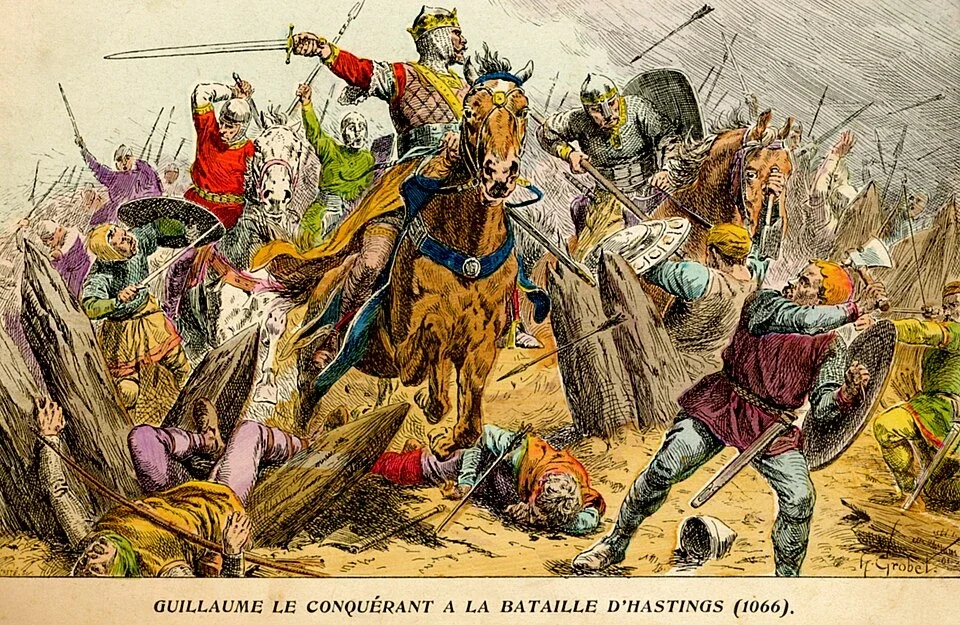
The battle lasted through much of the day. The English held their position on the ridge, making it difficult for Norman troops to break through. Accounts describe Norman withdrawals that drew English fighters out of the shield wall, followed by counterattacks. Historians debate how much of this was a deliberate tactic and how much a retreat under pressure. A tapestry is not a military log, and later chroniclers often had reasons to make the victory appear providential or the defeated king blameworthy.
The turning point came when Harold was killed and the English line collapsed. The Bayeux Tapestry shows a figure beside an inscription that says “Here King Harold has been killed”; scholars have debated the image’s details, including whether the figure with an arrow in the eye is Harold. The safest conclusion comes from the inscription and the broader record: Harold died during the battle, William won, and organized resistance around the king’s immediate army broke. The tapestry is a vital source, but reading it as a photograph would mistake a political narrative for neutral eyewitness evidence.
William did not become secure ruler of all England by sunset. He advanced toward London, met resistance and was crowned on Christmas Day 1066. Revolts continued. The conquest required more than the victory at Battle: a military occupation, the removal of English landholders, new castles and an administrative survey. The Domesday Book, compiled in 1086, recorded land and obligations across much of England and offers evidence of how thoroughly the ruling structure had changed.
The conquest’s slower transformation
The Norman takeover changed who held power more quickly than it changed what ordinary people spoke. French became the language of the royal court and much of the aristocracy; Latin remained central to church and administration; Old English continued among most of the population. Over centuries, contact among those languages reshaped English vocabulary and grammar. The idea that French instantly replaced English after Hastings is wrong. The linguistic shift was gradual and uneven.
Landholding changed sharply. William rewarded followers with estates and built a new elite whose loyalties linked England to Normandy. Castles made the occupation visible, while local rebellions showed that it was contested. The conquest also tied England more closely to the politics of continental Europe. William’s cross-Channel holdings would draw later English kings into conflicts with French rulers, though those consequences stretched well beyond 1066.
The sources themselves reveal how the story was made. The Anglo-Saxon Chronicle recorded the battle in compressed terms; the Bayeux Tapestry tells a longer visual narrative sympathetic to William; later histories interpreted the conquest through their own ideas about kingship and providence. Archaeology and landscape research add evidence about the battlefield, but they do not turn every disputed episode into certainty. A careful account separates what sources agree on from the explanations they offer.
Why 1066 endured
Hastings became a shorthand for conquest because the battle killed a king and made a new ruling order possible. But its importance does not rest on a simple claim that one afternoon created modern England. The succession crisis, the campaigns in the north and south, the Norman occupation and decades of administrative change all belong to the same story. The battle was decisive in the military sense; its social consequences were built afterward.
Battle Abbey, founded by William near the site, gave the landscape a lasting monument and a political memory. The abbey’s tradition says it stood where Harold fell, although identifying the precise spot remains difficult. Today, the town, battlefield and ruins preserve both the event and the later effort to interpret it. The familiar date—1066—marks not an instant national rebirth but the moment when a disputed crown was decided by force, and England’s rulers, land and connections began to change.
Sources: English Heritage: the battle, Historic England: battlefield record, British Library: the Bayeux Tapestry, English Heritage: where the battle happened, Anglo-Saxon Chronicle, 1066 annal