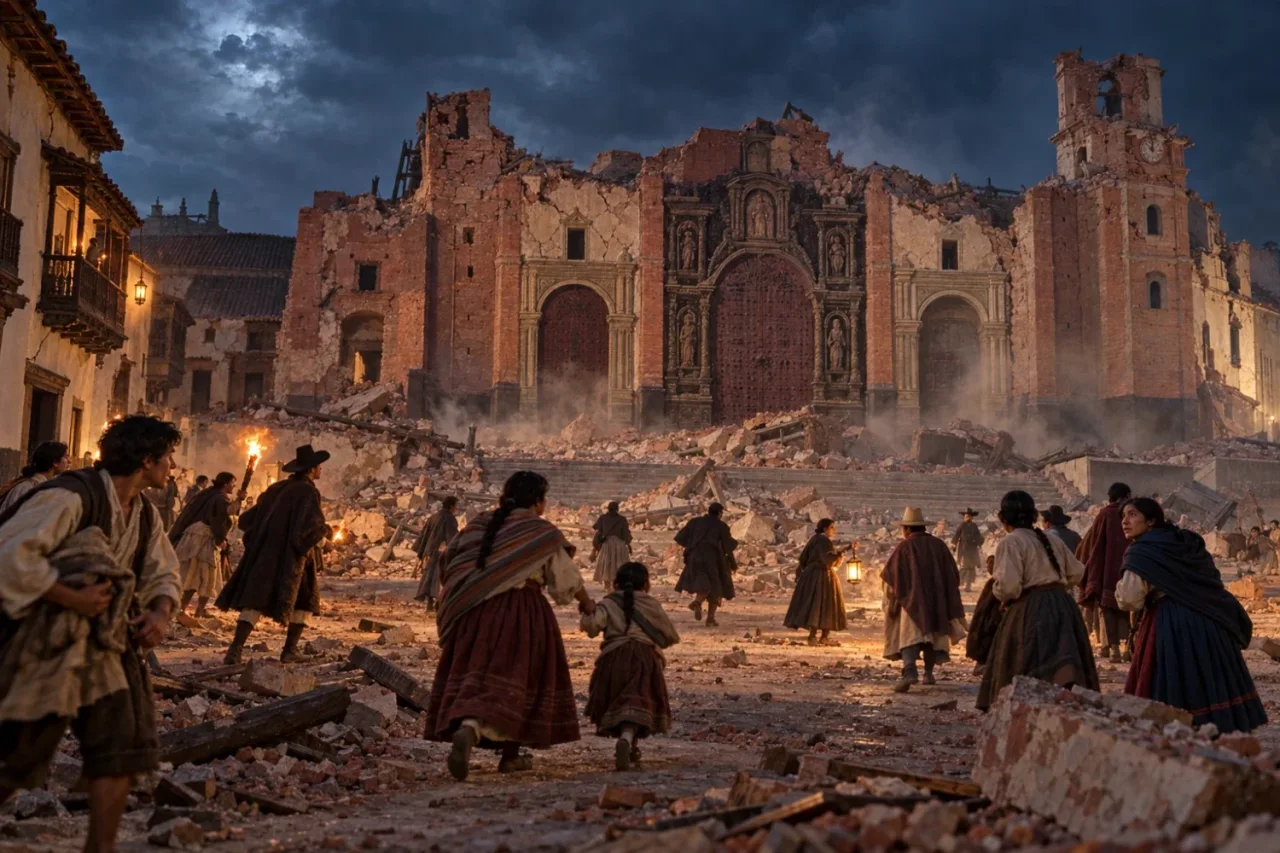
Late on October 28, 1746, the ground shook Lima, then the capital of Spain’s vast Peruvian viceroyalty. At the nearby port of Callao, the earthquake was only the beginning. The sea came ashore after the shaking and overwhelmed the harbor. Two hundred and eighty years later, the disaster is remembered for the destruction it caused, but its longer history lies in the questions survivors had to answer: where to find water and food, how to care for the sick, and whether to rebuild their city in the same way.
The earthquake struck at about 10:30 p.m., according to contemporary accounts and later historical studies. Its exact magnitude cannot be measured from an eighteenth-century instrument record; modern estimates differ. The extent of the damage is less uncertain. Buildings across Lima collapsed or were badly damaged, including major religious and public structures. An anonymous report printed in 1746 described ships carried beyond Callao’s walls by the water. It is a witness account, with the urgency and limitations of one, but it leaves little doubt about the force of the inundation.
A port lost to the sea
Callao was Lima’s maritime gateway: goods and people reached the colonial capital through its harbor. The tsunami destroyed the port’s buildings and fortifications and killed most of its inhabitants. A 2020 study in the Peruvian Journal of Experimental Medicine and Public Health gives approximate death tolls of 1,300 in Lima and 3,800 in Callao. Those numbers are reconstructions, not a complete count made on the night. Other historical estimates vary, and the dead from the diseases that followed are harder still to enumerate. The contrast between the two places is nevertheless stark: the earthquake devastated the inland city, while the water made the low-lying port a much deadlier place.
José Eusebio de Llano y Zapata, a Lima-born scholar, recorded the event and its aftermath in a letter or diary published in Madrid in 1748. Its title dates his account from Friday, October 28, 1746, through February 16, 1747, and promises a tally of the continuing tremors. That long span matters. The catastrophe did not finish when the waves withdrew. People faced damaged homes, repeated shaking and the loss of a port that supplied the capital. The diary belongs to the evidence of a continuing emergency, rather than to a single dramatic night.
The emergency after the earthquake
Viceroy José Antonio Manso de Velasco governed Peru for the Spanish crown. His own account, cited by historians of the disaster, describes crowds seeking open ground in Lima’s main square and other plazas, gardens and fields. Leaving a damaged house could save a life, but shelter outdoors exposed people to weather and disease. The poorest residents had the least protection. A city that had lost buildings also had to keep ordinary services working while many of the people who provided them had lost homes or relatives.
Water was an immediate problem. The earthquake damaged canals and pipes used for drinking, milling grain and supporting the surrounding farms. Bakeries and storehouses were ruined, and Callao’s warehouses could no longer serve as before. The viceroy’s administration worked to clear water channels, restore food supplies and rebuild ovens. According to the medical historians Carlos Carcelén, Daniel Morán and Laura Amador, wheat came from Chile while meat and other provisions came from inland. The effort to restore a functioning market was inseparable from the effort to keep people alive.
Hospitals had been damaged just when more patients needed them. The same historians document deaths among patients admitted to Lima’s San Andrés and Santa Ana hospitals in the year after the quake; Callao’s hospital was destroyed. Crowding, exposure, poor sanitation and shortages contributed to outbreaks of disease. Historical sources disagree sharply on how many people died afterward, so any neat total for the disaster would conceal uncertainty. What is clear is that the emergency moved from collapsed walls and flooding to hunger, illness and the struggle to deliver care.
Who would decide how Lima rose again?
Reconstruction brought a second conflict. Manso de Velasco asked the French astronomer and mathematician Louis Godin, then teaching in Lima, to help plan safer buildings. Godin delivered proposals in November 1746: wider streets, lower structures, fewer heavy vaults and greater use of quincha, a light framework of cane and plaster. Wider public spaces could provide places to gather when buildings fell. Historian Charles Walker shows that these ideas were also part of a broader attempt by the colonial government to regulate the city and its inhabitants.
The proposed limit on upper floors met resistance. For Lima’s wealthy property owners, a second story was living space, income and a visible sign of standing. Demolishing one was expensive, especially when labor and materials were scarce. The authorities argued that tall walls threatened people in the streets and in smaller homes. Owners disputed the terms and costs of the order. Walker’s study follows the petitions and official papers through several years; the result was a negotiated and incomplete reform, not the swift construction of a wholly new city.
Callao faced a different decision. The old harbor remained useful, but rebuilding civilian life immediately beside the water meant living with the memory of the tsunami. Research by Víctor Emilio Alvarez Ponce describes the relocation of civilians to Bellavista while a military fortress was built at the former port site. The move did not erase the harbor or end the danger. It shows instead that the geography of risk had become part of government policy: where a family lived, where a fort stood and who could return to the waterfront were matters of public choice.
What the records can and cannot tell us
The surviving documents do not speak with one voice. Colonial officials wrote about order, provisioning and rebuilding; an early printed relation conveyed the shock of the sea; Llano y Zapata kept a longer record of tremors. Later historians have asked whose experiences those sources leave at the margins, including the poor, Indigenous people and enslaved residents. Reading the records together gives a fuller account, but it cannot supply a complete list of the dead, a precise modern magnitude or every survivor’s view of what should have happened next.
The 280th anniversary is therefore more than a date in a catalogue of earthquakes. On October 28, 1746, Lima and Callao were struck by the same geological event and lived through different forms of loss. The months that followed exposed the dependence of a capital on its port, its water system, its hospitals and the people who kept them running. They also turned the rebuilding of walls and streets into an argument about safety and power. That argument, preserved in the archives, is part of the disaster’s history.
Sources: https://revistas.pucp.edu.pe/index.php/revistaira/article/download/26041/24507/102988 ; https://www.scielo.org.pe/scielo.php?pid=S1726-46342020000100164&script=sci_arttext ; https://revistas.pucp.edu.pe/index.php/historica/article/download/8680/9051/34338 ; https://www.cervantesvirtual.com/obra/carta-o-diario-que-escribe-d-joseph-eusebio-de-llano-y-zapata-a-su-mas-venerado-amigo-y-docto-correspondiente-el-doctor-don-ignacio-chirivoga-y-daza-en-que--da-cuenta-de-todo-lo-acaecido-en-esta-capital-de-el-peru-desde-el-viernes-28-de-octubre-de-1746-quando-experimento-su-mayor-ruina-con-el-grande-movimiento-de-tierra-que-padecio--hasta-16-de-febrero-de-1747-con-una-tabla-en-que-se-da-el-calculo/