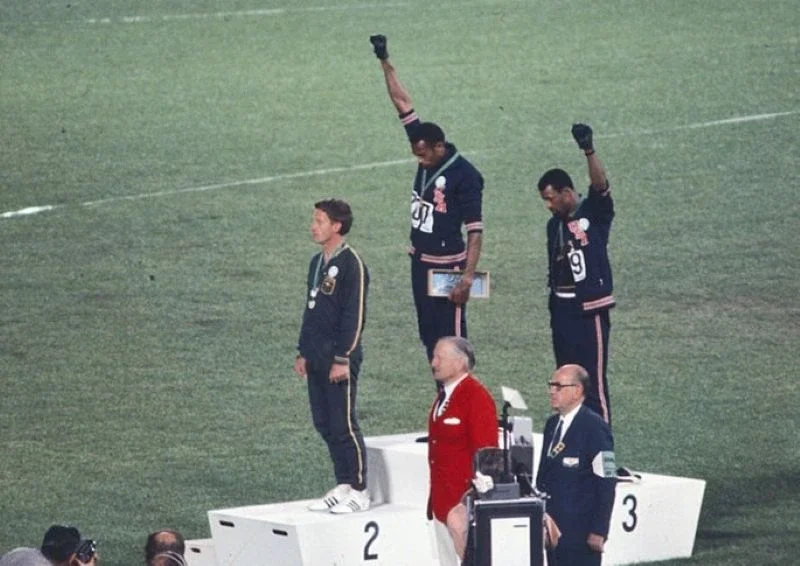
Two raised fists command attention. A badge asks the viewer to look closer. On October 16, 1968, the men's 200-meter medal ceremony in Mexico City brought three runners together on an Olympic podium. American Tommie Smith had won gold, Australian Peter Norman silver and American John Carlos bronze. The race had established that order. What followed gave it another meaning.
A protest during the anthem
During the United States anthem, Smith and Carlos bowed their heads and raised black-gloved fists. The Australian Olympic Committee's account places the gesture within the struggle for racial equality. Their country's victory ceremony became a setting for a demand their medals alone could not express.
Norman wore an Olympic Project for Human Rights badge, as did the two Americans. The organization advocated human rights in sport. His solidarity was visible without repeating their gesture. Treating him as merely a bystander removes a deliberate choice from the photograph.
Australia's National Film and Sound Archive identifies John Dominis as the photographer of the image it discusses. It explains another detail: Smith's lack of running shoes symbolized poverty among African Americans. These were considered symbols, not accidental features of a medal ceremony.
What the athletes said, and what followed
In an interview published by the Smithsonian American Art Museum in 2021, Smith described his action as a stand for all human rights. He associated the raised arm with pride and togetherness. His later explanation matters: it gives the athlete a voice alongside the interpretations accumulated around his image.
Smith and Carlos were sent home. Accounts of Norman's subsequent treatment require more care. The audiovisual archive describes unofficial sanctions and exclusion; the Australian Olympic Committee attributes his missed opportunity in 1972 to injury and a third-place finish at the national championships. Those accounts do not establish a single, uncontested explanation for his absence from another Olympics.
A friendship beyond the photograph
Norman had run 20.06 seconds to earn his silver. The protest should not erase the performance that put him on the podium. When he died in 2006, Smith and Carlos helped carry his coffin. In 2018, the Australian Olympic Committee awarded him a posthumous Olympic Order of Merit.
The image also became material for art. Glenn Kaino's Bridge, dated 2013–14 by the Smithsonian, repeats casts of Smith's arm. Fifty-eight years after Mexico City, returning to the three athletes keeps the familiar photograph connected to individual decisions: two raised fists, and the badge worn beside them.
Sources: Smithsonian: interview with Tommie Smith; Australian Olympic Committee: Peter Norman; National Film and Sound Archive; Australian Olympic Committee: Mexico City 1968.