On 20 November 1820, the whaling ship Essex was struck by a sperm whale in the Pacific. First mate Owen Chase survived to publish an account the following year. The vessel was real, the disaster was real, and the ordeal that followed was more terrible than the moment of impact. Decades later, a novelist would draw on that testimony without turning his book into a straightforward reconstruction of the wreck.
On 18 October 2026, the first British publication of Herman Melville's novel reaches its 175th anniversary. It appeared in London in 1851 as The Whale, before the American edition named Moby-Dick; or, The Whale. The white whale behind the famous title belongs to a meeting point between maritime experience, sailors' stories and literary invention. No single animal explains everything that Melville made of it.
What happened to the Essex
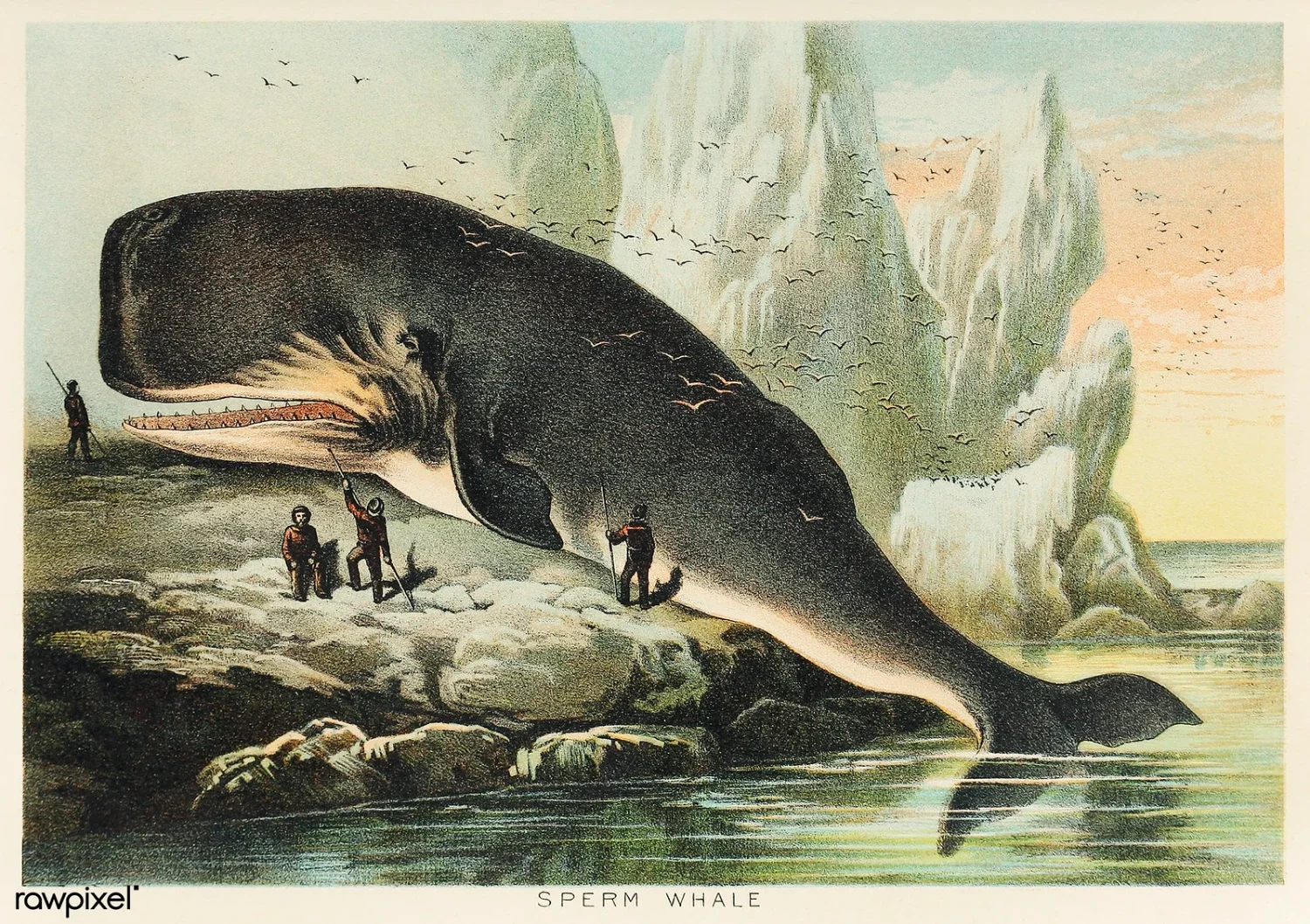
Chase's narrative describes a large sperm whale striking the ship twice. The crew had been hunting whales when the animal approached the vessel, and the collision left their ocean-going home beyond recovery. Twenty men escaped into three small whaleboats, carrying what supplies they could salvage. Captain George Pollard and his officers now faced a different kind of voyage: finding land before provisions and strength ran out.
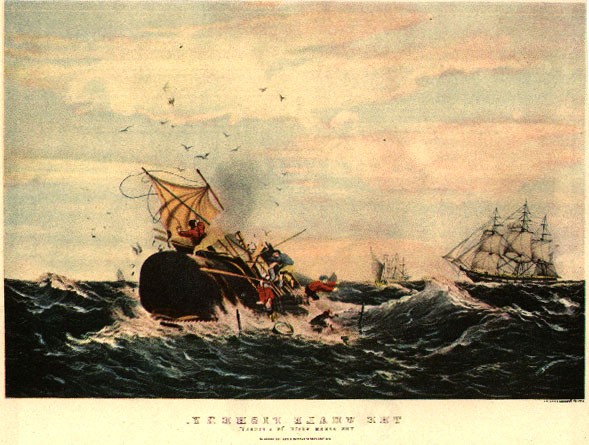
Chase records the practical details of survival: rationing, thirst, worsening weakness and navigation in exposed boats. The men reached an island, where three remained while the others resumed their attempt to reach help. Hunger eventually brought the survivors at sea to cannibalism. Eight men ultimately survived. These facts should not be dressed up as an adventure in which courage neatly resolves every danger.
Nor does Chase's account give us a whale's thoughts. He interpreted the encounter through the language and assumptions of a nineteenth-century whaleman. His testimony is evidence for what a survivor observed and believed, rather than proof of an animal's intention to wage a campaign against humanity.
The distinction also prevents a common confusion: the whale that sank the Essex is not established as the same animal later described as Mocha Dick. The wreck and the white-whale story are separate strands of the novel's background.
Mocha Dick, between report and legend
In 1839, Jeremiah N. Reynolds published Mocha Dick, or the White Whale of the Pacific in The Knickerbocker. His account presents an exceptionally pale sperm whale associated with the waters around Mocha Island, off Chile. Its body carries the marks of encounters with hunters, and the narrative gives it an almost legendary reputation for surviving them.
Reynolds openly frames the story through a sailor's telling and explains that he has reshaped its expression. That is a useful warning to a modern reader. The account shows how whalemen narrated a formidable animal, but its dramatic episodes and extravagant reputation cannot all be treated as independently verified observations. It is a historical text carrying a story, not a modern scientific identification file.
Even the vocabulary reveals its period. Nineteenth-century writers could call a whale a fish; modern zoology classifies sperm whales as mammals. NOAA describes them as deep-diving toothed whales that feed primarily on squid. A whale's capacity to injure a vessel says nothing by itself about the moral character that a novelist or sailor assigns to it.
A writer who knew the trade
Melville brought his own experience at sea to this material. He sailed aboard the whaler Acushnet in 1841, and the New Bedford Whaling Museum documents his encounter with the son of Owen Chase and the account of the Essex that reached him. The wreck was thus something he read about within the working world of whaling, not simply a remote curiosity discovered in a library.
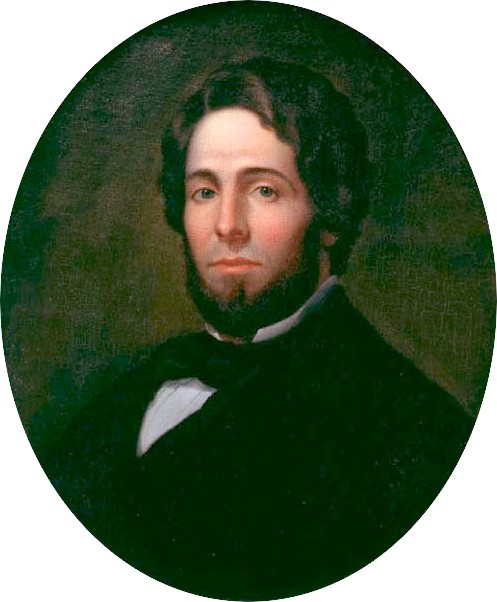
In chapter 45 of Moby-Dick, Melville himself draws attention to the Essex. Across the novel, he makes room for the work of an industry: lookout duties, boats, harpoons, the handling of carcasses and the extraction of oil. Its long excursions into whale classification also belong to the narrator's world of knowledge, and need not be mistaken for a current biology textbook.
The industrial setting changes how the pursuit looks. These were commercial voyages organized to obtain a valuable resource. Men travelled far from home, and a ship brought together different backgrounds under a hierarchy of command. The novel keeps that working world in view even as its captain redirects the voyage towards a private purpose.
Ahab adds the obsession
Captain Ahab's pursuit is the great transformation. The fictional whale has taken his leg, and he makes revenge the ship's overriding task. His officers and crew must live inside a purpose that is not simply their shared commercial mission. Starbuck's resistance exposes the danger of a command that cannot accept limits.
Read in that way, the book is also about the power to make other people follow an obsession. Ahab attaches meaning to the whale beyond anything an animal could explain. Ishmael's narration, with its changing perspectives and digressions, gives readers more room than the captain allows himself.
This interpretation does not require us to diagnose Ahab from a distance. It comes from the novel's conflict between work, authority, revenge and uncertainty. The Essex supplies the knowledge that a whale can destroy a ship; fiction asks what happens when a human being makes such destruction the centre of his understanding of the world.
An anniversary with two publication dates
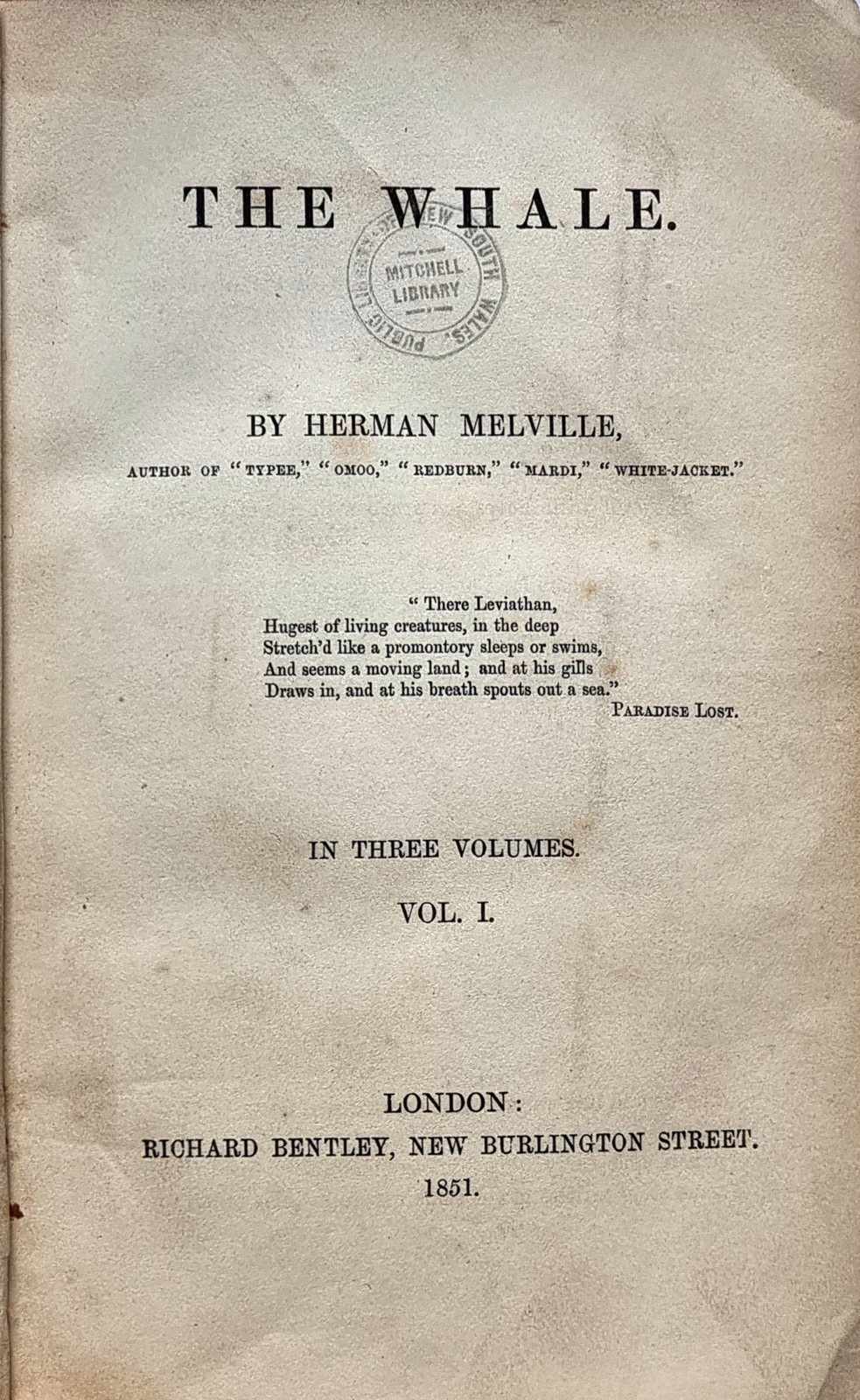
The London edition appeared on 18 October 1851 in three volumes. The American edition followed that November, generally dated to the 14th. They are related milestones, and the October anniversary should not be presented as the anniversary of the American release. Melville's reputation also changed after his lifetime: a book that received a divided reception became a central work of American literature.
For the historical wreck, Nathaniel Philbrick's nonfiction In the Heart of the Sea offers a modern reconstruction. Ron Howard's 2015 film of the same title offers a dramatization, with its own narrative inventions. Neither should replace reading Chase when the question is what a survivor actually reported.
The anniversary is an invitation to keep those layers together without collapsing them. Behind Moby-Dick are hunted animals, a wreck, men struggling to survive and stories enlarged in the telling. Melville made those materials into a question that remains unsettling: how much destruction can follow when one person's certainty becomes everybody else's destination?
Sources: Owen Chase's 1821 narrative, University of Nebraska–Lincoln, Reynolds's Mocha Dick, 1839, Herman Melville, Moby-Dick, New Bedford Whaling Museum, NOAA Fisheries
Books and resources
- In the Heart of the Sea — Nathaniel Philbrick
Historical nonfiction by Nathaniel Philbrick about the Essex disaster. The publisher link presents an English commercial edition. Useful alongside Chase's survivor account to distinguish reconstruction from fiction.
Paid resource - Moby-Dick (The Whale) — Herman Melville
An unforgettable journey into the depths of the ocean and the darkest corners of human obsession. A timeless classic about Captain Ahab’s obsessive pursuit of the legendary white whale. A gripping tale of adventure, revenge, and the mysteries of the sea. Read the complete novel online for free on Maskay.
Free resource