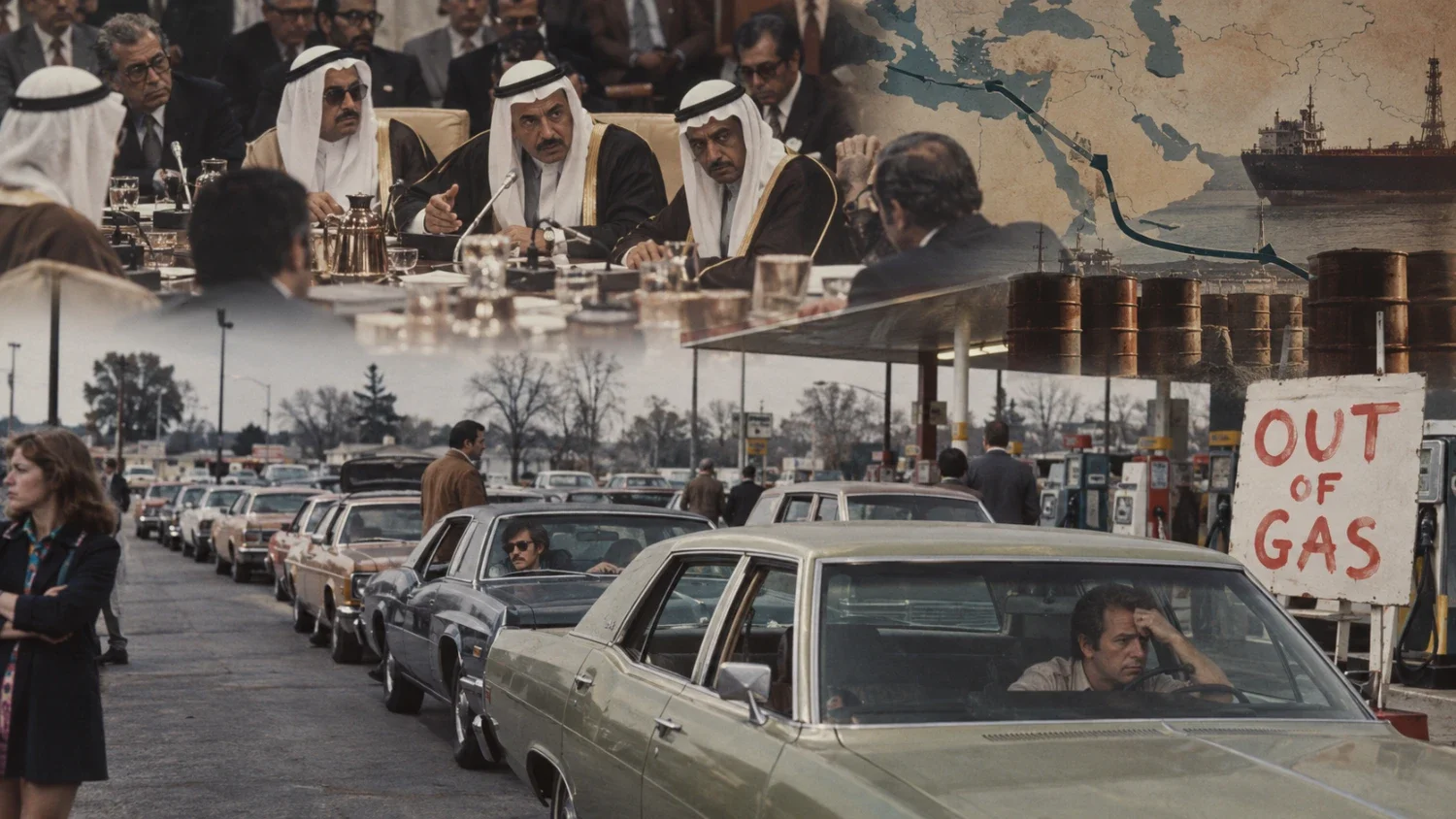
The first American oil crisis did not begin with a driver staring at an empty gas pump. It began with a decision taken on October 17, 1973, in Kuwait, as Arab oil ministers met during the Yom Kippur War. They announced monthly production cuts and tied their policy to Israel’s withdrawal from occupied territories and the restoration of Palestinian rights. Within days, the United States was added to an embargo. The distinction matters: the crisis was neither an overnight shutdown of all Arab oil nor a single act by every member of OPEC. It was a sequence of production reductions, selective export bans and price changes that exposed how vulnerable an oil-dependent economy had become.
A war, an airlift and an oil decision
On October 6, Egypt and Syria attacked Israeli positions on Yom Kippur, the Jewish Day of Atonement. The war drew in the United States and the Soviet Union, both of which supplied their partners. After Washington began a major airlift of military equipment to Israel, Arab oil producers used a commodity on which industrial economies relied as diplomatic pressure.
The organization central to the decision was the Organization of Arab Petroleum Exporting Countries, or OAPEC, not OPEC as a whole. On October 17, its members agreed to cut output by at least five percent each month, with additional reductions possible. A contemporaneous U.S. intelligence memorandum recorded the measure and its stated political conditions. The policy also differentiated among countries: states deemed friendly could receive relatively normal supplies, neutral states would face reductions, and governments considered supportive of Israel could be targeted.
The United States was not singled out in the public announcement on the first day. Saudi officials, however, were already discussing how to make the cuts effective against Washington. On October 19, Saudi Arabia announced an embargo on oil shipments to the United States. Other Arab producers followed with restrictions, while the Netherlands, Portugal and South Africa also faced measures. Government records show a shifting policy, not a switch that instantly stopped every tanker bound for America.
Why the shock travelled so fast
The embargo hit a market that was already changing. U.S. domestic production had plateaued, consumption had risen, and imports had become more important. In the years before the crisis, oil had seemed abundant and comparatively cheap. Many motorists and businesses had little reason to plan for a sustained interruption. As deliveries tightened, competition among buyers intensified and prices rose sharply.
The State Department’s historical account describes both export bans and production cuts as the mechanism. The political measure became a market shock because the cuts reduced available supply across borders, not only in the countries named by the embargo. Oil is traded through an international system: a restriction on one route can raise prices elsewhere as buyers compete for replacement barrels. The crisis therefore affected countries that had not been directly embargoed, including allies that had to manage their own supply and public anxiety.
In the United States, the effects appeared at service stations and in national policy. Motorists encountered queues, stations with limited hours or no fuel, and restrictions intended to conserve gasoline. The crisis also challenged assumptions that energy would remain cheap and plentiful. The Nixon administration urged conservation and proposed measures including a lower national speed limit and a return to daylight saving time on a year-round basis. Congress enacted emergency legislation permitting daylight saving time to begin in January 1974; the experiment was later curtailed after public complaints about dark winter mornings.
The response changed energy policy
The embargo ended in March 1974, after negotiations and diplomatic movement following the war. It did not erase the underlying dependence that had made the disruption consequential. The United States had to think about energy security as a matter of foreign policy, economic planning and infrastructure—not simply domestic production.
Congress responded with new rules. The Emergency Petroleum Allocation Act of 1973 authorized federal controls over the distribution and prices of petroleum products. In 1975, the Energy Policy and Conservation Act authorized creation of the Strategic Petroleum Reserve, a government stockpile intended to cushion a future supply interruption. The law also introduced fuel-economy standards for new cars. These measures did not make the country independent of world markets, but they institutionalized the idea that a disruption abroad could have immediate domestic consequences.
The crisis also accelerated changes that were already under discussion: conservation, smaller and more efficient cars, alternative energy research and coordination with other industrial countries. Some initiatives were temporary or politically unpopular. The broader shift lasted. Governments began treating oil supply as a strategic vulnerability and building tools to manage shortages rather than assuming markets would always deliver enough at a stable price.
What the embargo did—and did not—prove
It is tempting to remember 1973 as the moment producers “turned off the tap” and brought the West to a halt. The record is more complicated. OAPEC’s production cuts and country-specific embargoes were substantial, but supply continued, prices and trade patterns changed, and the impact varied by country. The embargo was an exercise of leverage during a war, not a total and permanent cutoff of petroleum to the industrial world.
Nor did the episode show that oil producers alone controlled every outcome. The United States’ vulnerability reflected its growing reliance on imports, rising demand and limited short-term alternatives. Producers could impose costs because consumers had little room to replace supply quickly. The political leverage lay in that imbalance.
The crisis ended as an embargo, but it did not return the energy landscape to its earlier appearance. It left Americans with a visible reminder that decisions made far from home could shape a morning commute, a heating bill and federal law. The lasting lesson was not simply that oil could be used as a weapon. It was that a country built around inexpensive fuel could discover, in a matter of weeks, how much its ordinary life depended on a global system it did not control.
Sources: U.S. Department of Energy: October 1973, the first energy crisis, U.S. State Department, Office of the Historian: Oil Embargo, 1973–1974, FRUS: CIA memorandum on the October 17 decision, FRUS: U.S. Embassy Riyadh report, October 17, U.S. Department of Energy: origins of the Strategic Petroleum Reserve