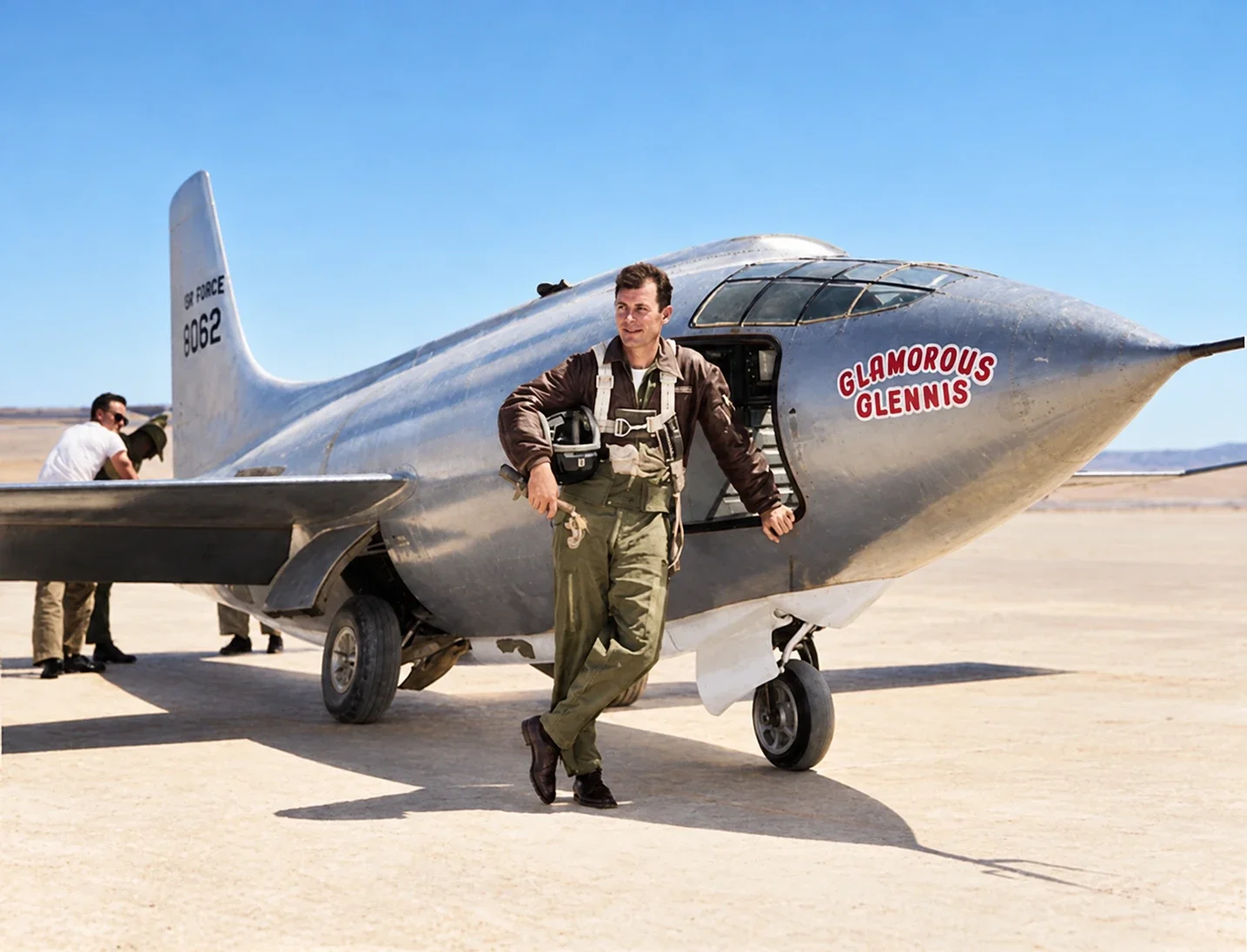
The Bell X-1 was small, orange and shaped more like a bullet than a conventional airplane. On October 14, 1947, it was carried beneath a B-29, released over the California desert and fired its rocket engine. At the controls was Air Force test pilot Chuck Yeager. The aircraft exceeded the speed of sound in level flight, a milestone that became one of aviation’s most famous dates. The familiar version makes it a duel between a fearless pilot and an invisible “sound barrier.” The records show a more revealing story: the result of a research program built to answer a technical question about how air behaves around fast-moving aircraft.
The word “barrier” came from a real engineering problem, even if the phrase suggested a wall in the sky. As aircraft approached the speed of sound, shock waves and changes in airflow could buffet control surfaces and threaten the aircraft’s stability. Pilots had reported severe jolts and loss of control in dives. Engineers needed reliable data from the transonic range—the speeds around Mach 1, where airflow changes rapidly. Wind tunnels helped, but tests on a full aircraft in flight could answer questions that models could not.
A plane designed for a question
The X-1 program joined the U.S. Army Air Forces, Bell Aircraft and the National Advisory Committee for Aeronautics, the research agency that preceded NASA. The Air Force funded the aircraft; Bell built it; the NACA instrumented and planned the test work. The X-1’s shape drew on a .50-caliber bullet, whose form remained stable at high speed. Its rocket engine used liquid oxygen and alcohol, giving it high thrust for a short flight. A B-29 bomber carried the aircraft to altitude, where the X-1 was released and its engine ignited.
This arrangement had practical consequences. The aircraft could accelerate beyond the speed a propeller plane could reach, but it had limited fuel and only minutes of powered flight. Its orange body was not a decorative choice: it made the experimental aircraft easier to see. Test pilots and engineers had to plan the sequence carefully, because the X-1 could not simply circle until a problem disappeared. The aim was to make a controlled measurement, not to stage a race.
Yeager was selected from a group of experienced pilots for his test-flying skill. He flew the aircraft named Glamorous Glennis, after his wife. NASA’s historical account records that he reached about Mach 1.06 at roughly 43,000 feet. The speed is often rounded to 700 miles per hour, but Mach number depends on local air conditions, especially temperature and altitude. Mach 1 is not one fixed speed in miles per hour everywhere. The important fact is that the X-1 crossed the local speed of sound in level flight.
The flight was a team achievement
The aircraft did not cross the threshold by itself. Researchers at the NACA had conducted wind-tunnel experiments on compressibility and high-speed flight. The Air Force supplied the test range and operational support. Bell’s engineers created a vehicle that could reach the transonic region. Yeager’s skill at the controls mattered, but so did instrumentation that measured the aircraft’s response and engineers who interpreted the data. The mission joined pilot judgment to laboratory work.
That collaboration is often compressed in popular memory. Yeager became the face of the achievement because one person had to occupy the cockpit, and his name was widely reported after the flight. Yet the X-1 project also demonstrated a postwar model of American aerospace research: the military set an operational need, industry built an experimental craft and a government research agency gathered scientific data. The arrangement would shape later experimental aircraft and NASA programs.
The “sound barrier” did not disappear that day. It became a solvable engineering region. Aircraft designers learned to manage shock waves through wing shape, control surfaces and structural changes. Supersonic flight became possible for military aircraft and, later, commercial jets such as Concorde. Crossing Mach 1 did not mean every aircraft could do it safely or economically. It opened a new range of research and design problems.
What the anniversary should remember
Yeager’s 1947 flight is sometimes told as a pure test of nerve, complete with stories about injuries, secrecy and the drama of the sonic boom. Some details come from later accounts and require attribution. The firmest historical center is less cinematic but more instructive: a planned test flight on a rocket-powered aircraft, equipped with research instruments, conducted by a pilot and supported by several institutions. NASA, the Air Force and the Smithsonian document the date, the aircraft and the program’s cooperative structure.
The sound barrier had also been crossed in other conditions before October 1947: bullets and artillery shells can travel faster than sound, and pilots had reached supersonic speeds in steep dives, though the measurements and conditions differed. The X-1 milestone was the first widely recognized piloted level flight above Mach 1. That qualification makes the claim more accurate and shows why the experiment mattered to aircraft design.
Nearly eight decades later, supersonic flight is again an engineering challenge, now shaped by noise, fuel use and regulation as much as raw speed. The X-1 story is not a simple promise that faster is always better. It is a case study in how technical barriers are reframed when researchers can measure what happens, design an instrument for the job and accept that a celebrated result rests on work done by a team.
The bright orange plane crossed a threshold, but not alone. Yeager’s flight became a public milestone because the aircraft, research program and pilot reached the same point at once. The history worth remembering is not only who flew it. It is how the country learned what would happen when an airplane moved faster than sound—and how that knowledge changed the machines that followed.
Sources: NASA: October 14, 1947, Smithsonian National Air and Space Museum: Chuck Yeager, NASA: X-1 research history, U.S. Air Force Historical Support Division, NASA: research and the sound barrier