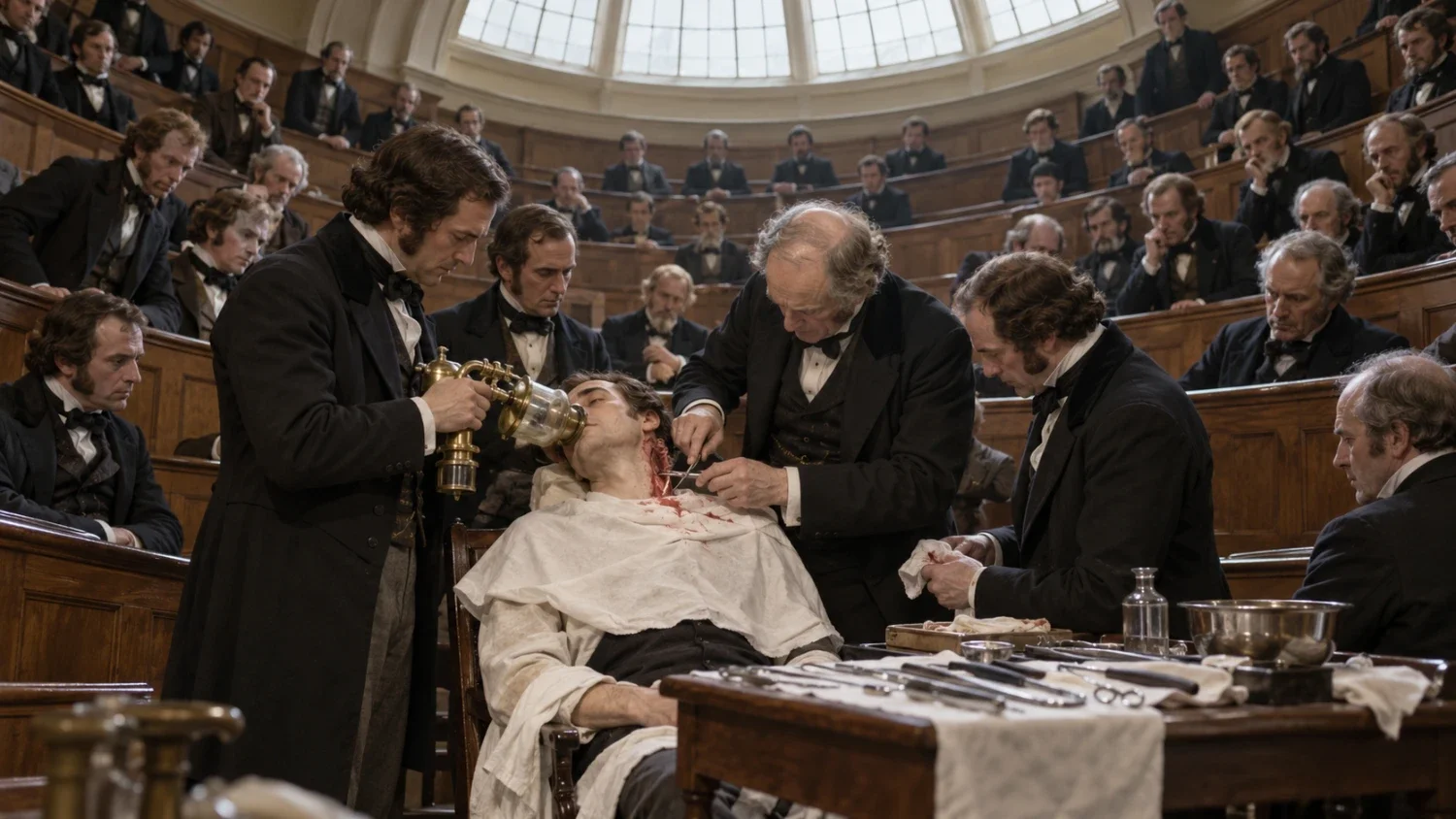
The patient remembered a scratching sensation in his neck. In the account preserved by the Massachusetts General Hospital's museum, he said the operation had not hurt. That report became part of a medical landmark. On October 16, 1846, dentist William T. G. Morton administered ether while surgeon John Collins Warren operated before observers in Boston. The patient was a young printer, Gilbert Abbott.
A demonstration, and a patient
The room later became known as the Ether Dome. It had been the hospital's operating theater since 1821. Today, 180 years after the demonstration, the familiar story invites a straightforward conclusion: pain had been defeated. Abbott's records require a more careful reading.
Anesthesiologist Paul G. Firth examined and reproduced those records in a 2022 study. Warren had attempted to tie off the blood supply to a congenital lesion beneath Abbott's jaw. Its size was unchanged when he left hospital on December 7. The celebrated operation had not cured the condition.
A retrospective account added to the file also describes movement and cries during the later part of the procedure, although Abbott subsequently reported no pain. Firth concludes that the general anesthesia was incomplete. This does not erase the demonstration's importance; it distinguishes a consequential experiment from the polished version commemorations can produce.
Before and after Boston
Ether's surgical history had already begun. Boston Children's Hospital's archive dates its known use as a general anesthetic in Georgia to 1842. The Massachusetts General museum also records dentist Horace Wells's work with nitrous oxide and an unsuccessful Boston demonstration in 1845. Morton entered a field shaped by other practitioners.
Publication helped give the Boston experiments their wider reach. Surgeon Henry Jacob Bigelow described the use of ether, and the news traveled beyond the hospital. Firth places Abbott's operation within a sequence of public procedures, rather than treating a single day as a complete and definitive proof.
The work beyond the anniversary
Making anesthesia useful for different patients remained a practical challenge. Boston Children's archive describes nurse anesthetist Betty Lank and engineer Geoffrey Dykes developing masks and blood-pressure cuffs sized for children and infants. Their equipment reached the market by 1940. The history continued through such adaptations, far from the famous demonstration.
Abbott belongs at the center of this anniversary: a person seeking treatment, rather than simply a name attached to an invention. Reading his file alongside the museum's account preserves both the importance of October 16 and the limits of what happened that day.
Sources: Russell Museum: the demonstration; Russell Museum: historical context; Boston Children's Hospital archive; Paul G. Firth: Ether Day Revisited, 2022.