The two letters that survived the first attempt were L and O. On the night of October 29, 1969, programmer Charley Kline at the University of California, Los Angeles, tried to log in to a computer at Stanford Research Institute in Menlo Park. Bill Duvall was waiting at the other end. They were testing a new network called ARPANET, and the remote machine failed before Kline could finish the command. About an hour later, they completed the login. The failed attempt has become the best-known episode in the network’s history; the work that made the second attempt possible deserves just as much attention.
Fifty-seven years on, the story is often compressed into the claim that the Internet began with “LO.” That is a useful anniversary image, but it needs two qualifications. ARPANET was a research network that would help lead to the Internet, not the global network we use today. And the surviving handwritten UCLA log does not spell out the two letters: its entry records that the team had talked to SRI “host to host.” The account of what was typed comes from the people who took part. The document and the memories illuminate different parts of the same event.
A test with a deadline
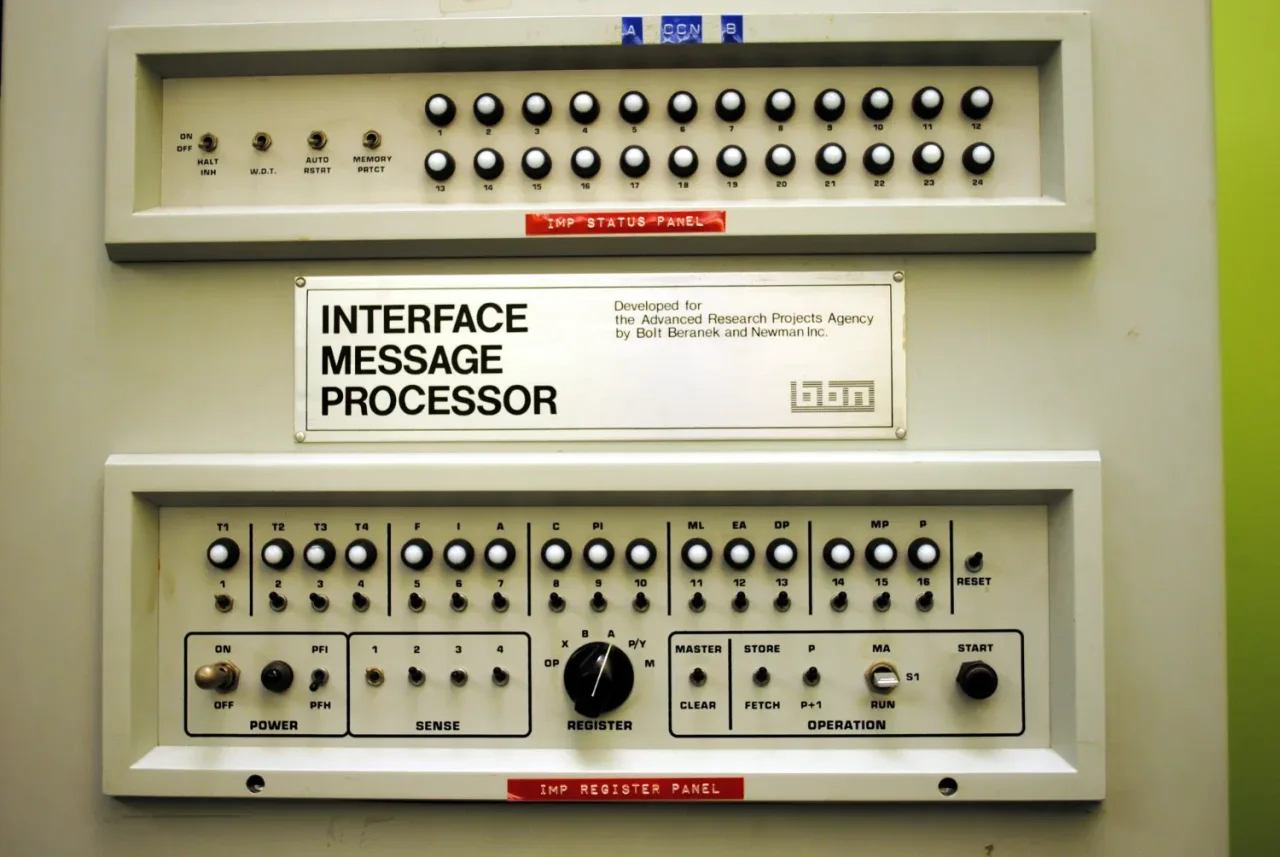
The United States Advanced Research Projects Agency, or ARPA, funded computing research at separate universities and laboratories. Its managers wanted researchers to use distant computers and share resources without needing a separate terminal connection to each machine. Bob Taylor championed the idea, Larry Roberts organized the network program, and a team at Bolt, Beranek and Newman, known as BBN, built the interface computers that linked the larger machines to the network. These devices were called Interface Message Processors, or IMPs: the early network’s traffic handlers.
UCLA received the first IMP in late August 1969 and connected it to its SDS Sigma 7 computer in early September. SRI received the second IMP in October and attached its SDS 940 host later that month. A line connected the sites, but a working line alone did not mean one computer could use the other. Each institution had to write software for its own machine and agree on how the machines would exchange information. An April 1969 memorandum by UCLA’s Steve Crocker, the first Request for Comments or RFC, laid out tentative proposals and open questions for that software. The network was being built through discussion as well as hardware.
In a later interview published by UCLA’s Internet50 project, Duvall recalled a deadline of October 31 for a remote login. The team arranged a test for October 29 at night, when fewer people needed the computers. He remembered the system as fragile and said he had been drawn into the SRI interface work because he knew both its protocols and its computer. Kline, who had written software at UCLA to connect its host to the IMP, recalled no special reason for choosing the date. They were ready to try, and so they did.
What happened to the third letter
At about 10:30 p.m. California time, Kline began entering the command. The two programmers had a telephone connection so they could confirm what reached SRI. L arrived. O arrived. When Kline typed G, the receiving computer failed. The first two characters were not a poetic greeting composed for history. They were the beginning of a practical login test. Leonard Kleinrock, who led UCLA’s network measurement center, later saw an apt “lo and behold” in them; that interpretation came after the event.
Duvall eventually gave a precise explanation for the crash. SRI’s computer could recognize the start of the command and send back the remaining letters automatically. Its initial specification allowed space for a one-character reply; when G triggered a longer completion, the reply exceeded that space. Duvall described it as a buffer overflow in his retrospective interview. The failure was in the host’s software, not proof that the long-distance link or the IMPs had failed. The team corrected the problem and made the full login roughly an hour later, according to Kleinrock’s account.
The log entry is modest: “Talked to SRI host to host.” It says nothing about a worldwide public service, and it does not preserve a dramatic transcript of the call. It does mark a transition. The UCLA computer had communicated with another host through a packet-switched network. In such a network, information is divided into small packets for transmission and reassembled at the destination. Crocker’s 1969 RFC described this division while its authors were still deciding how the host computers themselves should cooperate. On October 29, those plans were tested between two different machines.
More than two computers
The familiar photograph of a single log page can make the network seem like the work of two men. Kline and Duvall were indispensable to that test, but it depended on many others: the BBN engineers who made the IMPs, the ARPA managers who funded and organized the project, and the teams writing software at both ends. At SRI, Douglas Engelbart’s group hoped that networking could extend its work on interactive information systems. The institute was also to run a Network Information Center, a shared directory and source of documentation for the growing network.
UCLA and SRI were only the beginning. The University of California, Santa Barbara, joined in November and the University of Utah in December, completing the first four-node arrangement. The system still had to prove that it could serve researchers reliably. Other groups were also investigating computer networks, including Britain’s National Physical Laboratory. The Computer History Museum places ARPANET beside these contemporaneous efforts, while noting that its funding helped it grow beyond its early rivals. This was a crucial path toward the Internet, not the only experiment in connecting computers.
How a precursor became a network of networks
ARPANET later acquired services its first test could not offer. Network email appeared in the early 1970s. Researchers then worked out how to connect unlike networks, not just computers within one network. That work produced TCP/IP, the set of rules ARPANET adopted in 1983 and that remains fundamental to the Internet. The World Wide Web came later still. Calling the 1969 experiment “the first Internet message” is therefore shorthand: it recognizes a predecessor while folding decades of technical and institutional work into a single night.
The actual night was less tidy, and more revealing. A deadline pressed two programmers to test a fragile system after hours. A routine login failed, they found the error, and they tried again. Behind that small success were public funding, open technical proposals and cooperation among people whose machines did not naturally speak to one another. The two letters endured because the story is memorable. The achievement was that the conversation could continue.
Sources: https://www.lk.cs.ucla.edu/internet_first_words.html ; https://internethistory.org/internet50-highlights/ ; https://www.rfc-editor.org/info/rfc1/ ; https://www.computerhistory.org/internethistory/1960s/ ; https://www.computerhistory.org/timeline/networking-the-web/ ; https://www.internetsociety.org/news/press-releases/2013/new-years-day-marks-30th-anniversary-of-major-milestone-for-global-internet/