In 1977, Wangari Maathai, a lecturer at the University of Nairobi who had studied biological sciences and veterinary anatomy, helped found the Green Belt Movement under the National Council of Women of Kenya. Rural women had told the council that streams were drying, food supplies were shrinking, firewood was scarce, and the distances they walked for daily needs were growing. For Maathai, these were not isolated complaints but signals of a landscape under pressure.
A Rural Crisis Becomes a Mobilising Idea
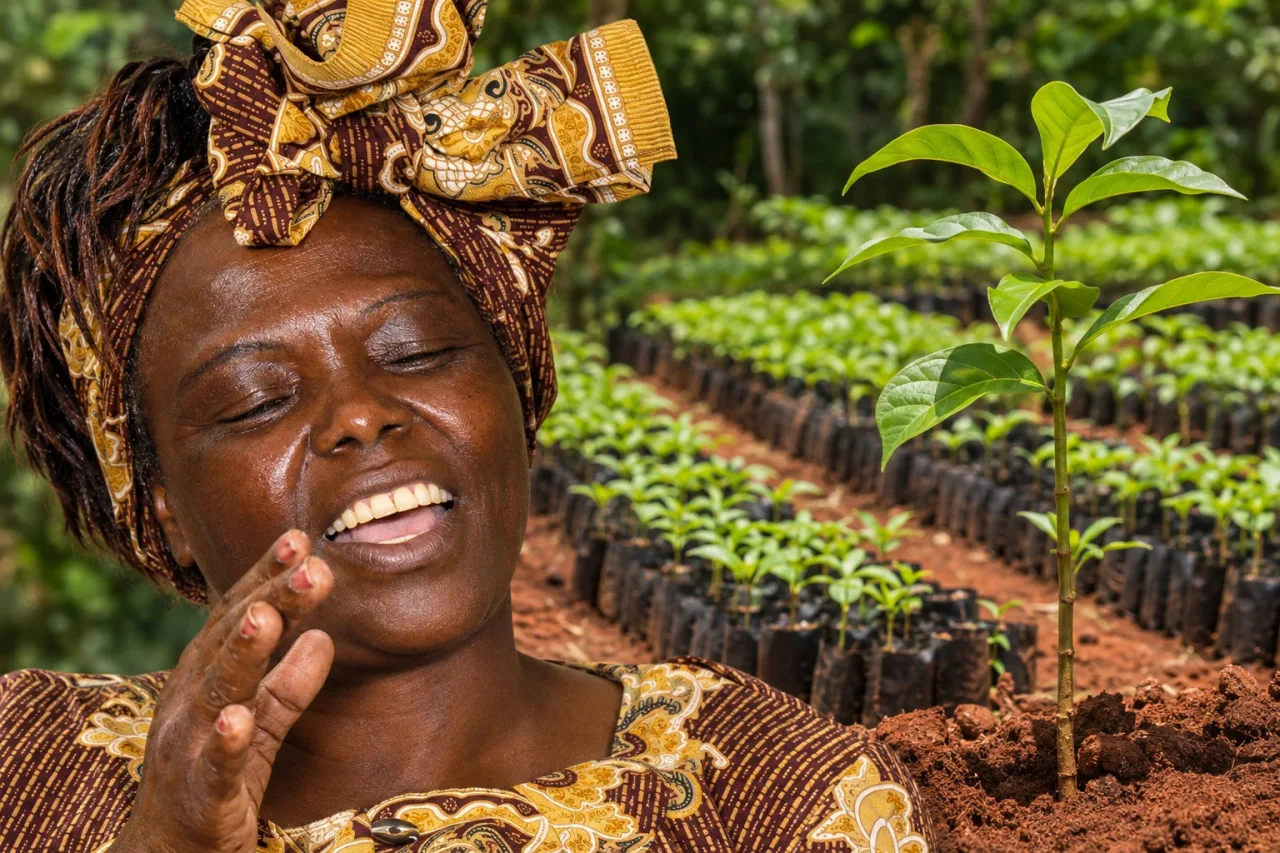
The movement began without grand promises. Maathai asked women to plant trees. Groups started nurseries, grew seedlings, and planted them on farms and public land. The groups received small payments for trees that survived. Over time the trees could help hold the soil in place and provide shade and fuel. This practical entry point mattered: it gave women an immediate stake in improving their surroundings and allowed the movement to grow from many small, local decisions rather than a central plan.
Maathai came to the project through a different working life. She trained in the biological sciences and taught veterinary anatomy at the University of Nairobi. In her Nobel lecture she put rural women’s accounts at the beginning of the story. The problems they reported had different names, from drinking water to cooking fuel, but trees could address several of them together. She found an environmental project in the practical business of supplying a household.
The use of indigenous trees reflected another set of choices. Local groups had to find seed, raise it and place the seedlings where they could survive. A nursery created work before any forest could be restored. It also gave women a way to participate at home or in their own communities, through tasks that could be learned and shared without a large plantation or a distant forestry office.
Seedlings as a Tool for Livelihood
A seedling might be inexpensive, but keeping one alive took time. Paying for trees that survived recognised the work that continued after planting. The women who ran the nurseries also had reason to pay attention to where seedlings were planted and how they were tended. In the longer term, the movement aimed to make local sources of firewood and other necessities more dependable. It linked the value of a tree to the household that could use it and to the people responsible for keeping it alive.
As the work spread, community education put individual problems in a wider setting. Through its seminars the Green Belt Movement asked participants to examine decisions about land and resources alongside changes they could see for themselves. A stream that was drying or a forest that had been cleared could lead to questions about who made decisions and whom they consulted. The movement put those questions to the people who lived with the result.
The movement could expand by working with groups already organized around their communities. It offered training while leaving much of the nursery work to local participants. That structure allowed people in different regions to respond to local conditions and kept women at the center of decisions about planting. It also made the program depend on people returning to the task after an individual planting day was over.
From Nurseries to Civic Action
The organizing learned around nurseries could also be used to defend existing public spaces. Maathai linked the loss of trees to decisions about who would control land. The Green Belt Movement’s own history records its opposition to land grabs and its defense of public land. These campaigns brought a different set of responsibilities to an organization already used to asking communities what they needed from their surroundings.
Uhuru Park in Nairobi became a public example. When development was proposed there, Maathai opposed it. The case put questions of public access and land allocation in a prominent place, close to the institutions that made such decisions. The fate of one city park offered a way for people far beyond a single nursery to see how the campaign cared about the use of land, as well as the trees that grew on it.
Maathai also supported calls for the release of political prisoners. The Green Belt Movement describes those efforts alongside campaigns to defend forests and public land. The work had broadened from what communities needed to grow, to what they needed to be able to say and do about the decisions affecting them. Maathai argued that good stewardship depended on room for people to participate.
Civic education gave the movement a way to work on both concerns. Community meetings could begin with visible shortages and explore the policies that helped create them. The movement’s workers asked participants to consider the decisions they could make themselves and the public decisions they had reason to question. Those conversations travelled with the planting program as it expanded.
Recognition and a Lasting Landscape
In 2004, the Norwegian Nobel Committee awarded the Nobel Peace Prize to Wangari Maathai, the first African woman to receive it. The committee cited her contribution to sustainable development, democracy and peace. By honouring an environmental activist, the prize acknowledged that the security of communities depends on the health of their land and on the participation of women in decisions about that land. The award brought global attention to a movement that had taken shape over almost three decades.
In her acceptance lecture, Maathai returned to women’s requests for clean water, food and firewood. She explained how planting offered a direct response to some of those needs and how the work exposed political problems that communities also had to address. By the time she spoke in Oslo, the connection between the two had become part of the international recognition of the movement.
The Green Belt Movement’s history describes how it continued after its founder’s death. Its work extends from conservation and community development to advocacy over land and governance. In practice, those activities rely on different skills. They have remained linked by groups that can raise trees in a nursery and speak about how a public forest or park ought to be cared for.
In 2004 the Nobel Committee put the scale of the work at around 30 million trees and noted that the methods had spread beyond Kenya. That estimate recognised the many people who had done the daily work, a necessary part of a story that often centers on one prominent figure. Maathai gave the movement a public voice. Its nurseries gave rural women a role that lasted well beyond a speech or an award.
The choices that gave the movement its form can still be followed from the first accounts of the search for firewood to the dispute over Uhuru Park. A tree could be raised by someone who had learned to grow it, protected by a community that used the land and defended through public action. The movement Wangari Maathai founded put those responsibilities in the hands of people who had to live with the result.
Sources: Green Belt Movement, organizational history, United Nations, Wangari Maathai, Norwegian Nobel Committee, 2004 award, Wangari Maathai’s Nobel lecture, video, Green Belt Movement, speeches and articles, Green Belt Movement, Taking Root documentary guide