A Record for the Ages
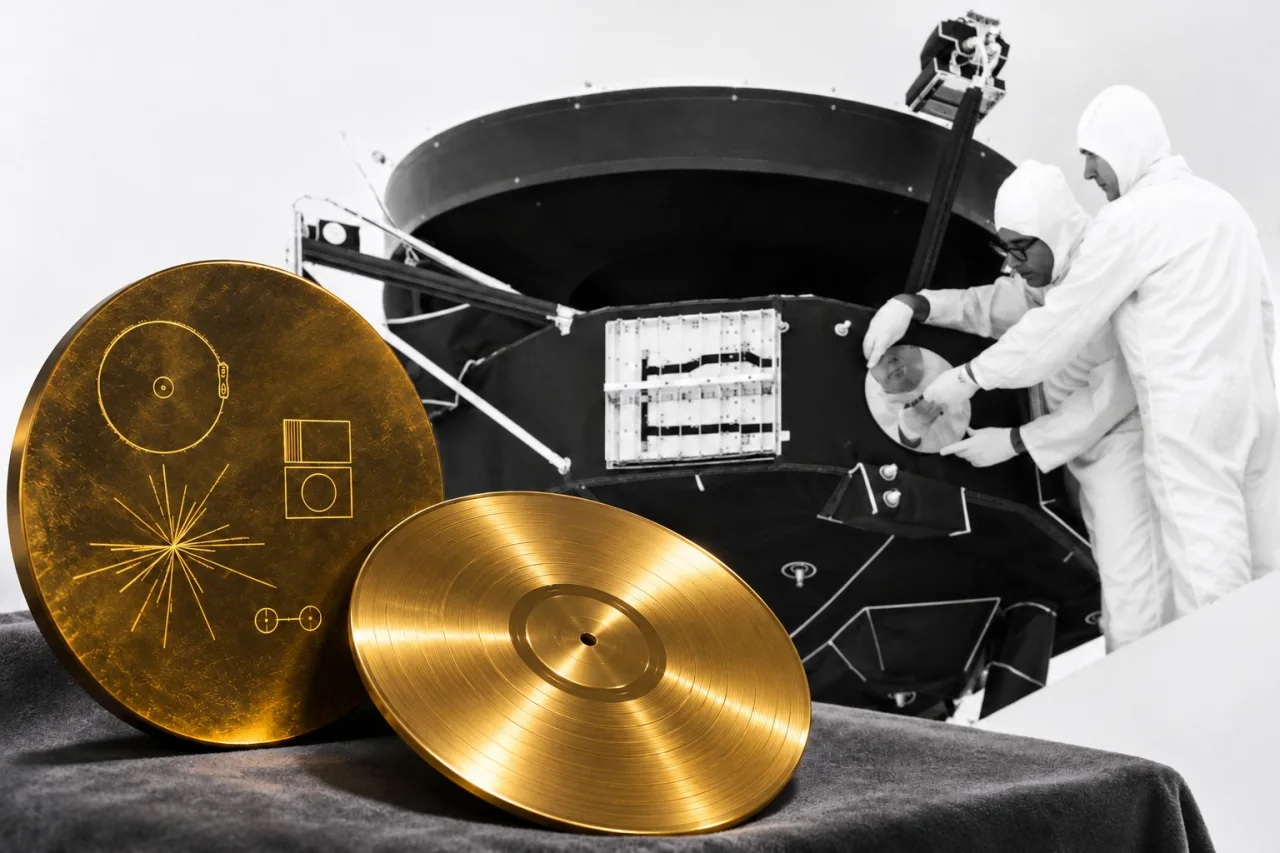
A 12-inch (30-centimetre) gold-plated copper record travelled on each of the two Voyager spacecraft launched in 1977. Each record was housed in a protective aluminum cover and came with a playback cartridge and needle. On Earth, the discs could be played using familiar technology. Anyone who found one in space would have to discover how its image signals and sounds were arranged. The first clues were drawn on the metal that protected it.
NASA asked a team chaired by astronomer Carl Sagan to decide what to put on the record. Frank Drake headed its technical work, Ann Druyan served as creative director, Timothy Ferris produced the record and Jon Lomberg was a designer. Linda Salzman organized the greetings. Making the object called for as much work deciding what a stranger might be able to understand as it did choosing sounds its makers liked.
NASA’s production history follows the object back through an Earthbound supply chain. A French firm supplied blank records. Lacquer masters were cut in Boulder, Colorado, and then sent to a processing center in Gardena, California, to make the metal discs. The discs were plated with gold on August 23, 1977, fitted in aluminum containers and delivered to the Jet Propulsion Laboratory. The flight record was a durable version of a medium people already used to listen to music at home.
Images and Words from Earth
The record carries 115 analog images encoded as a video signal. A finder must reconstruct them using the instructions on the cover, which explain the scanning pattern and the correct rotation speed. Among the chosen pictures are children with a globe, an astronaut in space, and diagrams of human anatomy. The images show buildings, landscapes, daily activities, and scientific instruments. Each image was selected to convey something about life on Earth without relying on written language. But the selection was necessarily limited by time and space.
The greetings followed the pictures in the program described by NASA. There were 55 languages. The catalogue lists Akkadian, spoken in ancient Mesopotamia, at the beginning and Wu, a language variety still spoken in China, at the end. The messages do not all say the same thing. Hearing them in sequence gives an impression of different voices addressing the same imagined recipient in their own words.
The package included printed messages from U.S. President Jimmy Carter and United Nations Secretary-General Kurt Waldheim. Their presence gave the undertaking an official voice alongside the images of daily life and the recorded greetings. The committee could choose very few representatives for a planet. The formal messages sat alongside voices and images that conveyed different kinds of experience.
NASA’s list of 115 images places scenes such as a fishing boat with its nets alongside diagrams of cells and cell division. It pairs scenes that ask the viewer to recognize a human activity with material meant to explain physical or biological information. Those are different tasks for a viewer. The recording scheme had to convey both an image’s detail and enough of its frame to make sense of the whole.
Sounds and Music Without Borders
After the greetings came sounds associated with Earth. NASA’s list includes wind, surf and thunder, birds and whales, and sounds made by people and their technology. A recording of a whale can be played without a human translation. A listener still has to work out what made the sound and how it belongs with the other sounds on the disc. The committee could supply a variety of examples without supplying the experience of having lived among them.
Music occupies about 90 minutes of the program. The recordings include Beethoven and Bach, the Georgian choral song Tchakrulo and Chuck Berry’s Johnny B. Goode. NASA’s inventory also lists music from Japan, India and Peru. These pieces vary in what produces the sound, in the number of performers and in the relationships between voices and instruments. The listener receives their sequence and duration as part of the message.
A book called Murmurs of Earth, published in 1978 by the members of the project team, described the record’s making. NASA’s catalogue preserves the names of performers and details of the recordings that can be followed on Earth. Inside a spacecraft the same collection becomes a physical object that a finder must start from the first groove, hundreds of separate choices held together by one recording medium.
The audio plays at 16⅔ revolutions per minute. The engineers could state that number to people on Earth, where minutes were a shared unit. Instead, the instructions on the cover gave the duration of a rotation in units defined by a transition in hydrogen. The choice gave a possible reader a reference drawn from physics, independent of time measured by any clock used by the record’s makers.
The Cover's Silent Instructions
The cover diagrams guide the finder from the stylus to the signal. A drawing shows where to put the stylus and where playback begins. The cluster of diagrams devoted to the pictures explains how to sweep a series of lines to reconstruct the image. A circle in the first image would give the viewer a way to check the reconstructed proportions. The drawings offered instructions for equipment the people making the record would never see.
Another diagram maps the Sun’s position relative to 14 pulsars. These objects emit pulses that can be timed, and their periods were encoded on the cover. If a reader could identify the pulsars, the map would offer a way to locate the system the spacecraft had left. Hydrogen supplies a time reference again. The record and its cover make use of the same idea in different ways: define a measurement with something a distant observer might also be able to find.
Being able to play the audio and being able to reconstruct the images are separate problems. The sounds are heard in the intended order if the stylus follows the grooves at the right speed. The pictures are analog signals. The finder needs to turn those signals into a regular series of lines with the intended timing. A speaker alone can make the signal audible while conveying none of the picture of a fishing boat or an instrument that the team put into it.
A message sent in pairs
The two spacecraft carried copies of the same selection. On Earth the list can be read as a record of decisions made by a particular team in 1977. The images, voices and music came through people and institutions that had access to one another within a short manufacturing schedule. The designers had enough space for a view of the planet, shaped by who could choose and what could be encoded on a record.
Long after launch, each record remains physically attached to its spacecraft. The object waits on the same sequence its makers planned: find the cover, read the symbols, set the stylus down and play the groove at the right speed. Then a listener could hear a voice speaking a language chosen in 1977 or rebuild a picture line by line. The NASA team left the means of doing that on a sheet of aluminum.
Sources: NASA, Golden Record contents, NASA, making of the Golden Record, NASA, image inventory, NASA, music and sounds inventory, NASA, decoding the cover