In the records of the Panama Canal, the same project appears under two payroll names. The gold roll carried mostly white Americans and Europeans. The silver roll included many Black workers recruited from the Caribbean, alongside people from Panama and other countries. The entries controlled more than what a worker was paid. They helped determine which quarters, schools and shops a family could use in the Canal Zone.
West Indians had travelled to Panama for work long before the United States took over construction in 1904. The Panama Railroad drew workers to the isthmus in the nineteenth century, and the French canal effort brought others. In the American period, Barbados was a major source of labor. The archives assembled in Panama, Jamaica, Barbados and Saint Lucia preserve evidence of recruitment and employment on both sides of the Caribbean.
Recruitment and the Caribbean Sea
The effort to cut a waterway between the oceans depended on people who had already crossed part of the Caribbean to reach it. On the isthmus, many West Indian employees worked in manual jobs. The construction sites required people to clear ground, handle spoil, move tracks and help keep equipment and crews working as the excavations advanced. Their jobs appear in personnel records that give a different view of the canal from a map of its locks and lakes.
The payroll labels could suggest a straightforward division by type of job. The archival record shows that employees of color could be teachers, clerks and supervisors and still be assigned to the silver roll. Skin color and citizenship also affected how the system was applied. A worker’s position could therefore be recorded in two ways, as a job called for by the canal and as a payroll category that determined conditions beyond the job.
One recommendation preserved in the National Archives gives the system a name and a workplace. The superintendent of schools recommended Alfred E. Osborne, a naturalized American and college graduate, for a post at La Boca. The recommendation explicitly put Osborne on the silver roll. His degree qualified him for a teaching job. The recommendation still assigned him to a payroll that carried fewer privileges. It establishes how officials proposed to hire him, without establishing whether he took up the post.
Cutting the Divide
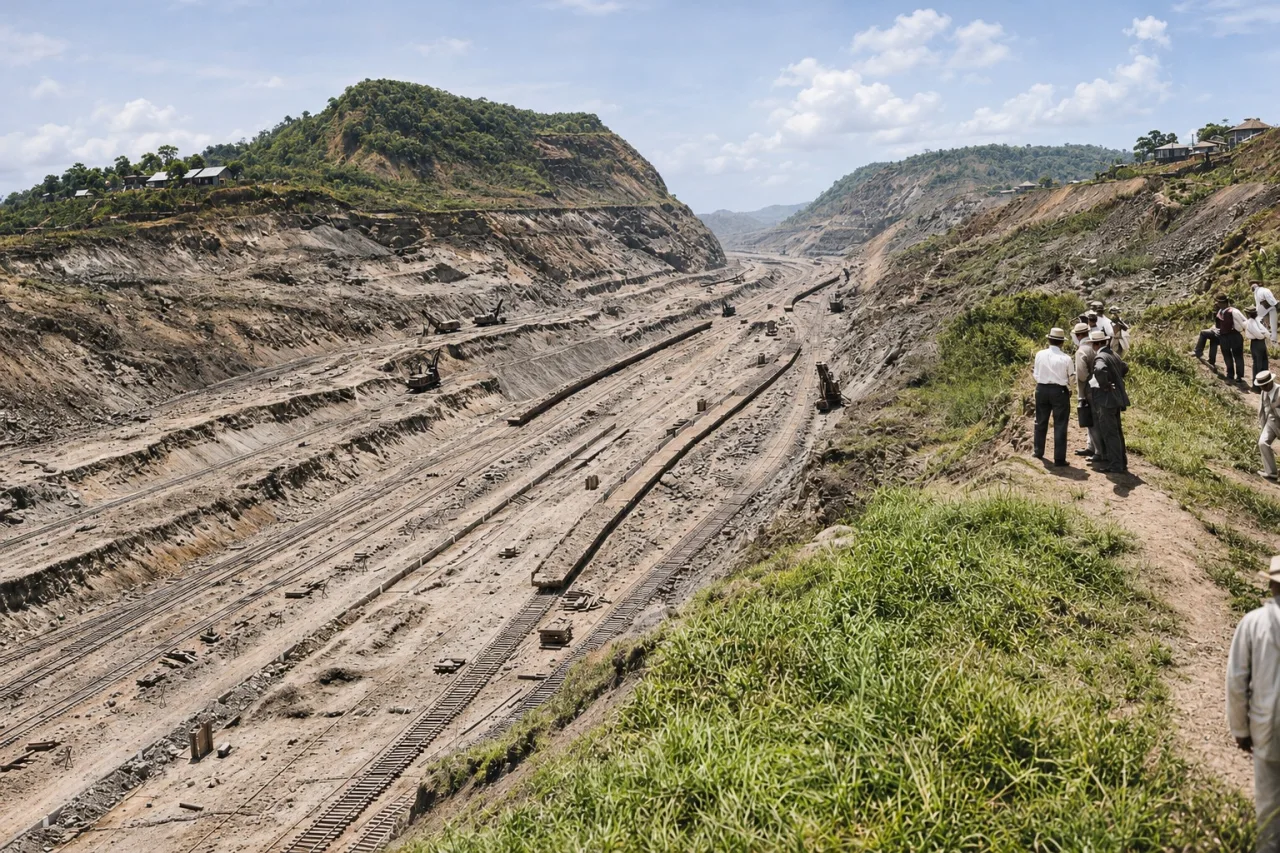
At Culebra Cut, the excavation ran across the Continental Divide. Steam shovels loaded rock and soil onto rail cars. Trains then took the material away so the shovels could keep cutting lower. The Panama Canal Authority’s construction history traces how the amount of excavation kept rising. An estimate of about 78 million cubic yards in 1908 had grown to roughly 100 million by 1913. The cut kept demanding labor after planners thought they knew its dimensions.
Each stage of the dig depended on tracks. They brought empty cars to the shovels and carried loaded cars away. As work moved and the bottom of the cut changed, those routes changed with it. The railways inside the excavation were part of its machinery, alongside the shovels. Photographs that show the equipment in place also show the human scale of the ground being moved.
Excavation took away some of the support for the cut’s steep banks. When sections of the sides moved into the excavation, the spoil that crews had cleared was joined by fresh material. The Panama Canal Authority identifies two of the most serious slides on opposite sides of the cut, near Gold Hill and in front of Culebra village. Each episode added work to a project whose timetable depended on getting trains through the cut.
The work also generated a permanent administrative record. The National Archives points to employee records and other series that can help trace individual West Indian workers. The surviving documents name people who otherwise appear only as distant figures in construction photographs. A payroll entry or employment record can connect a person to one of the jobs that made work in the cut possible.
Separate Lives on the Isthmus
The two rolls reached into everyday life. Quarters, commissaries, schools and clubhouses were divided. The distinction persisted even when the kind of currency in an employee’s hands no longer explained the payroll label. The National Archives records a stage at which both groups were paid in U.S. currency. The separation could remain intact at a store counter or in a school assignment even after that common change in pay.
A 1906 memorandum directed that Black employees paid by the hour on the gold roll be moved to the silver hourly basis. Protests about the treatment of Black Americans prompted some exceptions and special arrangements. The records show the same tangle in less formal encounters, such as complaints from workers who were turned away or treated differently in a commissary. Race, citizenship and payroll status could all be brought to bear on a purchase.
Canal authorities applied their divisions even in encounters with people outside the workforce. Archival correspondence records complaints involving West Indian and other residents at post offices. An employee’s workplace was only one part of the system. As the canal attracted migrants and their families, the rules of the Zone shaped where people could buy goods, send mail and find schooling for their children.
Opening and the Archive
On August 15, 1914, the steamship Ancon made the first official transit of the completed canal. The ceremony was modest, overshadowed by the outbreak of the First World War in Europe. The completion of the canal marked the end of a decade of intensive labor, though the contributions of West Indian workers remained largely outside the official narrative of that day.
The West Indian presence in Panama continued after the opening. The papers made during recruitment and construction now have a second use. Families and historians consult them to trace people across the islands and the isthmus. Many of the archival institutions that preserve them are in the places those workers came from, as well as in Panama and the United States.
In 2011, UNESCO registered The Silver Men, a documentary collection about West Indian labor on the canal. Archivists and museums from several countries nominated the material. The collection includes images as well as written records, and its span reaches back to the French era. Bringing those records together makes it possible to follow the work across changes of employer and government.
From the deck of the Ancon, Culebra Cut was finally part of a navigable route on August 15, 1914. In the archives, the same cut appears as a job done in stages, with rails to move and slides to clear. The records preserved across the Caribbean keep that work attached to the people who came to do it.
Sources: UNESCO Memory of the World Register, U.S. National Archives and Records Administration, Rediscovering Black History blog, Panama Canal Authority, Panama Canal Authority