A declaration printed, not signed
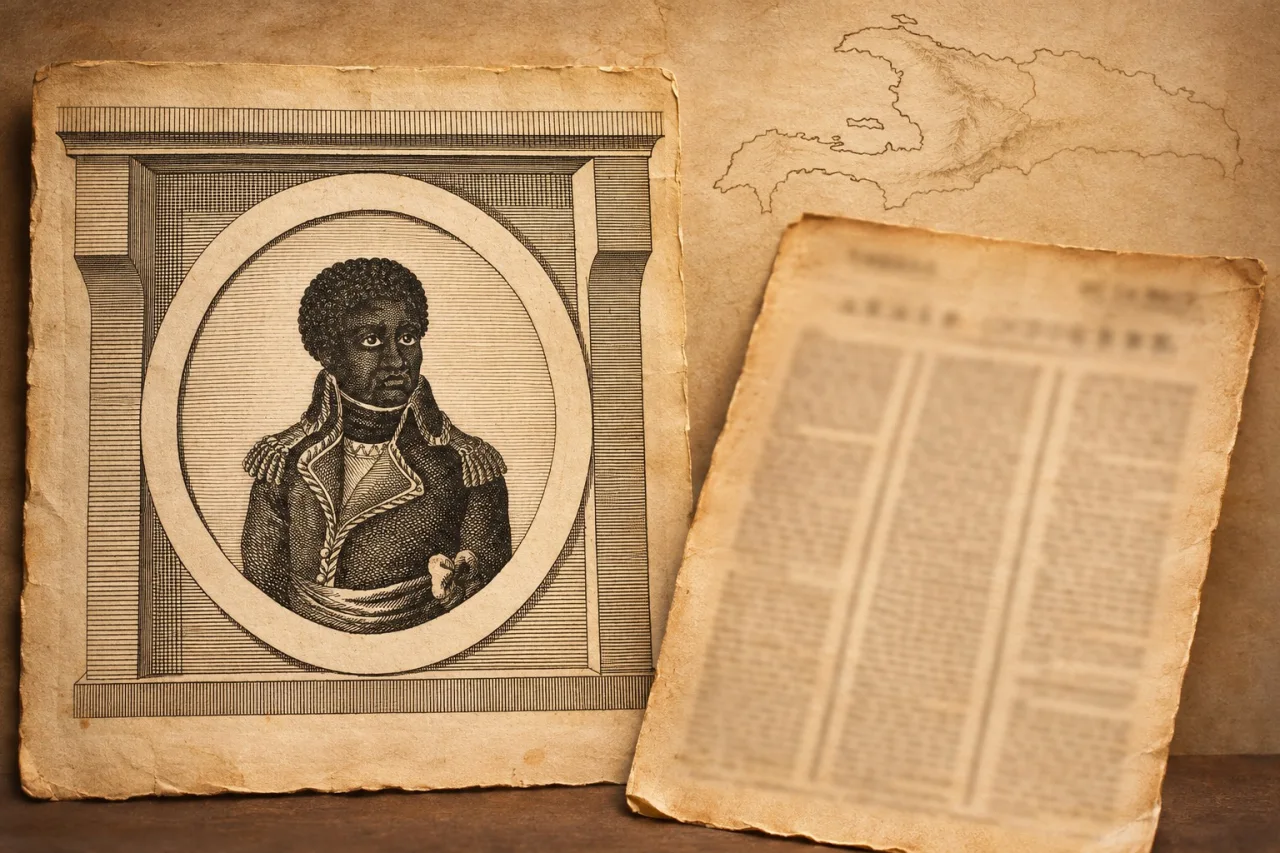
On 1 January 1804, after more than a decade of uprising and war in the French colony of Saint-Domingue, Jean-Jacques Dessalines and his generals assembled at Gonaïves to proclaim the independence of Haiti. The text they approved was not left as a handwritten parchment awaiting signatures. Instead, within weeks, it was set in type and printed as an eight-page government pamphlet, the official imprint of a new state. This modest printed object, rather than a signed original, became the authoritative form that circulated beyond the island.
The document had three distinct sections. The first recorded the generals’ oath to break with France forever. The second was an address to the people of Haiti, asserting independence and condemning the French colonial order from which they had freed themselves. A separate third section designated Dessalines as governor-general for life. Prominent military leaders such as Henri Christophe and Alexandre Pétion were among the signatories to the central act, but no handwritten signed original is known to survive.
Haiti’s independence emerged from a long and violent struggle. The uprising against slavery began in 1791 and transformed the colony; by November 1803, French forces had agreed to evacuate after a series of military defeats. The proclamation at Gonaïves formalized the break that victory had made possible. The declaration addressed both the people of the new nation and outside observers, making clear that Haiti would no longer accept foreign domination or the restoration of colonial rule.
Because the declaration was printed promptly and in official form, it could be distributed to inform other governments and commercial partners. Yet for generations, no contemporary printed copy was known to survive in Haiti or anywhere else. Historians relied on transcriptions and later reprints, uncertain whether an official imprint still existed. This archival absence created a peculiar situation: the clearest material trace of the founding act would eventually be found not in Port-au-Prince but in the records of a former colonial rival.
The route through Jamaica to London
The journey of the pamphlet to British archives began almost immediately. A British agent named Edward Corbet was in the Caribbean observing political changes after the French withdrawal. He obtained a copy of the newly printed declaration and carried it to Jamaica, a British colony directly affected by the turmoil in Haiti. Jamaica’s lieutenant-governor, George Nugent, received the pamphlet from Corbet and forwarded it with his own correspondence to the Colonial Office in London.
Nugent’s decision to send the document was part of routine intelligence-gathering rather than a pledge of diplomatic support. British officials were preoccupied with trade and the security of neighboring colonies. The receipt of the declaration did not amount to formal recognition of Haiti’s independence. It was filed among dispatches, reports, and memoranda, becoming one item in a larger record of imperial administration.
The file containing the pamphlet moved through the British colonial bureaucracy and eventually entered what is now The National Archives of the United Kingdom. There it remained among Jamaican colonial correspondence for more than two centuries before being identified. Within the collection it sat among records about British colonial affairs. The dispatch that accompanied it was part of the story of how it had travelled and also a clue to finding it.
In 2010, Julia Gaffield, then a doctoral student at Duke University, was working on a dissertation about early independent Haiti’s diplomatic and trade relations. She had been tracing references to the declaration in British and other archives, looking for the official text that had been cited so often. While examining correspondence sent from Jamaica to London, she came upon the printed pamphlet. Its location with Nugent’s dispatches confirmed the route from Gonaïves to Jamaica and then to London.
Searching for a Haitian original
The 2010 discovery attracted attention because no other contemporaneous printed copy of the declaration was known to scholars. Earlier efforts had been made to locate such a document. In 1952, as Haiti prepared for the 150th anniversary of independence in 1954, the historian Edmond Mangonès was asked to find an original for display. He searched without finding one. His failure to find an original helped cement the belief that the declaration might survive only in later transcriptions or newspaper excerpts. The appearance of the pamphlet therefore revised the scholarly record.
The found pamphlet was not the only printed form of the declaration made in early 1804. A year after Gaffield’s first discovery, Duke University reported that she had identified a second example: a single-sheet broadside, dated January 1804 in its archival record, that contained the text of the declaration in a different format. This broadside was distinct from the eight-page pamphlet, suggesting that the new Haitian government had produced multiple printings for distribution. Its date refers to the declaration itself and its form reflects the practical choices made in distributing the text.
The survival of two printed versions, both outside Haiti, tells part of the story of how the new state communicated with the outside world. The pamphlet and the broadside served different formats for official distribution. A manuscript with the original signatures has yet to be identified. The two printings show the text as it was presented to early readers. The printed texts, however, were official and circulated at the moment of independence, making them crucial primary sources.
The Jamaican route explains only one of these printings. The broadside was later found among other British papers, but its particular route into those records is less fully detailed in public accounts. What is clear is that British agents and colonial officials collected printed material from revolutionary Haiti as part of their assessment of events. The declaration was not simply a ceremonial announcement; it was a piece of political communication that foreign powers believed they needed to read and archive.
Archives, recognition, and public access
The presence of the declaration in British records should not be mistaken for British endorsement of Haiti’s independence. Officials in London and Jamaica recognized the declaration as an event that would affect their interests, but they did not extend diplomatic recognition to the new government. Recognition was a separate political act, and it did not follow from the receipt of the printed declaration. The archival journey therefore reflects surveillance and information management more than friendship or alliance.
For Haitians, the declaration was addressed first to the people of the new nation, affirming their freedom and their resolve to defend it. Its text condemned the French colonial regime and framed independence as a necessary rupture. The copy that crossed to Jamaica reached administrators who were weighing trade and security in the Caribbean. Its place in their official correspondence shows how they received news of the new government. The same document thus carried different meanings depending on the reader’s position.
The rediscovery by Gaffield changed the public and scholarly relationship to the declaration. Before 2010, scholars had access to transcriptions but could not examine the original printed object that had been handled by British officials in 1804. After the discovery, the pamphlet was digitized and made available online, together with a transcription and translation, allowing readers anywhere to consult the text. The broadside’s subsequent identification expanded the material record of the founding document.
Today, the declaration of Haiti’s independence is no longer confined to a single colonial file. Both the eight-page pamphlet and the broadside are publicly accessible through digital facsimiles, and the documentary trail from Gonaïves to Jamaica to London can be followed in detail. The documents can be read together today. The pamphlet moves through the act, address and appointment across several pages. The broadside presents the declaration on a single sheet. Each preserves a choice made by the first government of Haiti about how its break with France would reach readers.
Sources: Facsimile of the eight-page pamphlet, Official printings, transcription and translation, Duke University, discovery of the pamphlet, Duke University, discovery of the broadside, David Armitage and Julia Gaffield, scholarly study