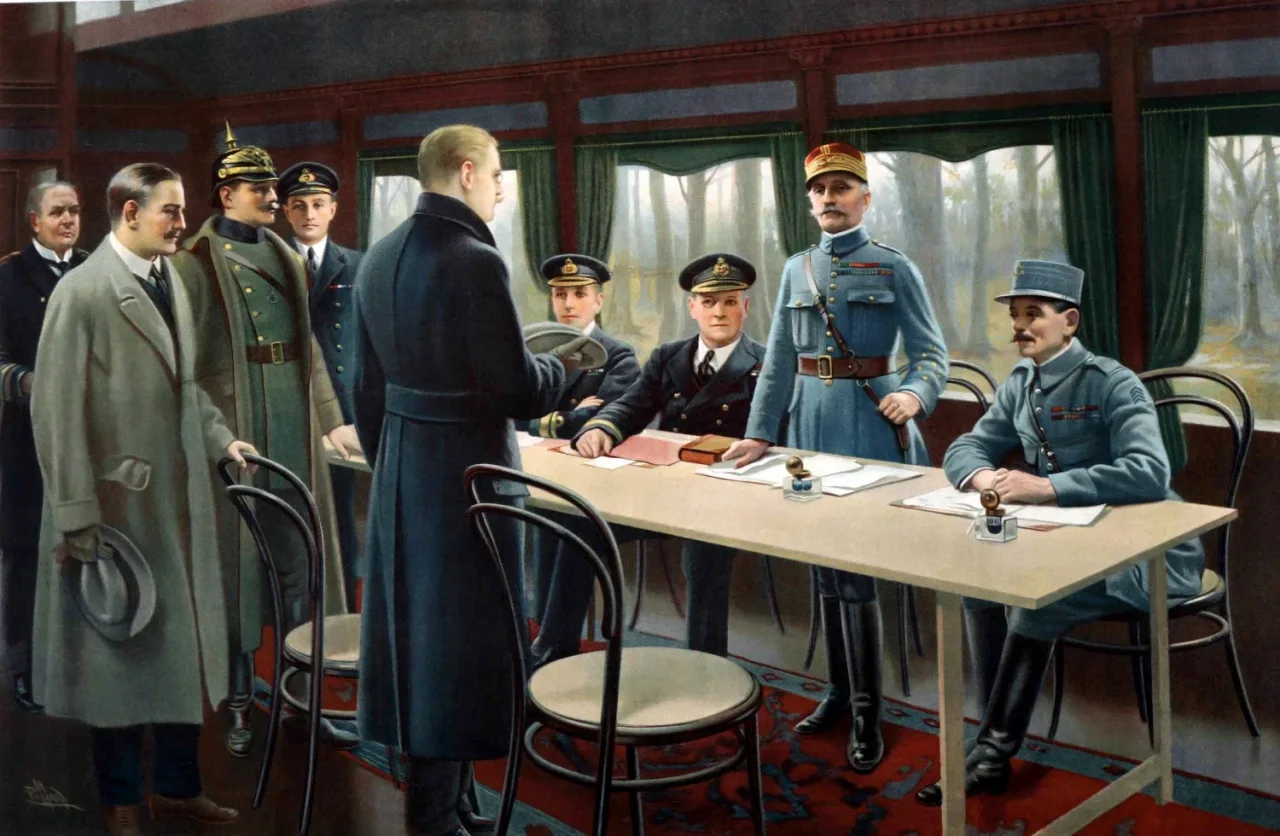
The document was signed at five in the morning. The guns were to stop at eleven. On November 11, 1918, the six hours between those two times belonged to both the war and its promised end. Allied and German representatives had agreed to an armistice in a railway carriage in the Forest of Compiègne, northeast of Paris. Soldiers on the Western Front still had to receive the order, survive the morning and wait for it to take effect.
The familiar phrase “the eleventh hour of the eleventh day of the eleventh month” describes the ceasefire, not the signing. That distinction mattered to the people still under fire. The agreement’s first clause stipulated a halt to fighting on land and in the air six hours after the signatures. It was a military timetable, written while a vast front remained active.
A carriage and a clock
Marshal Ferdinand Foch led the Allied delegation, accompanied by British Admiral Rosslyn Wemyss. Matthias Erzberger headed the German delegation. The German government had sought an armistice as its military position collapsed and political upheaval overtook the empire. Kaiser Wilhelm II had abdicated. Other Central Powers had already agreed to separate armistices, but Germany’s army still faced the Allies across the Western Front. The agreement signed that morning was designed to prevent a resumption of that fight.
Its terms extended well beyond a time to stop shooting. German forces had to leave occupied Belgium, France, Luxembourg and Alsace-Lorraine, the territory Germany had annexed after the 1870–71 Franco-Prussian War. Allied and American forces would occupy positions along the Rhine. Germany was to hand over weapons, aircraft, submarines and railway equipment. The existing Allied blockade remained in place, although the text contemplated provisions for Germany. The armistice was set for 36 days, with the possibility of extension. It was a suspension of hostilities under conditions, not a final peace treaty.
News moved faster in some places than certainty. Four days earlier, an erroneous report had said the armistice had already been signed. Newspapers printed the false claim, and crowds in American cities celebrated prematurely. The Library of Congress preserves those papers alongside editions that announced the real agreement on November 11. For readers at home, the difference between rumor and confirmation had become part of the war’s final week.
The morning that remained
Robert Casey, an American artilleryman whose account is preserved by the National WWI Museum and Memorial, wrote while the end was still hours away. He registered neither a simple triumph nor immediate relief: after months living under the guns, he found the prospect of quiet difficult to believe. His testimony puts a human scale on the interval established by the negotiators. An order could fix the hour of a ceasefire; it could not instantly change what four years of fighting had done to those waiting for it.
People died in that interval. The UK Parliament identifies Private George Edwin Ellison, killed at about 9:30 a.m., as a man believed to be the last British soldier killed in the war. It also records the death of American soldier Henry Gunther at 10:59 a.m. Such labels as “the last” depend on surviving records and on how the war’s different fronts are counted. The firmer point is that the agreement did not save everyone who was still alive at five o’clock.
A U.S. Army history estimates roughly 11,000 casualties on all sides on the last day of fighting. That figure includes people wounded as well as those killed; it is an estimate, not a count of deaths in the six hours after the signing. It shows why the armistice cannot be reduced to the instant the guns fell silent. For many families, November 11 brought news of an end to combat alongside news of a death or an injury that had come too late to prevent.
News at home
In Britain, former member of Parliament Roland Whitehead noted in his diary that the armistice had been signed at five. His short entry reflected the news as it reached him, while the ceasefire still lay ahead. In Kansas City, Nannie Howard wrote to her brother the following day that whistles and other noise had awakened people in the early morning with news of Germany’s surrender. Her letter looked beyond the announcement to the uncertain date when he might return. The distance between a public celebration and a private reunion remained open.
Newspapers made the moment visible to people far from the front. The Library of Congress records headlines announcing the signed armistice, President Woodrow Wilson’s statement and the cancellation of draft calls. Yet the same newspapers continued to carry names of the dead. Their pages show why jubilation and mourning could occupy the same day. Millions had been killed during the war, and those still serving, imprisoned, displaced or sick were not suddenly home at eleven.
An end that took longer
The agreement was renewed as governments negotiated a settlement. The Treaty of Versailles was signed on June 28, 1919. Even then, the end of fighting on the Western Front did not mean that violence ceased everywhere: the collapse of empires and disputes over borders fed further conflicts. The influenza pandemic also continued beyond the armistice. Calling November 11 the end of the First World War captures a decisive military change, but it compresses a far longer and less orderly aftermath.
Each November 11, commemorations return to an exact hour. The surviving agreement, diaries, letters and newspapers invite a fuller remembrance. The signatures at five, the fighting before eleven and the mixed news afterward were parts of the same day. For those who lived through it, silence on the Western Front was real and momentous. So were the losses and uncertainties that remained when it arrived.
Sources: https://history.state.gov/historicaldocuments/frus1919Parisv02/d1 ; https://www.theworldwar.org/learn/about-wwi/nov-11-1918 ; https://www.parliament.uk/about/living-heritage/transformingsociety/private-lives/yourcountry/collections/1918-armistice-memorial/whitehead-diary-1918/ ; https://guides.loc.gov/chronicling-america-wwi-armistice ; https://blogs.loc.gov/headlinesandheroes/2018/11/reporting-the-great-war/ ; https://history.army.mil/Portals/143/Images/Publications/ArmyHistoryMag/pdf/20102019/AH111%28W%29.pdf?ver=vP9kvjHUMX_JScaeoP_-jg%3D%3D