The broadcast began by naming its author, its performers and its title. Then a weather forecast gave way to dance music from a hotel ballroom. Only after listeners had settled into that ordinary radio evening did an announcer interrupt with news of strange flashes on Mars. On October 30, 1938, Orson Welles and the Mercury Theatre on the Air turned H. G. Wells’s The War of the Worlds into a drama that sounded, for stretches, like a developing emergency. Eighty-eight years later, the production is still remembered for a supposed national panic. The surviving broadcast and the letters it prompted tell a more interesting, less uniform story.
Some listeners were frightened. Others admired the acting, disliked the deception or understood from the start that they were hearing fiction. The point is not to deny anyone’s alarm. It is to ask how a radio play made a Martian invasion seem plausible to part of its audience, and how reports about that audience became nearly as famous as the performance itself.
A novel relocated to New Jersey
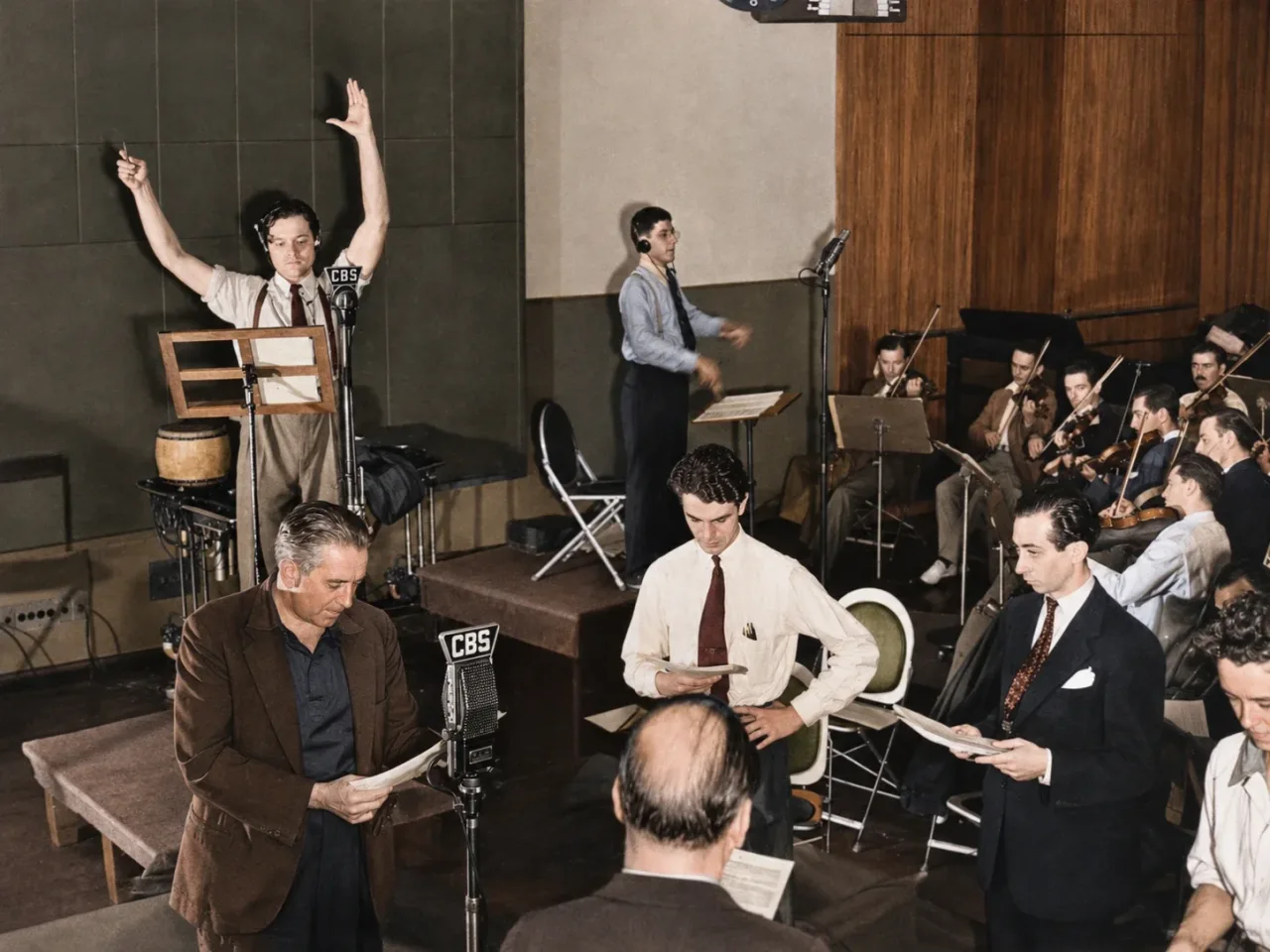
Wells published his novel in 1898 and set the invasion in England. Its advanced Martian weapons turned the power of an imperial nation against it, giving the adventure a political edge. For the American broadcast, writer Howard Koch moved the action to New Jersey, with a spacecraft falling near the real village of Grovers Mill. Welles directed and played Professor Richard Pierson; John Houseman produced alongside him. The adaptation was a collaboration among writers, actors, producers and sound technicians, rather than a feat of one voice at a microphone.
The program did not conceal its identity at the beginning. CBS introduced it as a Mercury Theatre adaptation of Wells’s novel. Yet that opening mattered only to those who heard it. A listener arriving later could encounter an apparently routine orchestra broadcast interrupted by increasingly urgent bulletins. The script placed fabricated reports from observatories beside interviews, field transmissions and official-sounding statements. Each returned briefly to the familiar before the next interruption advanced the fictional crisis. The invented news format made the fantastic premise seem to acquire evidence in real time.
Koch’s script shows the mechanism. At first, astronomers discuss explosions on Mars. Then a supposed meteorite lands near Grovers Mill, where reporter Carl Phillips describes the opening cylinder and the creature inside it. Phillips’s transmission breaks down as the Martians attack. Later reports move through New Jersey toward New York City; a rooftop announcer describes the city’s threatened evacuation before his own voice disappears. The broadcast had begun with a book’s premise, but its first long movement borrowed the changing locations, interrupted signals and uncertain information of live radio news.
Forty minutes without the usual pause
The pace was carefully worked out, even though the production came together under pressure. Historian A. Brad Schwartz, who examined drafts and correspondence, describes how Koch, Houseman, actor Paul Stewart and Welles revised the script. The news-like opening expanded; conventional dramatic scenes receded. Welles slowed the early musical passages so that the later reports could accelerate. The result was not continuous shouting. Quiet stretches made each interruption more consequential, while sound effects and actors’ voices supplied details a camera could not show.
The first clear announcement after the opening that the audience was hearing a CBS dramatization came near the two-thirds mark, following the supposed collapse of New York’s communications. Schwartz notes that listeners accustomed to a station identification at the half-hour did not receive the expected reminder. That gap did not erase the original introduction, and the closing also identified the work as fiction. But it increased the chance that someone tuning in late, or leaving the radio on while doing something else, would hear the most convincing portion without its frame.
The second part changes form. Pierson, apparently a survivor, recounts his wandering after the attack. In both the novel and the adaptation, the invaders ultimately die because they lack resistance to earthly microorganisms. The shift from bulletins to a survivor’s account reveals the story as crafted drama when heard whole. It also shows why the widely repeated claim that the entire hour impersonated a real newscast is inaccurate. The performance experimented with the authority of news, but it did not remain inside that disguise from beginning to end.
The audience was not one crowd
The following day, newspapers gave the confusion dramatic prominence. Yet the scale of a nationwide panic is difficult to establish. The Library of Congress cites a contemporary telephone survey of about 5,000 households in which only a small share were listening to the Mercury program, and many listeners recognized it as fiction. That survey does not tell us what every household experienced, nor does it make a frightened listener imaginary. It does challenge the simple picture of a whole country rushing into the streets.
More than 1,300 letters sent in response to the broadcast are now digitized by the University of Michigan Library. Historian Schwartz studied the collection and found evidence of fear, but also many other reactions. The letters are not a scientific sample of all listeners: people who chose to write to a broadcaster were already a selected group. Their value lies in the variety they preserve. They let us see responses that a single alarming headline could not contain, from anger to delight and praise for the craft of the show.
What remains of that night
There was a genuine collision between two kinds of credibility. The Mercury company used radio’s familiar voices, pauses and interruptions to make fiction immediate. Newspapers then used the resulting confusion to narrate the danger of believing radio. Some commentators have suggested that competition between the media encouraged the most sweeping accounts, but motive cannot be established from the headlines alone. The evidence supports a narrower conclusion: the broadcast upset some listeners, while the legend of universal panic outran what the surviving record can demonstrate.
The original recording is preserved in Indiana University’s Orson Welles collection, and the script can still be read. Returning to those sources makes the anniversary less a lesson about a gullible past than a chance to hear a group of artists testing what their medium could do. The uncertain reports in the play were invented; the human responses afterward were not. Understanding both requires attention to the words that identified the drama, the voices that made it convincing and the records that complicate its legend.
Sources: https://orsonwelles.indiana.edu/items/show/1972 ; https://shop.concordtheatricals.com/api/v1/product/document/126004 ; https://wellesnet.com/the-war-of-the-worlds-radio-script/ ; https://blogs.loc.gov/loc/2016/10/lcm-page-from-the-past-war-of-the-worlds/ ; https://lib-umich-edu.workshop.dnd.lib.umich.edu/about-us/news/revisit-war-worlds ; https://www.smithsonianmag.com/history/infamous-war-worlds-radio-broadcast-was-magnificent-fluke-180955180/