
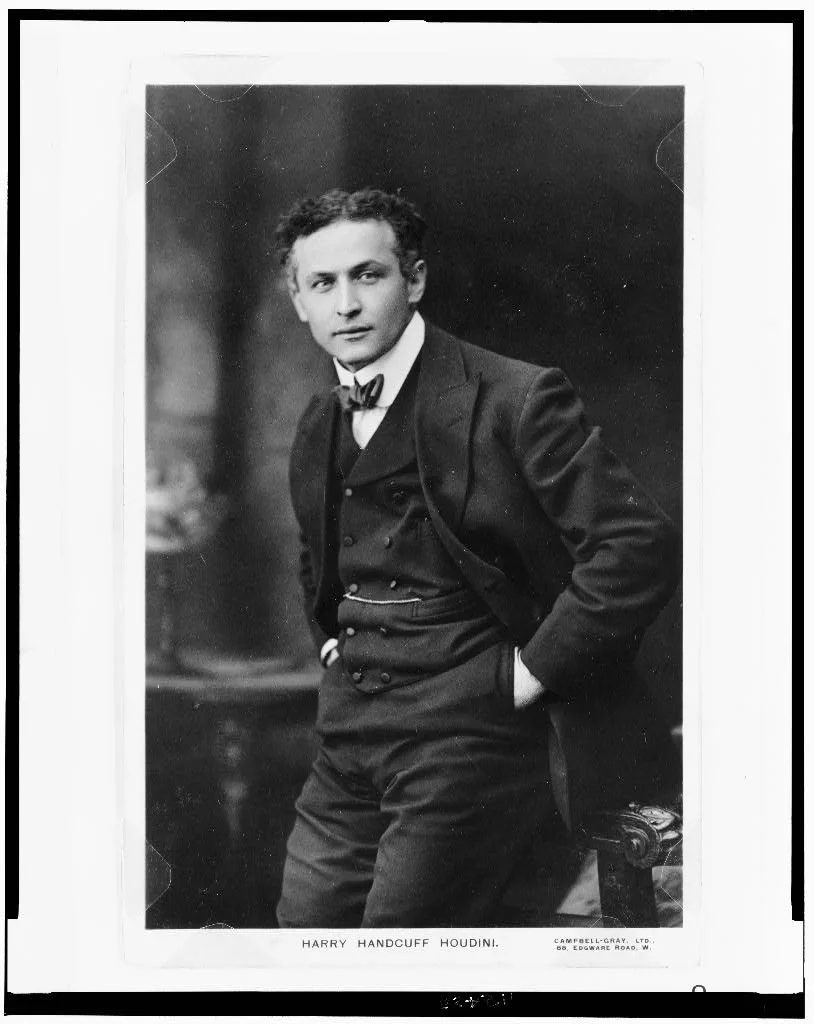
In a letter dated 31 July 1925, Harry Houdini invited a woman from Boston to visit his collection of papers about spiritualism. He could show her historical documents and perhaps send duplicate autographs. Then came an unusually domestic description of the great escape artist: he actually lived in a library. The letter survives at the Library of Congress.
As the centenary of his death on 31 October 1926 approaches, Houdini is still easiest to picture in handcuffs. Yet the papers reveal a second professional identity: the collector who investigated how apparently impossible events were produced. His performances encouraged an audience to wonder. His investigations asked what would remain of that wonder when someone examined the machinery behind it.
Building a name, then a career
Born Erik Weisz in Budapest on 24 March 1874, he grew up in the United States after his family emigrated. His father was a rabbi. The young performer adopted a name referring to the French conjurer Jean-Eugène Robert-Houdin, placing himself within a tradition of theatrical magic even as he developed an act that would become immediately recognisable as his own.
Success was neither instant nor the reward for discovering a single unprecedented trick. Houdini worked in inexpensive entertainments before vaudeville brought him a larger public. In 1899, the impresario Martin Beck recognised the commercial potential of his handcuff escapes. Other performers could free themselves from restraints; Houdini’s achievement was to make that skill the organising principle of a celebrity.
A pair of handcuffs offered a powerful theatrical object. It was associated with police authority, imprisonment and the limitation of movement. To escape was to reverse its ordinary meaning in front of witnesses. The promise could be understood without a long explanation, giving a performer a challenge that travelled readily between different audiences and languages.
How the impossible acquired a method
PBS’s account of the escape routines describes a combination of knowledge, dexterity and concealed assistance. Houdini studied locking mechanisms and collected restraints. There was no universal secret that opened everything. Different equipment required different opportunities, and the freedom spectators saw at the end depended on decisions they might never have noticed at the beginning.
Houdini also wrote about his methods. In Handcuff Secrets, published in 1910, he placed considerable emphasis on presentation. His advice distinguished a mechanism from a performance: a relatively simple procedure could become extraordinary through the way it was offered to the public. Revealing that distinction did not diminish the work needed to produce it.
Suspense was part of that work. The audience watched a body constrained by devices whose purpose it understood, while the performer controlled how much of the process could be seen. Physical ability and theatrical calculation reinforced one another. The success of the act rested on a familiar outcome made uncertain for the people waiting to witness it.
The routines also shifted the scale of performance. Library of Congress photographs document the straitjacket and other apparatus associated with Houdini’s name. Public escapes could turn an urban setting into a stage, gathering spectators around an event rather than requiring them to enter a theatre. The publicity extended the performance to people who had never watched it in person.
The collector behind the curtain
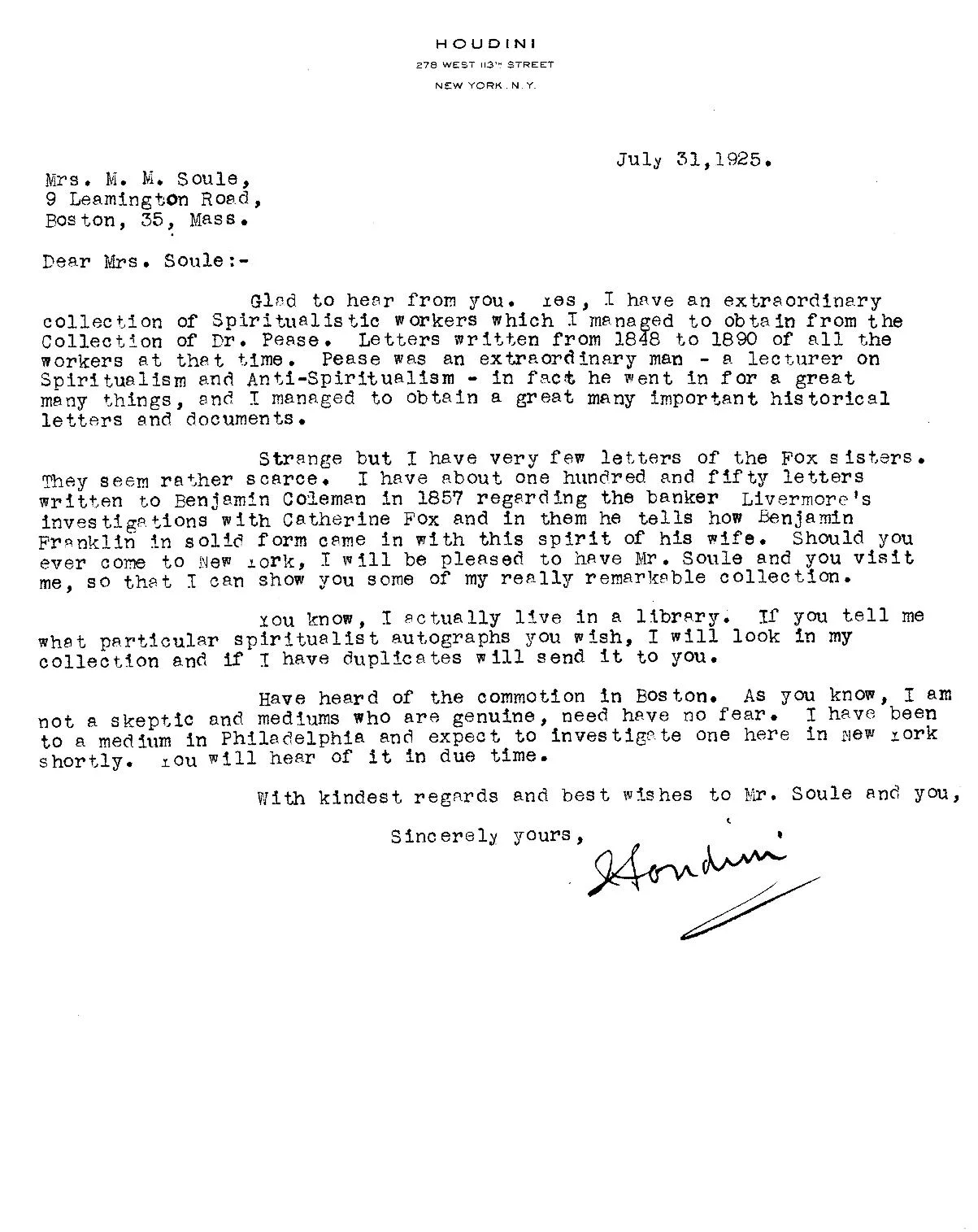
The 1925 letter offers a useful change of scale. Written to Mrs M. M. Soule, it concerns papers, their former owners and the difficulty of finding particular correspondents’ letters. Houdini described material dating from 1846 to 1890. He was interested in the documentary history of spiritualism, including claims and investigations that long preceded his own career.
The distinction matters because a collection is not the same thing as an endorsement. Preserving accounts of séances allowed a researcher to compare statements, personalities and methods. Houdini could collect the writings of believers while questioning their conclusions. His archive kept the movement’s history available even as his public appearances challenged its practitioners.
In the same letter, he rejected the description of himself as a sceptic and said genuine mediums need not fear him. That is Houdini’s own formulation, more complicated than a simple label of unbeliever. It positioned him as someone willing to investigate, while reserving the right to expose an apparent manifestation as a reproducible effect.
For a magician, that was an unusually practical line of inquiry. If an occurrence said to require a spirit could be recreated by ordinary means, the demonstration weakened the claim made for that particular occurrence. It did not require pretending that an investigator had settled every philosophical question about death. What could be examined was the performance placed before him.
The death reported in 1926
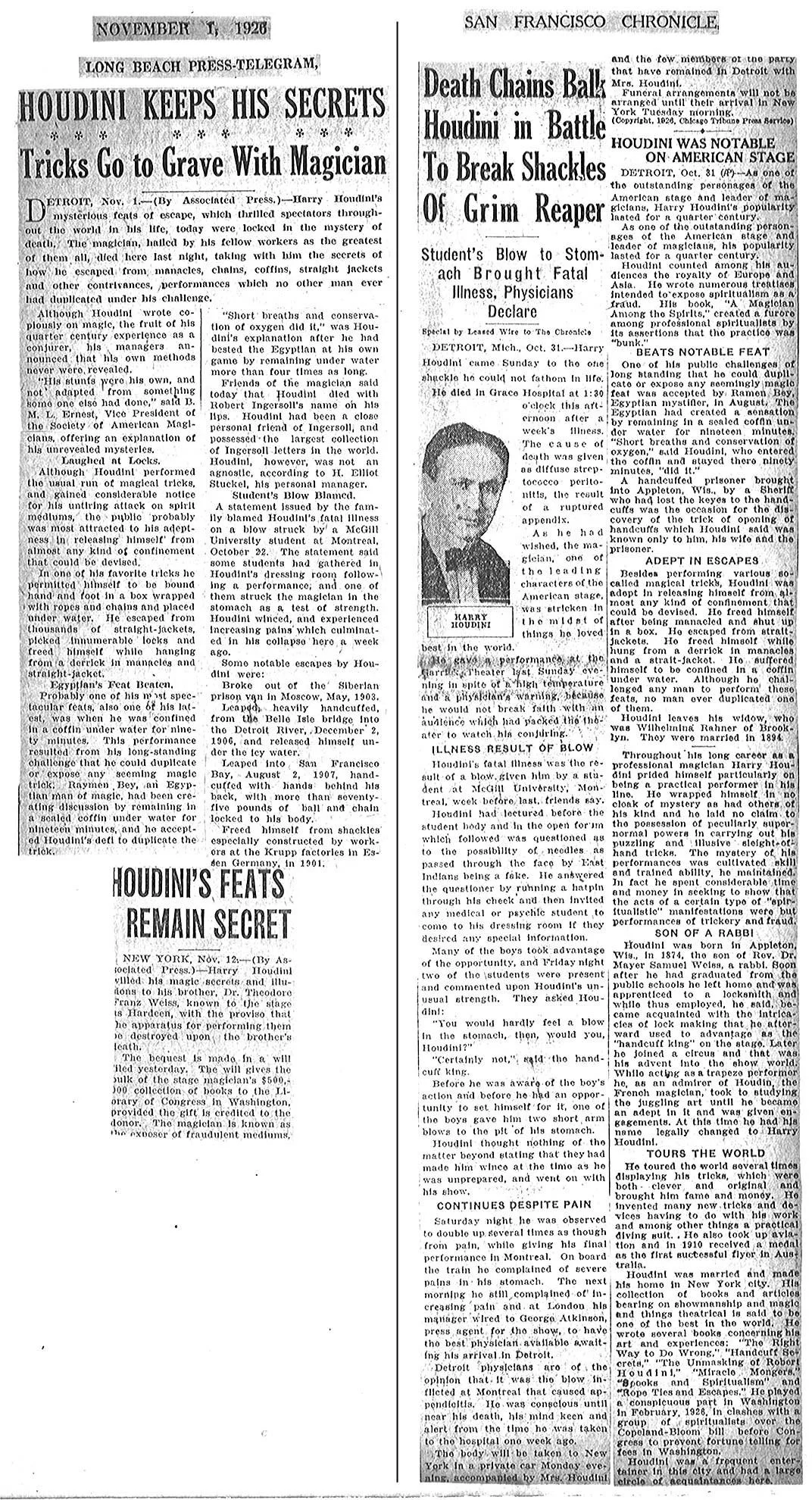
Houdini died in Detroit on 31 October 1926. The Library of Congress identifies the cause as peritonitis resulting from appendicitis. Two newspaper clippings in its collection show how rapidly the news entered his theatrical vocabulary: headlines described death through chains, shackles and secrets, extending the escape act into an event from which there would be no return.
Those headlines preserve the scale of his fame and the language used to explain it. They are also a reminder that a memorable image can outlast a medical account. The documents establish a death and its contemporary reporting. Halloween supplied an exceptionally durable anniversary, without establishing a supernatural explanation for what happened.
His collection took a less spectacular route into the future. Houdini left holdings on magic and spiritualism to the Library of Congress. The papers and printed works allowed later readers to encounter the performer as a researcher and collector. Material once used to support a personal campaign became evidence through which that campaign itself could be studied.
An ending staged after the ending
The relationship between showmanship and investigation continued after his death. In 1936, Bess Houdini took part in a final anniversary séance on the roof of Hollywood’s Knickerbocker Hotel. The attempt to contact her husband drew an invited audience and became a recorded event. The man who had challenged mediums was now the absent subject of a performance.
The Library of Congress preserves documentation of that event, including its radio script. Its account points out the prepared speaking instructions. That detail turns the séance into something more tangible than a story about a returning spirit: a production whose timing, voices and pauses were arranged for an audience. No verified return emerged from it.
This afterlife in performance explains why Houdini resists a biography confined to feats and dates. He understood the value of an image, but also the usefulness of records. His own papers let us examine the claims of both the magician and those he opposed. They preserve confidence and contradiction alongside the successes advertised on a poster.
The handcuffs remain the easiest emblem. The letter to Mrs Soule supplies a quieter one: a performer at home among documents, offering to share what he had collected. His most enduring legacy includes that movement from spectacle to examination. Once the applause has ended, there is still something to open, read and test against the story we remember.
Sources: Houdini’s letter, 31 July 1925, Contemporary death notices, Library of Congress: Great Escapes, PBS: Escape Secrets, The documented 1936 séance
Books and resources
- Houdini’s letter about his collection — Library of Congress
Free digitised original letter in English, dated 31 July 1925. Read the collector’s own description of the papers he preserved.
Free resource - Escape Secrets — PBS American Experience
Free English-language explanation of Houdini’s performance methods, with excerpts from his books. Historical analysis, rather than a training guide.
Free resource