The cover of the second edition of The Workers' Union, published in 1844, carries an appeal that explains much of Flora Tristan's life: workers are weak because they are divided and should unite. Beneath it, the book itself identifies the maxim as a proverb. That small detail calls for care with a frequently repeated claim: that she invented the phrase “Workers of the world, unite.”
The documents establish an important precedence. Tristan published the first edition of The Workers' Union in 1843, five years before the Communist Manifesto. An earlier appeal for unity, however, is different from authorship of the specific formulation concluding Marx and Engels' text. Her historical importance does not depend on an attribution these documents cannot establish.
A pariah between France and Peru
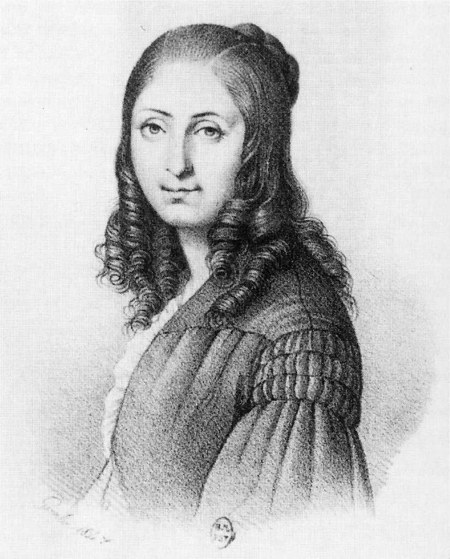
Born in Paris in 1803, she was the daughter of a Peruvian father, Mariano Tristan, and a French mother. The chronology provided by the Biblioteca Virtual Miguel de Cervantes records her marriage to André Chazal, their separation and his attack on her in 1838. She survived the shooting. Her defence of women had a painfully concrete personal dimension.
Her Peruvian story can be followed in her own account. Peregrinations of a Pariah, published in 1838 about her 1833–1834 journey, reproduces letters to her uncle Pío Tristan and his replies. She sought family recognition and a solution to her financial circumstances. Blood relationship did not secure the rights she expected: the argument turned on the legal status of her birth.
In a letter reproduced in the book, Pío acknowledges her as his brother's daughter while maintaining that this does not make her a legitimate daughter for the purposes of her claim. The exchange documents a decisive boundary: relatives could accept kinship while denying its legal consequences. Flora makes this contradiction central to her account of exclusion.
“Pariah” therefore means more in the title than a description of poverty. It names a position within family and society, a form of incomplete belonging. Her letters show how she transforms an intimate dispute into a public question: what protection does someone receive when rules recognise certain family members while leaving others outside?
The journey includes Arequipa and Lima, portraits of relatives, convents and political episodes. It is not a tourist postcard. She arranges encounters and conflicts around what she observes and what she needs to obtain. Her account should also be read as a situated perspective: the testimony of a participant with interests, judgments and emotions, rather than a neutral description of an entire country.
Unity had to include women
The Workers' Union proposes an organisation reaching beyond divisions between trades. Tristan considers it insufficient for each group to tackle its difficulties alone. She advocates pooling contributions, supporting common representation and maintaining collective action. The project's strength lies in moving from compassion for individual cases towards a shared structure.
Her proposals include workers' union palaces. Although the name sounds aristocratic, the programme allocates them schools, workshops and accommodation for children and older people, among other functions. The book addresses material details: funding, location, water, ventilation and building layouts. Emancipation required places, resources and an organisation capable of supporting it.
Women appear as participants in their own right. The book explicitly addresses working men and working women. Tristan devotes a chapter to their subordination, describing how institutions and ideas treating women as inferior then justify denying them an adequate education. Exclusion creates conditions subsequently invoked to sustain further exclusion.
The relationship between education and inequality is particularly clear in her argument. If women are prevented from developing their abilities, their lack of opportunities cannot then establish a natural incapacity. Her reasoning recasts an allegedly inevitable difference as the outcome of social decisions that can change.
She also places women's participation within general wellbeing. Their involvement in social activity would make use of capacities belonging to a marginalised half of humanity. Reading her programme, unity loses its purpose if it reproduces internally the hierarchy it seeks to challenge outside.
What lies behind the famous slogan
The celebrated formulation closes the Communist Manifesto of 1848. The German original refers to proletarians of all countries. “Workers of the world, unite” is a widespread rendering of that appeal, with wording varying between translations. This textual history must be distinguished from the association Tristan had already proposed.
The 1844 Workers' Union cover documents an invitation to unite but labels it a proverb. The book establishes something broader than a verbal resemblance: its author had developed a programme for workers' organisation before 1848. Crediting her outright with the Manifesto's final phrase would require additional evidence concerning its wording and transmission.
The comparison likewise cannot establish, by itself, that Marx and Engels copied those words from her. Chronological precedence identifies what appeared first; it does not automatically explain how an idea reached another writer. The strongest recognition comes from reading her actual programme: solidarity across trades, shared institutions and women's emancipation within the workers' cause.
Gauguin, the grandson she never met
The National Gallery of Australia's chronology identifies Paul Gauguin as the son of Clovis Gauguin and Aline Chazal, Flora's daughter. He was born in Paris on June 7, 1848. His grandmother had died in 1844: they could never have met. Any account of scenes they shared would be fictional.
Gauguin spent part of his childhood in Peru with his mother's family. This connects both biographies to the country but does not demonstrate that he received artistic or political instruction directly from Flora. Kinship is established; a specific influence needs its own documentation. Family history brings their journeys together without creating an impossible personal relationship.
The end of a journey and a lasting memory
In 1844, Tristan travelled through French cities to promote her programme among workers. She died, after falling ill, in Bordeaux on November 14, aged 41, before completing that journey. The commemoration preserved by the city's website locates her grave in the Chartreuse cemetery and recalls the workers' memorial of gratitude.
Her death left written work that still makes the proposal accessible. The details of The Workers' Union preserve plans she could not carry through to their final consequences. In Peregrinations, the letters retain the family conflict that drove her search. Together, the books show the distance between what she demanded, what she hoped to achieve and the resistance she encountered.
Those texts offer a starting point for readers. Promenades in London extends her observations of industrial society, while Brigitte Krulic's biography follows her wider trajectory. Michelle Perrot's lecture, preserved by France's national library, provides another approach: hearing a historian place her proposals within the debate about working men and women.
Flora Tristan deserves a reading that preserves her arguments while examining their limits. Her precedence can be recognised without assigning an unproven phrase to her, and her relationship to Gauguin without reducing her to that connection. Her central question remains in the books: how to build collective emancipation that includes people pushed aside by family, law and the organisation of work.
Sources: Flora Tristan, The Workers' Union, Flora Tristan, Peregrinations of a Pariah, Marx and Engels, Communist Manifesto, National Gallery of Australia: Gauguin chronology, Bordeaux: remembering Flora Tristan
Books and resources
- Unión obrera / Union ouvrière — Flora Tristán
Her original programme. Free French text of the 1844 edition.
Free resource - Paseos en Londres — Flora Tristán
Free Spanish digital edition of her observations of industrial society.
Free resource - Flora Tristan — Brigitte Krulic
French biography, Gallimard, 2022. Paid book; ordinary bookshop link with no commission for this website.
Paid resource - Flora Tristan · conferencia / lecture — Michelle Perrot · Bibliothèque nationale de France
Free French lecture by a historian; this is a recorded talk, not a fictional film.
Free resource