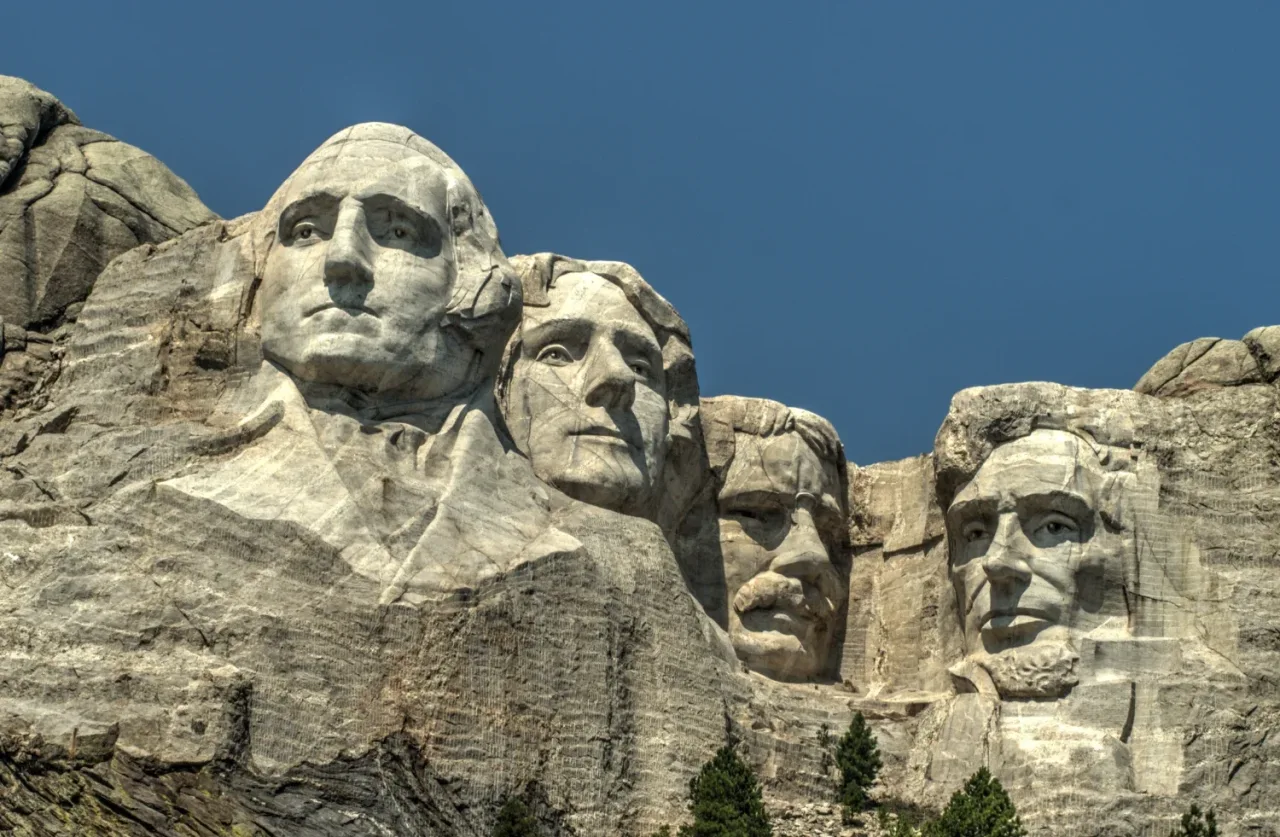
On October 31, 1941, the last drilling ended at Mount Rushmore. The four presidential faces had already been unveiled, one by one. Gutzon Borglum, the sculptor who conceived them, was dead; his son Lincoln directed the final work. The memorial was declared complete, although parts of Borglum's larger scheme remained on paper or deep inside the mountain. Eighty-five years later, that word—complete—still asks a question: whose story had been finished, and whose had scarcely been told?
The date marks the end of a fourteen-year undertaking in South Dakota's Black Hills, not a single unveiling of the monument we know today. The National Park Service records the first actual carving on October 4, 1927, and the final drilling on October 31, 1941. Between those dates, a tourist proposal became a federally supported national memorial. It also placed an account of American history into a landscape that held another history long before the first drill arrived.
The mountain selected for a story
South Dakota state historian Doane Robinson proposed a monumental attraction in 1923 to bring visitors to the Black Hills. His first idea involved figures associated with the American West. He approached Borglum, who had worked on a Confederate memorial at Stone Mountain in Georgia. Borglum wanted a broader national subject and chose four presidents. He also rejected an earlier proposed site among the Needles, finding its rock unsuitable, and selected the granite mountain that became Mount Rushmore. The choice of site and subject was deliberate, not an inevitable feature of the terrain.
For Borglum, George Washington stood for the republic's founding; Thomas Jefferson for expansion; Abraham Lincoln for the Union's preservation through civil war; and Theodore Roosevelt for the country's development. That is the commemorative program explained by the Park Service. It tells readers why those men appear on the rock, but it does not make the selection a neutral account of the United States. A monument can reveal as much about the period that built it as about the era it claims to portray.
Permission and money took years. Federal and South Dakota legislation authorized work in 1925. President Calvin Coolidge attended an August 1927 dedication and backed federal funding. During the Depression, Senator Peter Norbeck pursued additional support through federal relief programs. The project changed hands and faced disputes over control and expenses. Its progress depended on politicians, appropriations and employees as surely as it depended on Borglum's design.
The people who made granite look like faces
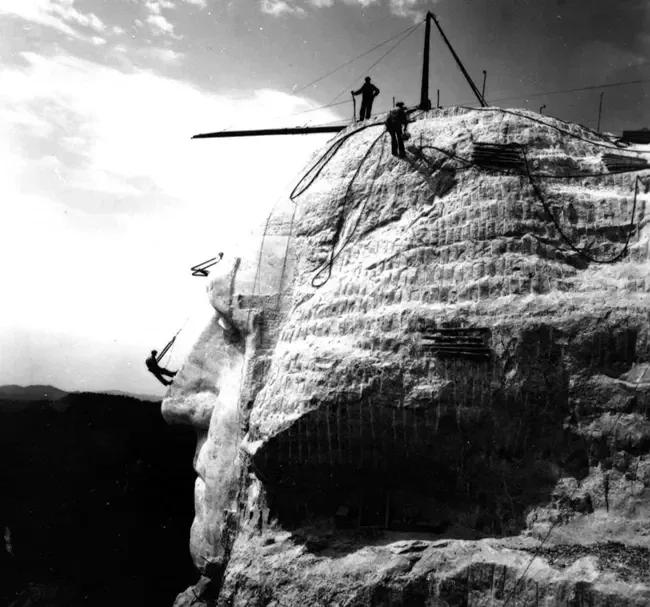
Nearly 400 men and women worked on the memorial during its carving years, according to the Park Service. They were drillers, blacksmiths, hoist operators and other workers, not merely an anonymous crew beneath a famous sculptor. Some climbed 700 steps to the summit before being lowered over the rock face on cables in suspended seats. Dynamite removed most of the stone; closely spaced drill holes then weakened the remaining granite so it could be broken away and smoothed. Dangerous work produced no recorded fatalities during the carving, an important fact that should not make the danger itself disappear.
The four figures did not emerge together. Washington's face was dedicated in 1930, Jefferson's in 1936, Lincoln's in 1937 and Roosevelt's in 1939. Jefferson had to be moved from Washington's right to his left after the rock proved unsuitable for the earlier arrangement. Such changes show a sculpture shaped not only by an ideal drawing but by the stubborn physical character of the mountain.
Borglum imagined words as well as faces. An enormous inscription, or entablature, would have summarized important events in U.S. history. It became impractical to read from below, and Jefferson's relocation consumed the space intended for it. Borglum then pursued a Hall of Records behind the figures, a chamber to explain the memorial and preserve national documents. Workers blasted a tunnel about 70 feet (21 meters) into the mountain in 1938–39. Congress restricted funding to the sculpted faces, and work on the hall stopped. The rough tunnel remained; the grand chamber was never built.
A finish defined by its limits
Gutzon Borglum died on March 6, 1941. Lincoln, already experienced in supervising work, took responsibility for the final months. The Park Service says the prospect of American involvement in World War II joined the loss of the sculptor and funding limits in bringing the undertaking to a close. On October 31, the last drilling took place and the memorial was declared complete. The United States would enter the war in December; the October decision should not be described as a response to a war the country had already entered.
A later intervention partly answered Borglum's wish to leave an explanation. In 1998, a small repository holding records was placed in the floor of the unfinished Hall of Records entrance. It is not the vast room he planned and is not open to visitors. Its existence makes the distinction visible: the monument's public image had been fixed in 1941, while the question of how to explain it continued.
The older name beneath the memorial
There is another limit to the word complete. The Black Hills, Paha Sapa, are sacred to Lakota people and significant to other Native nations. The Park Service notes that the mountain selected for carving was known to Lakota people as the Six Grandfathers and that the choice disregarded its cultural significance. The 1868 Treaty of Fort Laramie recognized the Black Hills as Lakota territory. After gold was found in 1874, prospectors and settlers entered in violation of the treaty. The later carving did not create this conflict, but it gave a prominent national form to one side's account of the land.
In the 1970s, American Indian Movement demonstrators challenged the monument and demanded that treaty obligations be honored. The dispute over the Black Hills has not vanished into the granite. Remembering the final drilling on its eighty-fifth anniversary therefore requires more than admiring the achievement or condemning it in a sentence. The work of hundreds of people and the ambition of its makers are part of the record. So are the abandoned hall, the political choices that ended construction, and the history of the land beneath the presidents. The drilling stopped in 1941. The meaning of the mountain did not.
Sources: https://home.nps.gov/moru/learn/historyculture/timeline.htm ; https://www.nps.gov/moru/learn/historyculture/memorial-history.htm ; https://www.nps.gov/moru/learn/historyculture/the-workers.htm ; https://www.nps.gov/moru/learn/historyculture/carving-history.htm ; https://www.nps.gov/moru/learn/historyculture/hall-of-records.htm ; https://www.nps.gov/moru/learn/historyculture/the-entablature-idea.htm ; https://www.nps.gov/articles/000/mount-rushmore-national-memorial-501080.htm ; https://www.nps.gov/moru/learn/historyculture/doane-robinson.htm ; https://www.nps.gov/moru/learn/historyculture/lincoln-borglum.htm