A new blue in Edo
At the lower edge of an untrimmed impression of Under the Wave off Kanagawa, a small irregularity shows how the wave was printed. The dark stripes continue past the edge of the brighter blue laid over them. The two layers are easier to distinguish there than in the finished swell, where they work together. Researchers at the Metropolitan Museum of Art used that clue, along with close examination of the colors and paper, to reconstruct how the printers gave the wave its depth.
Katsushika Hokusai designed the print for Thirty-six Views of Mount Fuji, a series advertised by the publisher Eijudo around the New Year of 1831. Prints like these were sold in Edo, the city now known as Tokyo, and could be made in repeated editions from carved blocks. The advertisements drew attention to Prussian blue, a synthetic color imported into Japan and newly available to the print trade. Landscape offered a broad surface on which buyers could see what the color could do.
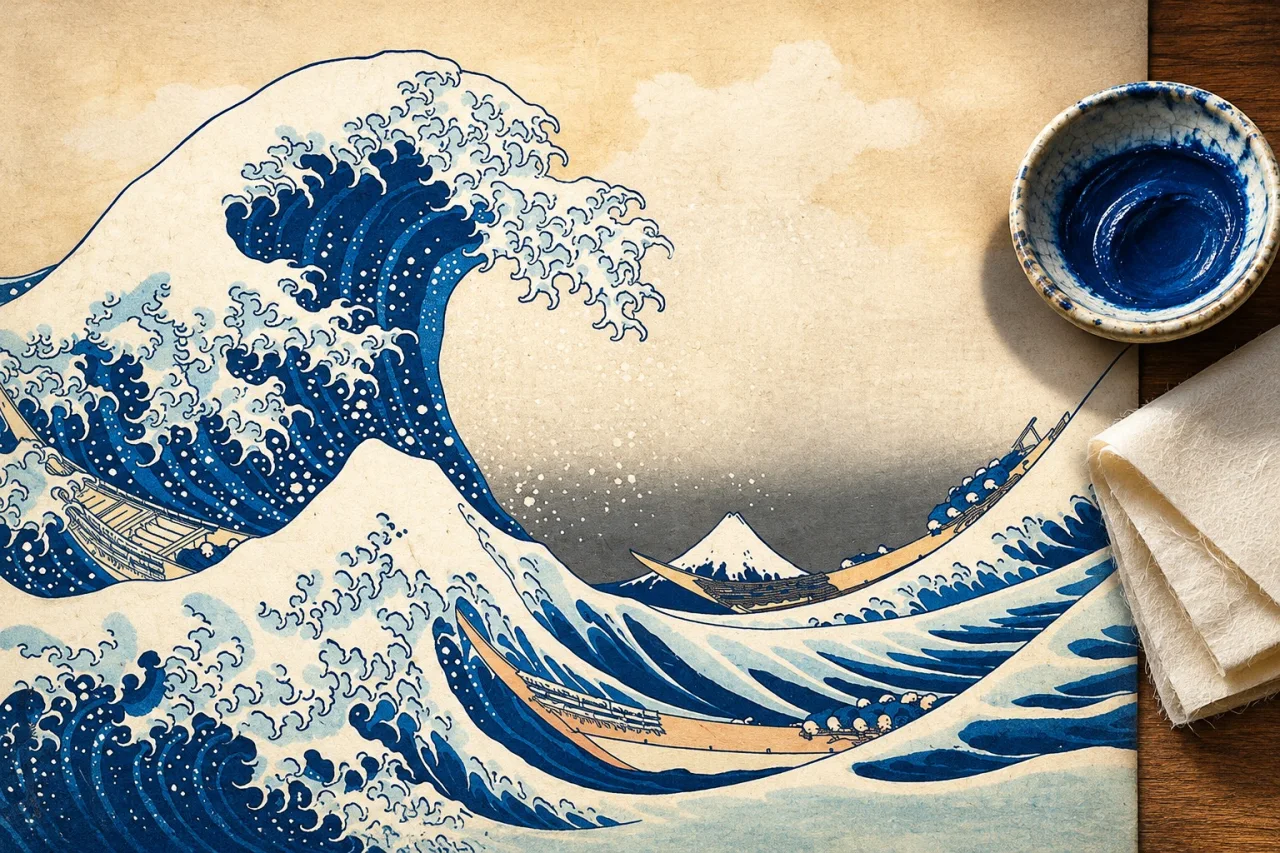
Mount Fuji is the subject that ties the series together. In the Kanagawa print, it occupies a small gap below the crest of the wave. The snow on its summit picks up the whites in the breaking water, and a swell in the foreground echoes the mountain’s outline. Three long, narrow boats run diagonally through the lower part of the picture. Their crews lean low as the troughs and ridges around them make the boats seem briefly suspended. Most of the energy of the composition comes from the rising water; the mountain stays sharply still.
The printers build the swell
A color woodblock print passed through several hands before it went on sale. A publisher commissioned and sold the work. A designer supplied the image, carvers transferred its lines and areas of color to blocks, and printers brought those pieces together on paper. To print a second color, the printer had to place the sheet so that the new impression lined up with the first. The finished wave depended on decisions about which parts went onto each block and which layers would meet on the paper.
Eijudo’s printers began the dark vertical stripes in the hollow of the wave with a mixture of indigo and Prussian blue. Indigo was a familiar material in Japanese prints. The mixture made a dark outline with a slightly different cast from the blue that followed. In a second pass, the printers laid pure Prussian blue across the stripes and into the spaces left between them. The areas covered twice took on a deeper blue; the gaps, printed once, stayed brighter. In the hollow above the leftmost boat, the alternating tones make the water appear to curve inward.
The paper records these steps as well as the color does. The Met used a three-dimensional scanning microscope to examine the surface of an impression. In those scans, the white paper of the foam sits above the blue that was printed once. The deepest blue sits lower, where the paper was pressed twice against the carved relief. These differences are very small, but they show that a sheet can preserve evidence of both the pigment mixture and the pressure of the blocks.
The printers could have used the new pigment alongside indigo without overlapping the two. Their choice to print the hollow over the stripes let the dark tones retain a strong blue, even where the color had to be deep enough to make the wave look hollow. A lighter passage beside that darkness gains brightness without any change in the pigment itself. The result is legible across the room, though one clue to its making survives at the edge of a sheet.
When the blocks changed
Museum visitors can see The Great Wave in New York, Los Angeles and other cities because the workshop produced many impressions. They share Hokusai’s design, but the impressions also record changes over the life of the blocks. Small breaks appear in lines that had once printed continuously. In later examples, some shapes and colors differ enough to show that blocks had been replaced or recarved. The prints carry no numbered sequence to establish the order in which they came off the blocks.
The British Museum scientist Capucine Korenberg approached the sequence by comparing 111 impressions. Among the details she tracked were interruptions in the lines around the printed title and a break in a line in the wave. Once a ridge in a block had been damaged, it could leave the same break in later impressions. Comparisons across many sheets helped separate such changes from the effects of uneven inking or pressure on an individual sheet. Korenberg identified eight states from the evidence she could read.
Some of the changes are easier to see with the unaided eye. The study found late impressions in which a new block gave the bodies of the boats a brownish-pink color in place of the earlier pale gray and yellow. The clouds also acquired a different appearance in very late impressions, and some of those sheets have black outlines where earlier examples had blue. Korenberg could trace the difference to the materials and the blocks. The surviving prints leave open whether a damaged block, a lost one or a decision about color prompted every change.
Looking at an impression
The Met dates its well-known Havemeyer impression to around 1830–32 and considers it probably an early printing. Its finely defined lines and saturated colors make it a good place to look for the layering that Eijudo’s printers achieved. The Los Angeles County Museum of Art holds another impression. The obvious places to compare are the shape and color of the boats, the clouds beyond the swell and the small dark lines where blue meets white. The same composition lets each difference stand out.
The wave would be recognizable even if those details were lost. Its outline, the three boats and the distant mountain hold the composition together. Look again at the dark ribs of the wave above the leftmost boat and a different part of the story comes into view. The narrow strips of color were laid down separately, then brought together so precisely that they read as a single swell. Hokusai’s design gave the printers the wave. Their handling of two blues gave it a depth that surviving paper, more than a century later, can still show.
Sources: Metropolitan Museum of Art, the print, Metropolitan Museum of Art, Anatomy of an Icon, Conservation research on Hokusai's prints, British Museum study of the print’s different states, Los Angeles County Museum of Art, surviving impression