
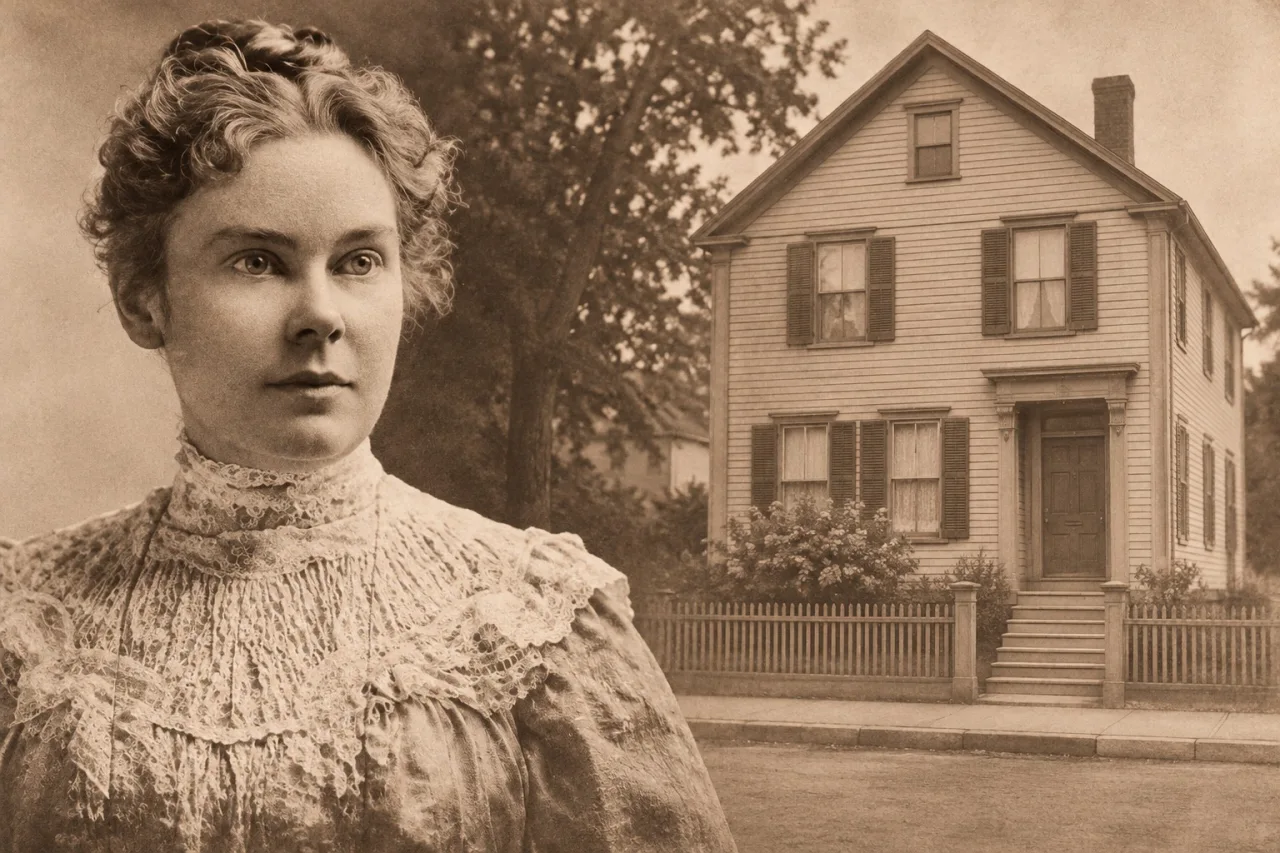
The Borden Household
On June 5, 1893, in a New Bedford courtroom, the case against Lizzie Borden opened for the killing of her father and stepmother. Among the physical exhibits shown to the jury was a photograph marked Exhibit 10, a view of the neighboring Buffington house, the barn and the Borden house on Second Street in Fall River. The image oriented jurors to the domestic spaces where both bodies had been found on August 4, 1892.
Andrew Jackson Borden and Abby Durfee Gray Borden were discovered dead in that home, Abby upstairs in a guest room and Andrew downstairs. Abby was Lizzie's stepmother. The household also included a domestic worker, Bridget Sullivan, who was at home that morning. Sullivan later described her routine chores and Andrew's return, but she saw neither killing.
Lizzie Borden was arrested on August 11, 1892, on the last day of an inquest that had begun on August 9. The investigation had already drawn wide public attention, and rumors circulated in Fall River. By the time the trial convened ten months later, a large press corps had gathered. The trial itself would rely on formal testimony rather than rumor. The inquest testimony would later become a point of legal dispute.
What the Jury Heard
Bridget Sullivan’s account concerned the parts of the morning she had seen: her work around the house and Andrew Borden’s return. Her movements were one element of a timeline the prosecution was trying to put together from people who had seen different parts of the day. Medical testimony indicated that Abby died before Andrew, though exact clock times remained uncertain. The prosecution relied on this sequence to suggest opportunity, but it established no direct link.
Alice Russell offered one of the most discussed pieces of testimony. She said that in the days after the killings she saw Lizzie burn a dress. According to Russell, Lizzie explained that the dress was stained with paint. At trial, the dress's condition at the crime scene had not been established, leaving the jury to weigh an action without a clear link to the violence.
Medical witnesses described the wounds but were cautious about assigning a precise timeline. The jury also saw the Exhibit 10 survey photograph and heard references to the house's layout. Prosecutors Hosea Knowlton and William H. Moody attempted to connect circumstantial details, while the defense, led by former governor George D. Robinson, stressed the absence of direct evidence. No witness testified to seeing Lizzie kill either victim. The physical exhibits were admitted but remained open to interpretation.
Evidentiary Rulings
The judges made two significant evidentiary rulings that shaped the trial. Lizzie Borden's sworn testimony from the August inquest was kept from the jury. The inquest was a separate proceeding that took place before the indictment and trial. Once the judges excluded the testimony, the state could no longer ask the jurors to weigh Lizzie’s answers there against the trial witnesses’ accounts.
A second ruling barred testimony about an alleged attempt by Lizzie to buy prussic acid. The lawyers’ efforts to introduce the allegation remain part of the record, but the judges excluded the proposed testimony from the evidence the jury could consider. The surviving case papers distinguish between the offers made by counsel and the testimony admitted before the jury.
The prosecution still had witnesses and objects to put before the jury. Its problem was to connect them. Russell’s testimony could establish what she had seen after the deaths, for instance, but her account alone could not tell the jury what Lizzie had worn during the killings.
Press and Public Spectacle
While the courtroom worked through testimony, newspapers across the country printed daily reports, sketches, and editorial commentary. The trial opened in New Bedford, not Fall River, but the press treated it as a national sensation. B. West Clinedinst's 1893 illustration of Lizzie and Robinson sitting together shows the courtroom before the acquittal. The sketch gave readers far outside Massachusetts a view of the defendant and her lawyer.
The public account diverged from the legal record in important ways. The coverage ranged from a June 16 story in the Fisherman & Farmer of Edenton, North Carolina, which introduced the case to readers far from Fall River, to the San Francisco Morning Call’s coverage of the acquittal five days later. The events could reach readers in a single installment even though the jurors had heard them unfold piece by piece.
Reporters in the courtroom did transmit actual testimony, but editorial choices emphasized sensation. The discrepancy between what the jury heard and what the public believed became part of the case's legacy. A printed account could set the inquest, the arguments over exclusions and the final verdict side by side. In the courtroom those belonged to different stages, and the jury’s authority extended to the case put before it at trial.
Verdict and Aftermath
On June 20, 1893, the clerk read the verdict: not guilty. Lizzie Borden was acquitted of the murders of Andrew and Abby. The verdict answered the charge brought by Massachusetts. The deaths of Andrew and Abby remained without a conviction.
Lizzie Borden continued to live in Fall River for the rest of her life. The trial remained a subject of national interest even after the press left New Bedford. The official result was clear, while the fate of the two people found on Second Street kept drawing attention back to the witnesses and the house.
The records kept by the lawyers allow later readers to reconstruct the proceedings. The Fall River Historical Society preserves correspondence and exhibits from Knowlton’s files, including material created before the trial and documents produced after it. For the sequence of evidence, the transcripts remain the record of who spoke and what lawyers put before the court.
Place Sullivan’s testimony beside Russell’s and the limitations of that record become plain. One covered a morning in the house without witnessing either killing. The other described a dress destroyed later, with no opportunity to identify it as part of the crime. Both witnesses supplied facts that jurors could consider. The questions those facts left open were part of the case the state had to prove.
Exhibit 10 is still there, with the house and barn side by side. It gives a definite answer to one question the jury faced, about the arrangement of the buildings on Second Street. The witnesses could help the jury put people inside that photograph at different moments. They could not show who killed Andrew and Abby Borden.
Sources: Fall River Historical Society Knowlton Papers, Trial and Inquest Transcripts, Library of Congress Chronology, Chronicling America Trial and Verdict Coverage, B. West Clinedinst Courtroom Illustration