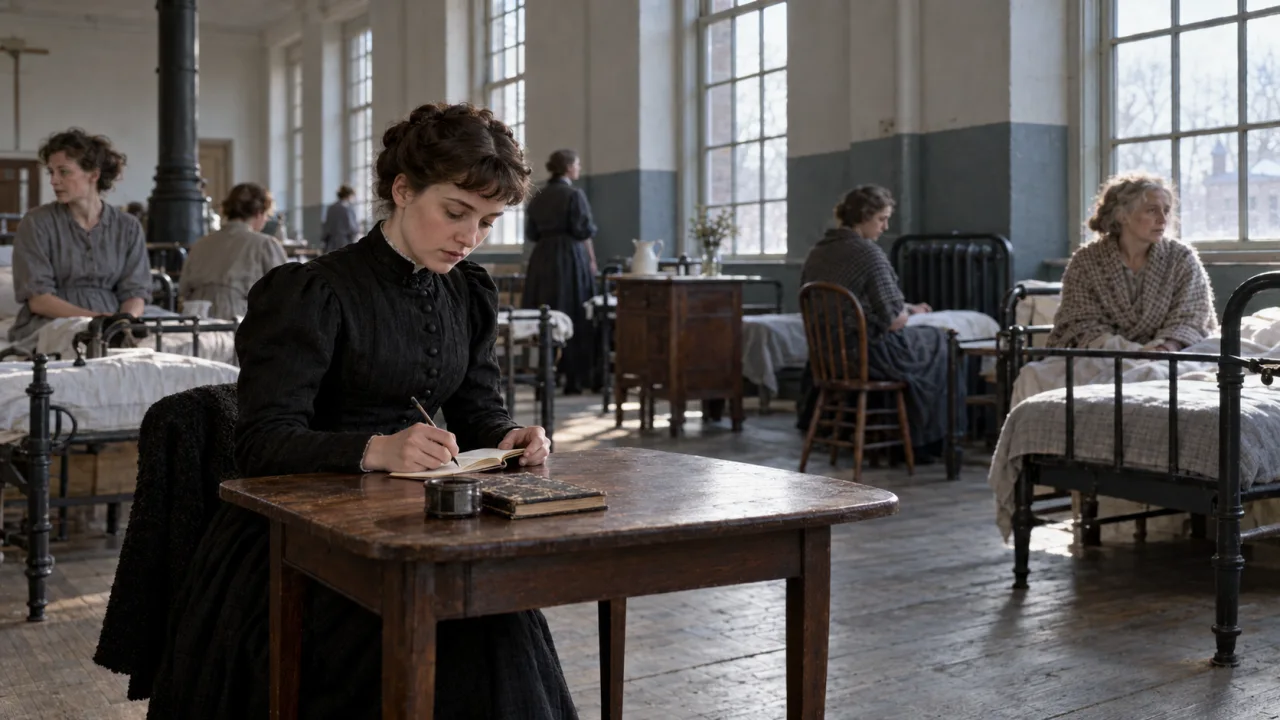
In October 1887, readers of the New York World encountered a reporter who had crossed into one of the city’s least visible institutions. Nellie Bly had spent ten days at the women’s asylum on Blackwell’s Island, admitted under the name Nellie Brown. Her account began as a newspaper investigation and became a question that still follows undercover reporting: what can a journalist show by entering a place the public rarely sees, and what can one person’s testimony establish about an entire system?
A route into the institution
Bly was born Elizabeth Jane Cochran in Pennsylvania in 1864. She took the name Nellie Bly while working for the Pittsburgh Dispatch, where she wrote about women’s work and social conditions. In 1887 she moved to New York and joined Joseph Pulitzer’s World. The assignment that made her famous required more than visiting the asylum. She had to persuade strangers and physicians that she was mentally ill, pass through the city’s intake process and remain inside long enough to report what happened.
The Library of Congress reconstructs the route: using the name Nellie Brown, Bly stayed at a temporary home for women, came to the attention of police and a court, and was examined at Bellevue Hospital. Physicians there sent her to Blackwell’s Island. It was not a simple act of voluntary entry. The episode depended on people and institutions taking her assumed condition as real, and on the World’s editors promising to secure her release.
That distinction matters. Bly could control her disguise and record what she experienced; she could not control how staff interpreted her or what would happen to patients after she left. The reporting was an experiment in access, but the people inside were not participants in a controlled study. They were patients living under conditions she described as cold, crowded and degrading.
What she reported—and what it could prove
Bly’s narrative appeared in the World in two installments, “Behind Asylum Bars” on October 10 and “Inside the Madhouse” on October 16, 1887. The pieces were soon published as a book, Ten Days in a Mad-House. She described inadequate food and clothing, harsh treatment and patients whose needs, in her account, were not being met. She also wrote that ordinary behavior could be treated as evidence of madness once a person had been classified that way.
Her testimony has force because she was there and described the routines she encountered. It also has limits. Bly was one observer, present for ten days, writing for a newspaper that needed readers and had assigned her a dramatic investigation. Her experience cannot stand in for every ward, staff member or patient. Nor was her report a clinical evaluation of the women she met. The Library of Congress notes that patients included people with mental illness, people sent by relatives and people with physical ailments. Bly could document conditions and decisions she witnessed; diagnosing the women from a newspaper account would repeat the institutional certainty her story questioned.
The asylum predated the investigation by decades. New York State Archives records identify the municipal institution on Blackwell’s Island as an early public mental hospital, founded in 1834. By Bly’s arrival, the question was not whether New York had a public system of care, but what happened inside it and who was accountable for its daily conditions.
The response after publication
The World’s publication drew attention beyond New York. The Library of Congress cites contemporary newspaper coverage and a November 1887 Evening World call to reform the asylums. It also records a financial response: the appropriation for the city’s Department of Public Charities and Corrections rose from $1.5 million to $2.34 million, with $50,000 specifically designated for Blackwell’s asylum.
Those figures show that the story reached the budget process. They do not, by themselves, prove that Bly’s reporting caused every allocation or that increased spending repaired the institution. Reform had a longer history, and one newspaper series could not substitute for inspection, staffing, medical care or public oversight. The asylum closed in 1894, seven years after the investigation; the passage of time alone does not establish that Bly’s work caused its closure.
Her achievement is better understood as a breach in public ignorance. She gave readers an account of an institution difficult to inspect from outside and helped make its treatment of patients a civic question. That mattered in a profession where women reporters were often pushed toward fashion and society pages. The World kept her on staff after the series, and she continued reporting, including her 1890 journey around the world.
The ethics of going undercover
Bly’s method carries a tension that later journalists have never entirely resolved. Deception opened a door that ordinary observation might not have opened. It also left the people inside unaware that one of them was a reporter. Her account was not a neutral window: it was a shaped narrative, with a sequence of encounters and a public argument. That is a reason to read it alongside institutional records and other contemporary accounts, not to dismiss the evidence she gathered.
The investigation is best measured between two extremes: the legend of a lone heroine who fixed an asylum and the claim that one reporter’s experience tells us everything. Bly made a hidden institution visible, recorded treatment that demanded an answer and helped move the question into public view. The record supports that achievement. It also reminds readers that exposing abuse is the start of accountability, not its completion.
Sources: Library of Congress, Library of Congress research guide, Ten Days in a Mad-House, New York State Archives, National Park Service