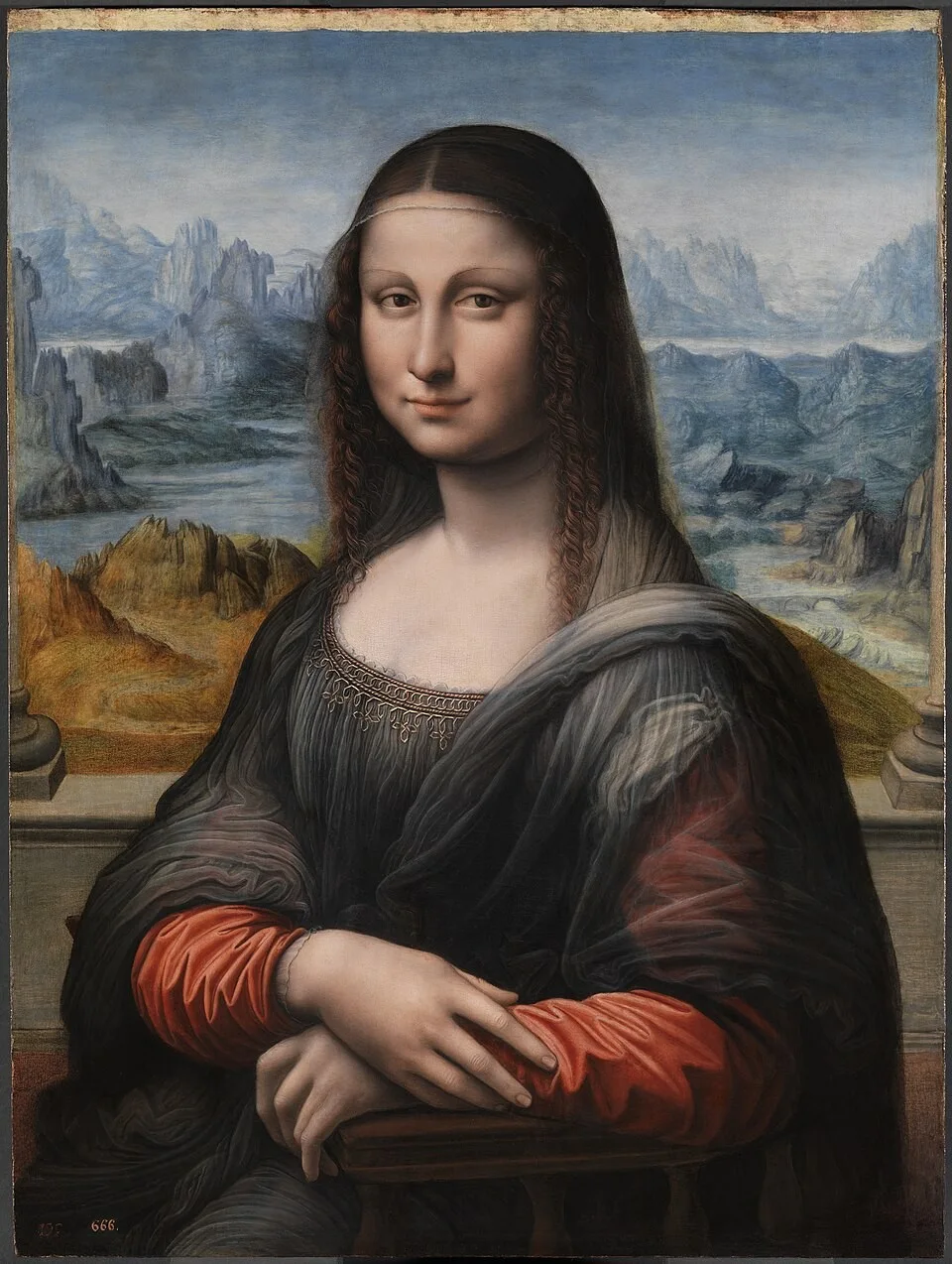
For years, the woman in Madrid sat against a black background. The pose was familiar, the hands and smile recalled another painting, but the darkness seemed to separate her from the Mona Lisa in Paris. Then examination found a landscape beneath the black paint. Its recovery changed more than the view behind her shoulders: a picture long catalogued as a copy became evidence of a painting being invented. The Prado's Mona Lisa had something to tell historians about Leonardo's work that the finished image in the Louvre could not reveal by itself.
A familiar face, an incomplete journey
The Prado now catalogues its panel as a work from Leonardo da Vinci's workshop, dated 1507–1516. Painted in oil on walnut, it measures 76.3 by 57 centimetres. It repeats the subject of the Louvre portrait, identified by that museum as Lisa Gherardini, wife of the Florentine merchant Francesco del Giocondo. This is another painted version of that image, rather than a portrait of a different woman. Yet sharing a composition does not mean sharing an author: the Prado does not attribute its painting to Leonardo himself.
Its route to Spain remains partly obscure. The museum considers it probably the female portrait associated with Leonardo recorded in the Madrid Alcázar's inventory of 1666. That identification is a qualified one, not a documented account of arrival. No established purchaser, shipment or gift explains the passage from the Italian workshop into the Spanish royal collection. An old attribution to Leonardo helps trace how a painting was understood; it cannot, by itself, certify who painted it. The uncertainty belongs in its history as much as the inventory number.
Subsequent royal inventories place the work in Madrid's palaces. The Prado's provenance record includes the new Royal Palace in 1772 and 1794, then the chief steward's room in 1814–1818. It entered the Prado's collection at the museum's foundation in 1819, from royal holdings that formed the institution's nucleus. The answer to how it reached the museum is therefore clearer than how it reached Spain: it came through the royal collection. Its museum history begins with those royal holdings becoming a public collection; the earlier journey remains a separate, unanswered question.
The landscape beneath the darkness
The turning point began with a request from Paris. In 2010, the Louvre sought the painting for an exhibition devoted to Leonardo's Saint Anne. The Prado investigated its construction and condition; comparison with technical images of the original encouraged closer examination. Ana González Mozo undertook the technical study, Almudena Sánchez Martín restored the painting, and Miguel Falomir coordinated the project. Their work, presented publicly in 2012, combined infrared imaging, X-rays, laboratory analysis and close inspection. An object the museum had long held acquired a different history through the tools of its own conservators.
The black background was an addition. Chemical examination dated it no earlier than 1750, and an organic layer separated it from the landscape underneath. That separation, together with solubility tests, supported its controlled removal. Cleaning also removed oxidised varnish that had yellowed the flesh tones, recovering distinctions in cloth and the veil's transparency. The landscape was well preserved but unfinished in places. Its incompleteness might explain why someone covered it; the painter of that black layer and the reason for the intervention remain unknown.
The strongest evidence was not the reappearance of scenery. Infrared reflectography, which helps reveal drawing beneath paint, showed changes corresponding to those underneath Leonardo's original. Adjustments to the waist, fingers, veil and head recur in the Madrid panel. A copyist looking only at a finished picture could reproduce its visible forms, but could not simply see revisions already buried beneath paint. The Prado interpreted those shared alterations as evidence that the two works developed in parallel. The copy followed decisions while they were still available to someone in the workshop.
A workshop is not a signature
That finding changes the meaning of copying. The Madrid painter was not merely repeating a famous finished image at a later date. The work preserves stages of its development. Its careful execution and costly materials also led the museum to suggest an important commission, although a suggestion is not a surviving order. Nor do common revisions establish that Leonardo painted the copy. Evidence of access to his process answers one question while leaving another open: whose hand followed it?
Salai and Francesco Melzi, trusted pupils close to Leonardo, recur in discussions of the painting. The museum locates its maker near their Milanese circle, without choosing either man as the identified author. Its 2012 study found the handling unlike that of more clearly defined collaborators such as Boltraffio, Marco d'Oggiono and Ambrogio de Predis. In 2021, research presented by the Prado associated the panel with copies of Saint Anne in the Hammer Museum and the Ganay Salvator Mundi, on similarities of underdrawing and flesh painting. The proposed common painter still had no name.
The landscape opens another unresolved question. The Prado identifies rocky formations related to Leonardo's drawings that do not survive in the same way on the original's finished surface. Its catalogue suggests the copy may preserve an earlier stage, before further changes by the master. Alternatively, the panel may have remained in Milan when Leonardo left for Rome in 1513. Both explanations leave the chronology open while accounting for how two paintings begun in close relation could cease to develop together.
What the copy reveals
The Prado made the picture central to its 2021–2022 exhibition on Leonardo's workshop practices. Its importance now rests partly in that ability to illuminate other works. The museum points out differences in brushwork and the quality of the two paintings. In the original, Leonardo uses sfumato to soften the transitions between light and shadow. The Madrid panel offers something different: a way to follow changes that disappeared from view as Leonardo worked.
The recovered landscape makes the portrait less isolated, but the investigation has not abolished its mysteries. The patron is unknown, the route into Spain incomplete, the painter unidentified. What has emerged is a work made close enough to Leonardo's evolving image to preserve some of its decisions. The woman in Madrid remains a copy. The change is in what that word allows us to see—a record of looking, learning and painting beside a masterpiece still taking shape.
Sources: Prado: current catalogue and provenance; Prado: restoration findings, 2012; Prado: technical study; Prado: Leonardo workshop exhibition, 2021; Louvre: identification of Lisa Gherardini.