
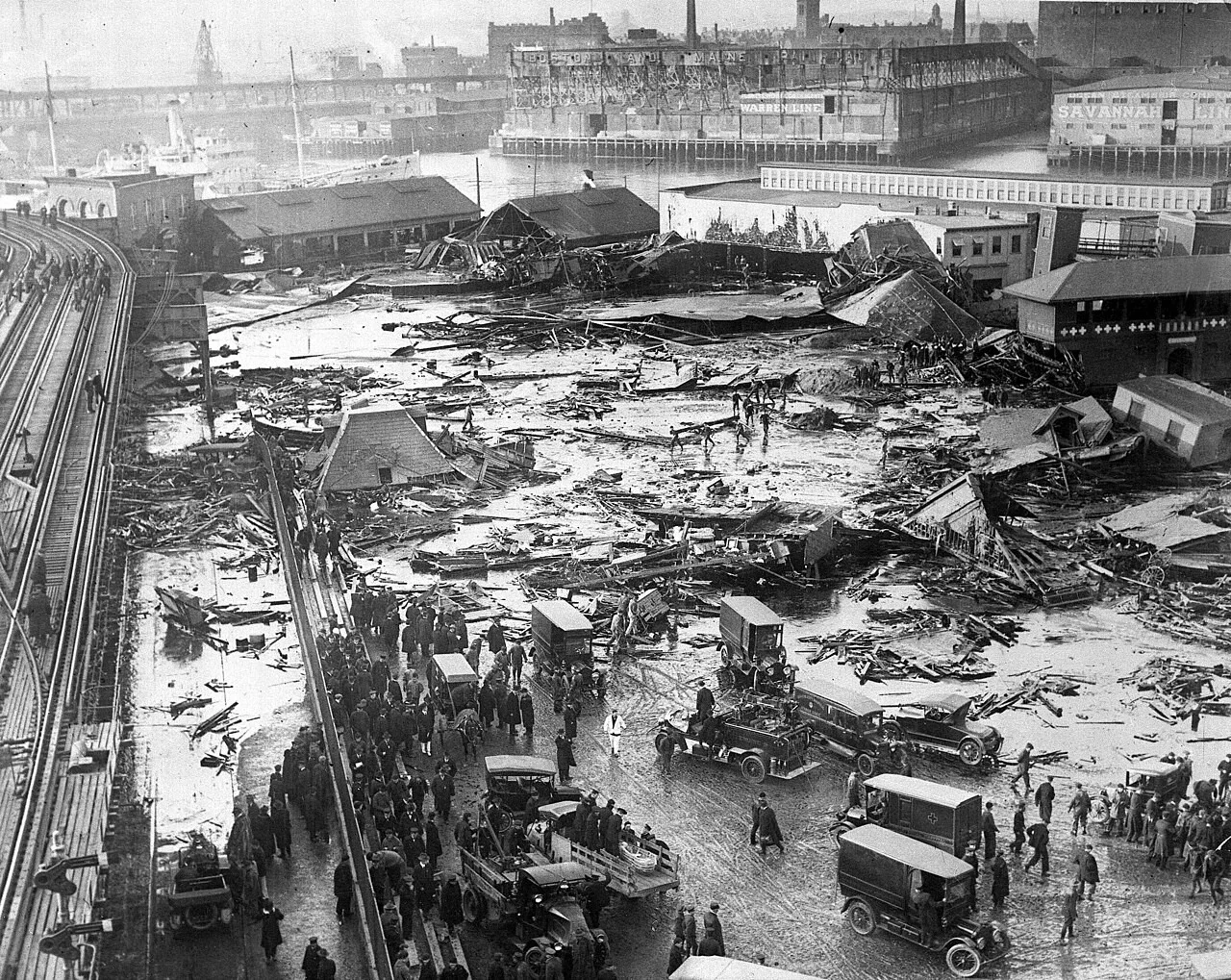
At about 12:40 p.m. on January 15, 1919, a storage tank on Boston’s Commercial Street ruptured. Witnesses first heard a rumble; then an enormous mass of industrial molasses swept through the North End, carrying debris into streets, homes and a firehouse. Twenty-one people died and roughly 150 were injured. The disaster is remembered for its unlikely substance, but the question at its center was ordinary: who had checked the tank, and what had its owners done when it began to leak?
The answer emerged slowly, through an investigation and years of civil litigation. The surviving record describes a catastrophe in a working neighborhood, followed by a technical inquiry into a structure built quickly and operated despite visible problems. It also explains why the familiar shorthand of a “wave of molasses” should not make the event sound comic. The liquid was heavy, moved with force and mixed with wreckage; people were trapped, crushed or suffocated.
A tank beside a crowded neighborhood
The tank belonged to Purity Distilling Company and stood by the waterfront and elevated railway tracks in Boston’s North End. The City of Boston’s historical account says it was about 50 feet tall and built in 1915. Molasses arrived by ship and was stored before being sent by rail to distilleries. The location put a huge industrial vessel beside homes, businesses and the paving yard where many of the eventual victims worked. The City of Boston’s account notes that people in the neighborhood knew the tank leaked. The leaks were visible before the structural failure that investigators later had to explain.
On January 15, a tank holding an estimated 2.3 million gallons failed. The first report in the Boston Post, reproduced by the Massachusetts Humanities site Mass Moments, captures the uncertainty of the early hours: rescuers were still counting the dead, and the cause remained unknown. That contemporary account is vivid, but it is an early report written amid confusion, not a final engineering explanation.
The victims included laborers and drivers, fireman George Layhe, and two ten-year-olds, Pasquale Iantosca and Maria Distasio, whom the city later identified. Cadets from the USS Nantucket, police, firefighters and Red Cross workers joined the rescue effort. The damage continued after the flow stopped. Survivors faced injuries, destroyed homes and cleanup made difficult by molasses mixed with broken buildings and equipment.
From rumor to evidence
In the immediate aftermath, the company suggested an anarchist bomb might have caused the rupture. The theory drew on the anxieties of 1919, a period of bombings and political fear, but was not established by the evidence. Boston’s account says an initial inquiry and a later court proceeding focused instead on structural instability.
The civil process lasted years. Families and property owners brought claims that were consolidated before the Massachusetts Superior Court. The court-appointed auditor, Hugh W. Ogden, heard evidence about the tank and the losses. Lehigh University’s finding aid describes a collection of reports commissioned from engineer Albert Ladd Colby for the defense team, including steel tests, blueprints, photographs and analyses of possible failure mechanisms. These materials are valuable precisely because they were prepared for one side in the litigation: they are technical evidence, but their origin matters.
In 1925, Ogden’s report assigned responsibility to the tank’s owner. The City of Boston describes his finding as negligence by the owners; Mass Moments dates the submission to April 28 and presents the Boston Post’s first account alongside its later history. The key documented conclusion is that the court-appointed auditor rejected the company’s theory of sabotage and found the owner responsible. The legal finding grew from testimony and technical records, not from a confirmed attack.
Witness statements, engineering documents and damage claims gave Ogden a way to test the competing accounts. The evidence shifted attention from speculation about an attacker to the decisions involved in designing, building, inspecting and operating a large tank beside a residential district.
A legal record of neighborhood losses
The proceedings considered more than the tank. Lawsuits recorded deaths, injuries, damaged homes and lost livelihoods. WorldCat’s catalog description of the auditor’s report identifies at least 110 civil suits consolidated in the matter, including claims by individuals, the city and the Boston Elevated Railway. The archive therefore documents the disaster’s human reach as well as the structure’s failure.
The surviving public record is uneven. The Massachusetts archival collection includes a later state report with a short account; Lehigh describes technical materials assembled for the defense; and Boston’s account draws on city photographs and records. None replaces the original hearing transcripts or individual damage files. The public sources show which questions Ogden had to resolve, even where they do not preserve every test or statement he heard.
Boston rebuilt the waterfront, and the tank disappeared. But the North End remained a neighborhood shaped by industry and immigration. People who lost family members, homes or the ability to work were not abstractions inside an engineering dispute. Their claims placed the company’s decisions into a public legal record.
Why the strange name endures
The molasses flood is easy to retell as an oddity. Its name invites a joke, while the scale of the event resists one. A familiar food ingredient became a deadly industrial load because it was stored in a tank that failed beside a populated area. The image is memorable; the court record makes the memory more serious.
The litigation helped reinforce the demand that industrial structures be designed and maintained with competent engineering and public accountability. It would be too neat to say that one disaster alone created modern building codes; regulation develops through many accidents, professional debates and laws. What this case left behind is a record showing how negligence claims could be tested against physical evidence and how victims’ families could seek compensation through consolidated proceedings.
A century later, the useful question is not whether molasses can move like a wave. It is how company decisions, public oversight and the placement of dangerous infrastructure intersected in Boston’s North End. The answer begins with a tank that split at lunchtime and continues in the reports, photographs and testimony that made responsibility harder to evade.
Sources: City of Boston historical account and archive photographs, Massachusetts archival report, Lehigh University tank investigation collection, Mass Moments with the 1919 Boston Post report, catalog of the 1925 auditor’s report