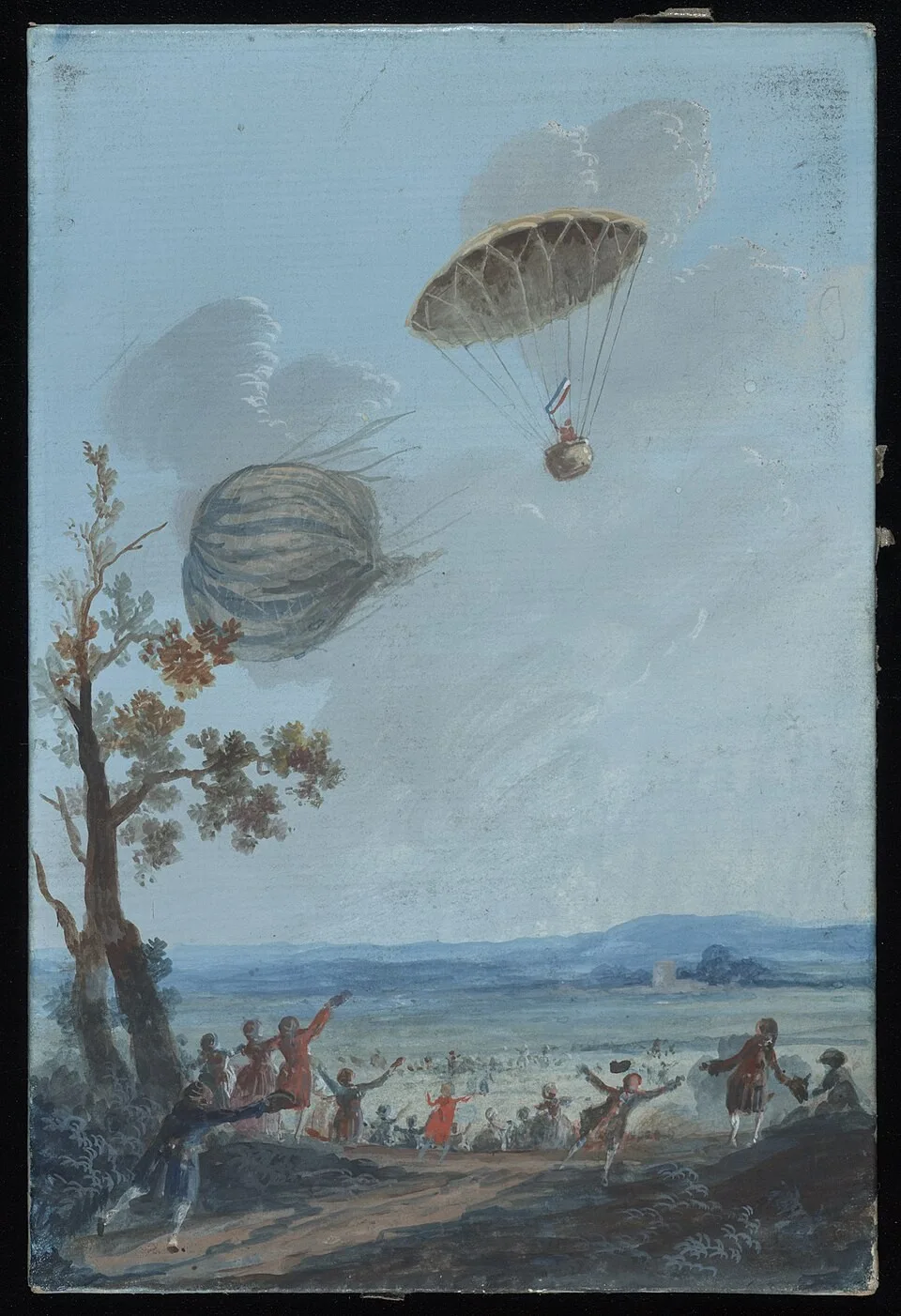
The basket went down with him. André-Jacques Garnerin's experiment placed the aeronaut beneath a fabric canopy suspended from a balloon; when the connection to the balloon was severed, the basket and parachute began their separate descent. The whole arrangement had to carry a person back to earth. In the history of flight, gaining height had created another problem: how to leave the machine that had taken you there.
On October 22, 1797, Garnerin demonstrated that possibility above Parc Monceau in Paris. The descent is recognised by Guinness World Records as the first recorded parachute descent from a balloon. Two hundred and twenty-nine years later, the date connects a public spectacle with the practical question of survival in the air. Accounts, prints and a later patent preserve the experiment and the careers that grew around it.
A way back from the air
Garnerin's place in this history does not require erasing earlier experiments. The RAF Historical Society's survey describes work by the French pioneer Lenormand and animal descents arranged by the balloonist Jean-Pierre Blanchard before 1797. People were already considering how fabric could slow a fall. The balloon extended the problem beyond a building: an aeronaut might need a way to escape from a vehicle high above the ground.
Garnerin used a basket suspended beneath a parachute, carried upward by the balloon. The fabric opened after the assembly was released. This was a public experiment with a means of descent, whose behaviour had to be tested in the air. Its success depended on more than opening the canopy: the basket also had to remain survivable while hanging beneath it. The accounts of the event make the instability of that arrangement particularly clear.
The reported height varies. The account presented by France's patent office, INPI, places the release above 700 metres; Guinness estimates 914 metres. The shared point is the scale of the experiment, hundreds of metres above Paris. A single precise altitude would give the history a certainty its accounts do not share. The date, the setting and the successful descent from the balloon are much more securely established.
A parachute that carried a person had to work in circumstances where an audience could observe only part of the experiment. Spectators could see the balloon rise and watch the fabric open. The person in the basket had a different view of the descent. This is one reason that the surviving prints and the later accounts tell complementary stories: one shows how the apparatus was presented, while the other describes what happened to its passenger.
The parachute opened, and swung
The canopy slowed the descent, but the basket oscillated violently. INPI's historical account describes the alarm this caused among the spectators before Garnerin reached the ground. A later Air & Space magazine account likewise emphasises the swinging. The experiment demonstrated a route back from altitude while exposing a further problem for designers: descending under an open parachute could still involve a highly unstable ride.
Garnerin continued to perform. On September 21, 1802, he made a parachute descent in London. MIT's collection catalogues an article containing an abbreviated version of his own account and an illustration showing stages of ascent and descent. At the Science Museum Group, a separate print describing his parachute was published in London by E. Bell on September 23, two days after the event. The demonstration had become something that could circulate in print as well as be watched outdoors.
An account of a later English descent reproduced by Air & Space describes the basket swinging like a pendulum, at times almost level with the canopy. It reports a descent of about ten minutes and a pale Garnerin briefly sick after landing, but otherwise unharmed. These details belong to the later performance, not to the day in Paris. Repeating the experiment had carried the aeronaut's reputation across the Channel without making the ride a comfortable one.
Jeanne Labrosse joins the history
The story soon included Jeanne-Geneviève Labrosse, Garnerin's pupil and later his wife. INPI records her solo balloon flight in November 1798 and her parachute descent in 1799, identifying her as the first woman to undertake the latter. Her contribution continued beyond performing. On October 11, 1802, acting on her husband's behalf, she filed a five-year patent for a machine called a parachute. The preserved patent record places her name directly within the invention’s documentary history. The flight records show Labrosse operating a balloon and parachute herself. The 1802 file records a different role for the same aeronaut, now acting in a formal procedure on Garnerin’s behalf.
The Musée de l'Air et de l'Espace also connects Labrosse with the 1802 filing and the couple's subsequent demonstrations before European royal courts. Its collection includes a fan depicting their balloon ascent in Berlin in 1803, accompanied by a local passenger, Mr Gärtner. Such objects show how aeronautical performances became part of popular material culture. The people who flew were also the subjects of souvenirs, portraits and accounts that travelled further than a single audience could.
What the anniversary preserves
A later engraving in the Library of Congress depicts Garnerin standing in his gondola and waving a French flag, with the released balloon nearby. The subject is the Paris descent of 1797. The library dates the print itself to the nineteenth century. The flag and the pose in the basket belong to the engraver’s depiction. The image shows how the experiment continued to be pictured after the event. Alongside the contemporary London print and the patent, it belongs to the long public afterlife of a man descending beneath an unfamiliar machine.
October 22 marks a practical demonstration in the early history of human flight: separation from a balloon could end in a living passenger reaching the ground beneath a parachute. Garnerin's swinging basket exposed the difficulties as well as the possibilities. The later performances, Labrosse's descents and the patent filed in 1802 show the work continuing after the famous day in Paris. The anniversary belongs to that developing practice of finding a way down from the air.
Sources: Guinness World Records: first recorded balloon descent; INPI: Jeanne-Geneviève Garnerin’s patent record; RAF Historical Society: early parachute history; Air & Space: Paris and a later English descent; MIT Digital Collections: Garnerin’s London account; Science Museum Group: London print, September 23, 1802; Musée de l’Air et de l’Espace: the Garnerins in Berlin; Library of Congress: a later image of the 1797 descent.