The spacecraft kept circling Earth long after its passenger was dead. On November 3, 1957, the Soviet Union launched Sputnik 2 with Laika, a small dog, inside a sealed cabin. She became the first animal known to orbit the planet. The satellite's signals stopped days later; the craft itself did not burn up in the atmosphere until April 1958. Those dates measure different things. Neither tells us with certainty the precise moment Laika died.
The mission joined an enormous technological achievement to a decision made before launch: there was no system to bring her home alive. Sixty-nine years later, her story is often compressed into a brave animal, a triumphant rocket and a single explanation of her death. The surviving record is less tidy. It reveals what researchers wanted to learn, what the Soviet public was told, and how difficult it remains to reconstruct an animal's last hours from incomplete signals.
A dog chosen for a new kind of flight
The Soviet Union had launched Sputnik 1, the first artificial Earth satellite, on October 4, 1957. Its successor followed less than a month later. The Cold War lent both launches political force, and the approach of the fortieth anniversary of the 1917 Russian Revolution added pressure for another demonstration. Sputnik 2 carried scientific equipment and a living passenger. The feat was orbital flight: the craft traveled fast enough to continue falling around Earth, rather than simply rising and returning along a short arc.
Animals had reached space before Laika. Soviet dogs Dezik and Tsygan had survived a suborbital rocket flight in 1951, returning after a journey that did not circle the planet. Researchers wanted to understand launch forces, confinement and weightlessness before attempting human flight. Going into orbit made the experiment longer and raised an additional problem: a spacecraft had to provide a breathable environment far beyond the launch pad.
NASA describes Laika as a small stray dog. Historian Amy Nelson's research on Soviet space dogs explains that teams selected small, healthy animals and looked for dogs that could adapt to people and to tests. The program's preparation included confinement and exposure to launch-like forces. Those were practices imposed on animals, not choices they made. Details of individual dogs' lives remain difficult to establish: Nelson notes inconsistent names, restricted records and the limitations of participants' memories.
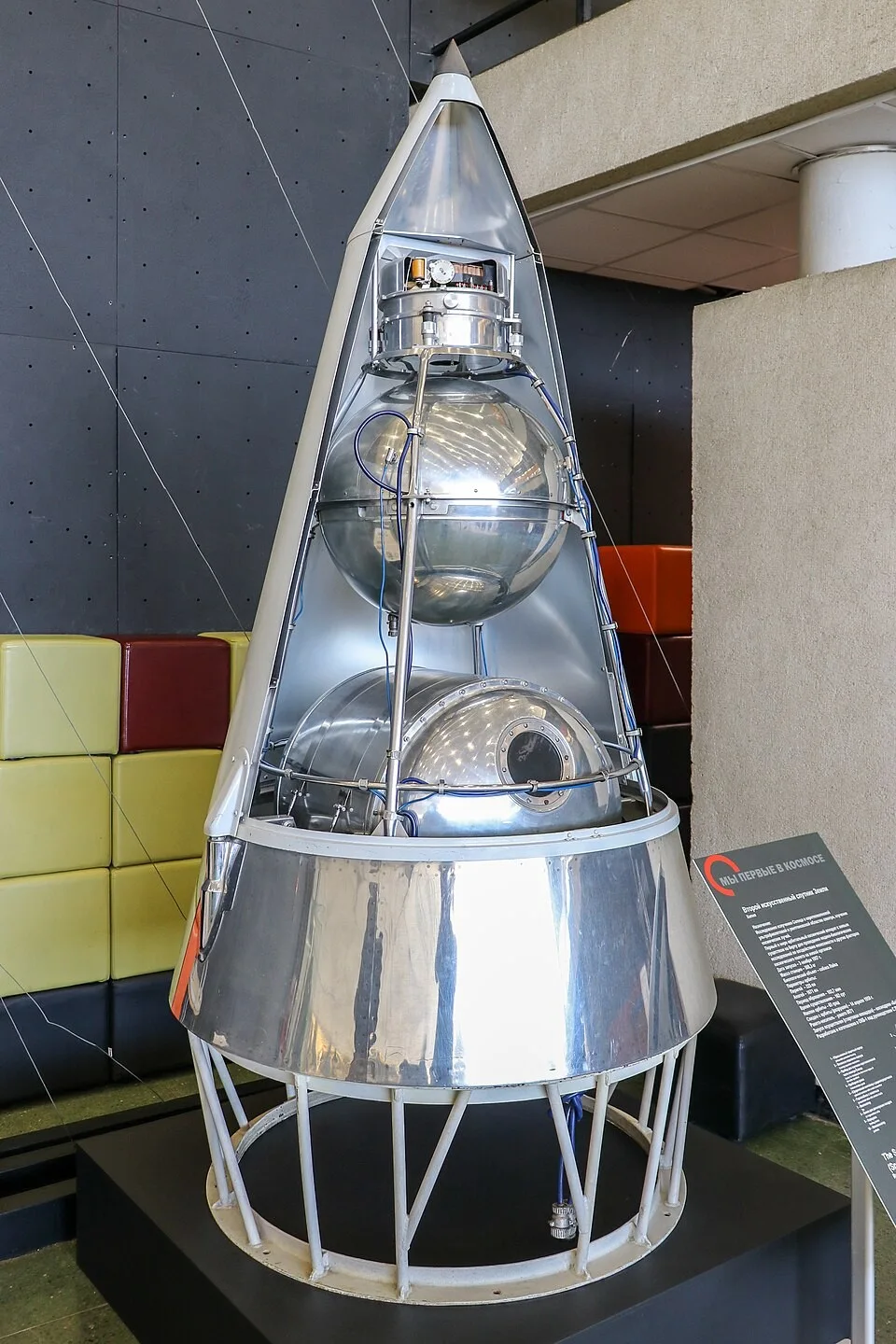
Sputnik 2 weighed 508 kilograms, according to NASA. It was much heavier than its predecessor and remained attached to its booster after entering orbit. Carrying a living passenger meant accommodating a pressurized compartment and monitoring equipment in a spacecraft put together in a matter of weeks. NASA’s account also notes that its environmental control system was designed for a short mission.
The cabin and the signals
Laika's compartment included equipment intended to support life and instruments to monitor her body. A U.S. government report reproducing a Soviet physiologist's account described measurements of breathing, heart activity and other functions. Data could be transmitted to the ground, but readings were not a continuous film of everything she experienced. They showed physiological changes within the limits of the equipment and the information that reached the people interpreting it.
The experiment addressed a real question: could a living animal survive the launch and the onset of weightlessness in orbit? Early measurements were interpreted as showing that Laika lived through those phases. This did not establish that a human could safely complete an orbital mission, much less return from one. No recovery system had been provided for Sputnik 2. The distinction between surviving the start of a journey and completing it safely was central to the experiment's limits.
The satellite continued to transmit after Laika's death. NASA's history places the end of the battery-powered signals on November 10, 1957, and the craft's atmospheric reentry on April 14, 1958. A functioning transmitter was not proof that its passenger was alive. Separating the life of the satellite from the life it carried is necessary to understand both the engineering and the stories that circulated afterward.
What later accounts can—and cannot—settle
Public explanations of Laika's death changed. A 1959 U.S. Senate report reproduced an account of questions put to Soviet physiologist Andrei Kousnetzov. He associated her death with a failure of air regeneration but, the account says, did not specify when it happened. The seven-day duration discussed there referred to the intended period of information gathering, not a demonstrated survival time. Later claims that she lived for a week should not be treated as established by the batteries' life alone.
In 2002, a researcher from Russia's Institute of Biomedical Problems reported that overheating had killed her within hours. NASA later described survival for only a few hours as likely. Yet a 1957 Soviet memorandum published decades afterward complicates a precise reconstruction: as reported by space historian Anatoly Zak, it recorded a sharp cabin temperature rise and sparse, partly conflicting indications from sensors on later orbits. Zak questioned whether a reported later heart signal was reliable. The available accounts point toward a short life in orbit and serious overheating, but the exact time cannot be recovered confidently from these reports alone.
The journey home that came later
On August 19, 1960, the Soviet Union launched another spacecraft carrying the dogs Belka and Strelka along with other animals and biological specimens. They returned alive the following day. Other animal flights failed, and returning living passengers required a different capability from placing a capsule in orbit. On April 12, 1961, Yuri Gagarin became the first human in space. Laika's flight belonged to that sequence of research, but it was not a rehearsal with the same prospect of return.
Laika became a public symbol, while the individual dog is harder to recover from the record. The mission produced information and accelerated a contest between states; it also subjected an animal to a flight without a planned rescue. Those facts deserve to be held together. Remembering her on November 3 means reading the technical record carefully, acknowledging its uncertainties and recognizing the life behind the measurements—not giving the silence after the signals stopped a meaning the instruments cannot supply.
Sources: NASA Johnson Space Center history of Sputnik 2, NASA, animal spaceflight history, Amy Nelson, British Journal for the History of Science Themes, Soviet space dogs, 1959 U.S. Senate report, Project Mercury, reproduction of report on Soviet physiologist Andrei Kousnetzov, Anatoly Zak, Laika Declassified, Smithsonian Air & Space, NASA, Soviet cosmonaut program and Belka and Strelka, 1959 NASA launch record.