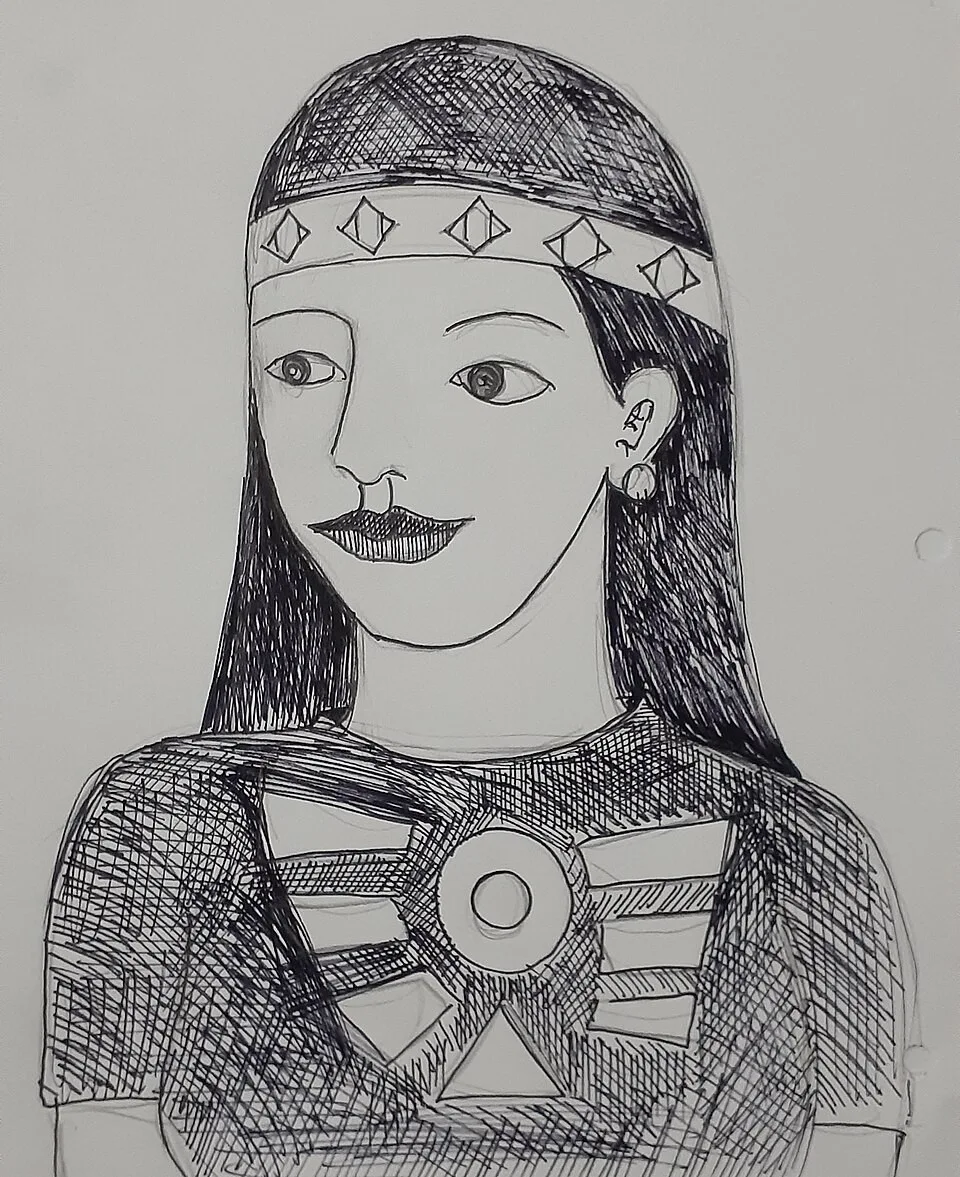
In Pedro Cieza de León’s account, a ruler offered five leading men as hostages so that Francisco Pizarro would feel safe coming ashore. She had already been willing to board his ship herself. The woman Cieza calls the Capullana receives the visitors and sets the terms of the encounter. Before the conquistador steps onto her land, he must deal with her authority.
The episode is a chronicler's reconstruction, not a transcript of their conversation. Yet it preserves something more consequential than a picturesque reception: a woman acting as a political interlocutor. The capullanas were female Indigenous leaders associated especially with Piura, in what is now northern Peru. Their story runs from accounts of the conquest into colonial lawsuits in which women had to establish, in writing, their right to govern.
A coast with more than one centre of power
Calling them queens can make them sound familiar while obscuring their position. They were not successive sovereigns of one kingdom stretching across Peru. They belonged to local ruling structures, notably among the Tallán populations of the north coast. The Andean term curaca and the Spanish colonial usage cacique referred to Indigenous authorities; curacazgo or cacicazgo could designate their office or jurisdiction. A capullana held a place within that political world.
María Rostworowski traced their presence in places including Catacaos, Narihualá, Colán, Sechura, Menón and Nonura. That geography matters. The history of the Andes cannot be reduced to the Inca ruler in Cuzco, and the history of Indigenous women cannot be confined to the ruler's wives. On the northern coast, women appear in the records as holders of local authority, with communities and succession rights attached to their position.
The woman who received Pizarro
Cieza's narrative, examined by historians Estela Cristina Salles and Héctor Omar Noejovich, describes a capullana arranging hospitality and communicating with the Spaniards before Pizarro's capture of Atahualpa at Cajamarca. The offer of hostages belongs to that negotiation. The welcome is not simply a scene of Europeans discovering a passive population: the account gives the local ruler initiative and people whose presence she could offer as a guarantee.
Cieza also introduces a Spaniard's attraction to her. That detail has the ingredients of a romantic story, but the historians caution that the literary treatment shapes the exchange. Food, invitations and assurances were instruments of contact between parties who did not yet trust each other. In the narrative, the person managing them on shore is a woman.
A name seen through Spanish eyes
The Dominican Reginaldo de Lizárraga, writing later in the colonial period, placed women rulers in his description of the river of Motape. He explained capullana through capuz, the long garment to which Spaniards compared local women's dress. Rostworowski later proposed a different derivation, drawing on vocabulary recorded for Catacaos: the element capuc appeared in a term for a daughter. These are competing explanations, not a settled translation that permits us to recover exactly what every ruler called herself.
Lizárraga also wrote that these women could dismiss a husband and marry another. His account lingers on the rejected man, humiliated while the new couple celebrates. It is an arresting passage, but it reaches us through a friar's moral categories and taste for contrast. It establishes what he reported; it does not establish that every capullana followed the same marriage rules, or that all women enjoyed the freedoms of an elite ruler.
Bartolomé de las Casas supplied a different emphasis. In the text later collected as De las antiguas gentes del Perú, he described certain Tallán and Huancavilca communities where women, rather than men, inherited leadership. His wording concerns particular peoples. Expanding it into a single matriarchy governing ancient Peru would erase the regional differences that make the testimony valuable.
Francisca's claim
By the early seventeenth century, the question of female government was being argued in a different setting. Doña Francisca Canapaynina, also identified in the scholarship as Francisca Mesocoñera, claimed rights to the cacicazgo of Narihualá. Rostworowski studied the proceedings; Salles and Noejovich later revisited the testimony. A legal provision reproduced in their study stated that being female did not prevent succession, invoking the capullanas' longstanding custom of inheriting such offices.
The witnesses did not all describe the custom in the same way. Some recalled women succeeding and governing as men did. Others added a restriction: a woman inherited when there was no legitimate male heir. One account allowed a principal man to govern temporarily for an underage female successor. These differences concern who could wield authority, not merely who could receive a family's possessions.
Rostworowski cites a deposition of 15 March 1612 in which Captain Bartolomé Carreño discussed female authority. Her discussion also names doña Leonor in Menón, doña Latacina in Colán and doña Isabel Socolá in Narihualá. The names give substance to a category often left anonymous. Francisca's claim drew on a remembered political practice, but the evidence was now being assembled for colonial officials, in the language and procedures of their courts.
Keeping an office as its world changed
Salles and Noejovich interpret the differing succession accounts as evidence of a transition: Spanish norms increasingly favoured men, while older practices offered women a stronger claim. Alejandro Diez's research on Piura stresses the importance of belonging to a ruling lineage. These approaches help explain why the survival of a title and the freedom to exercise its powers are different questions. Women's authority persisted, but under changing conditions.
The surrounding institutions were changing too. Diez describes the creation of the colonial resettlement towns of Catacaos and Sechura in 1572, which brought different Indigenous groups together while retaining their own leaders. Caciques now operated within a system that required tribute collection, labour recruitment and participation in Christian instruction. A claim to ancestral leadership had to function in this new administrative order. The conquest did not simply make all local offices disappear; it altered their obligations and the ways they were recognised.
Beyond the image of an exceptional woman
Archaeology has widened the background to this history. At Chornancap, in Lambayeque, a tomb discovered in 2011 belonged to a woman interpreted by its investigators as a ruler and priestess of the twelfth or thirteenth century. Alicia Alvarado Escudero's research, published at the Universidad Pablo de Olavide in Seville, examines the political and religious roles of elite women on the north coast. Such findings make female power harder to dismiss as an isolated curiosity. They do not identify the woman in that tomb as a sixteenth-century capullana or prove an uninterrupted institution across the intervening centuries.
The chronicler who recounts a negotiation and the witnesses who describe a succession show the capullanas exercising power in different circumstances. Neither the Spaniards' surprise nor later admiration is enough to describe them. They governed within particular communities, belonged to powerful lineages and faced changes that could separate an inherited right from its exercise. Francisca's proceedings preserve that struggle in a concrete form: a woman asking a colonial legal order to recognise that governing was also her inheritance.
Sources: Salles and Noejovich: female inheritance and colonial change, 2006; María Rostworowski: Los curacas costeños, 1999; Reginaldo de Lizárraga: Descripción colonial, book I, chapter VIII; Bartolomé de las Casas: De las antiguas gentes del Perú; Alejandro Diez: local government in Piura, 2006; Alicia Alvarado Escudero: reading the chroniclers, 2016; Alicia Alvarado Escudero: elite women on the north coast, Seville, 2015; Carlos Wester on Chornancap, interviewed by Andina, 2016; Miguel Arturo Seminario Ojeda: names in the Piura records, 2017.