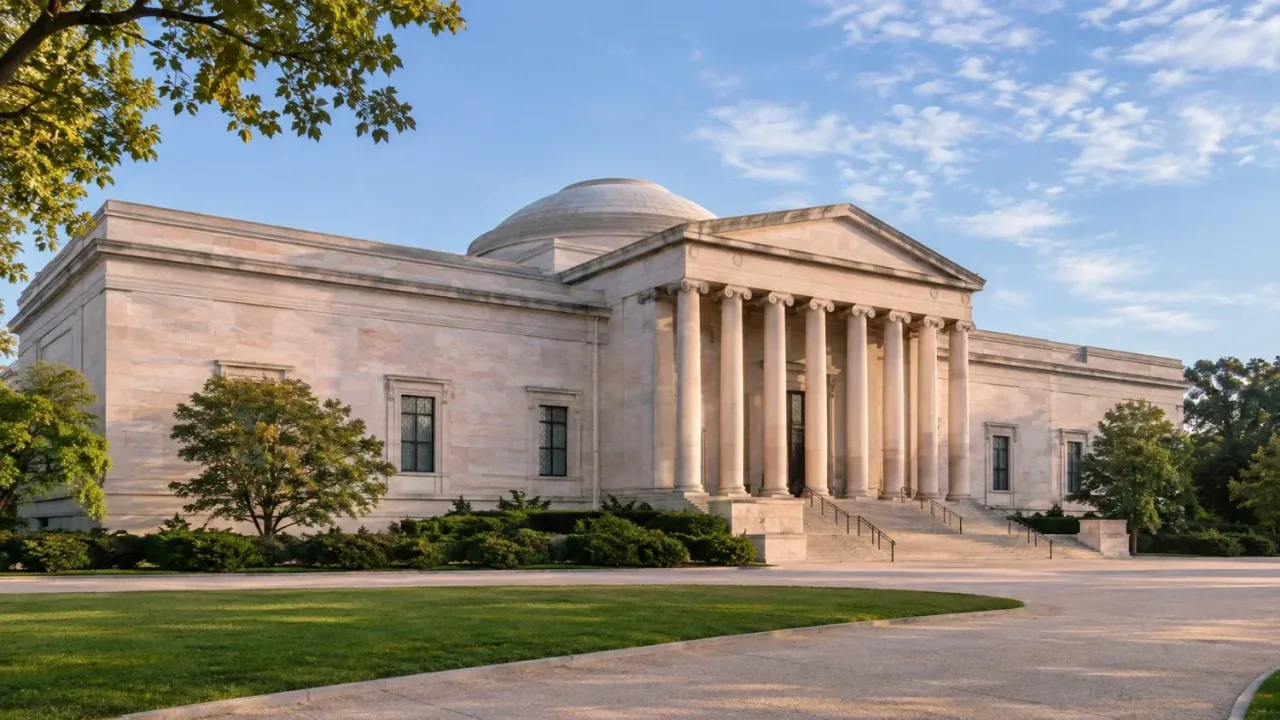
Washington offers a tempting illusion: because so many of its major museums are free, a visitor should be able to see them all. Admission, however, is only one part of the calculation. A reservation can determine whether a door opens; the scale and subject of a collection can determine whether the visit becomes memorable or merely exhausting.
These seven museums offer different ways into science, art, American identity and historical responsibility. All seven are in Washington, DC. The Air and Space Museum's Steven F. Udvar-Hazy Center, a separate destination in Virginia, is not counted here.
1. National Air and Space Museum: the machinery behind the achievement
The original 1903 Wright Flyer gives the museum on the National Mall a persuasive starting point. The aircraft is the centerpiece of a gallery examining the Wright brothers and the invention of the airplane. Its value is not simply that it is famous: it gives physical scale to an achievement usually reduced to a date and a photograph.
This is the strongest choice here for readers interested in engineering and the relationship between an idea, an experiment and a working machine. Build the visit around a question rather than an ambition to inspect everything. How did control become possible? What had to change before flight could become transportation?
Admission is free, but the DC museum requires timed-entry passes. Check gallery availability when reserving.
2. National Museum of Natural History: dinosaurs with a larger argument
The Deep Time fossil hall offers the spectacle people expect, including a Tyrannosaurus and a Triceratops, but its underlying subject is change. Fossils become evidence for interpreting ecosystems, evolution, extinction and a planet whose conditions have never been fixed.
That makes this a particularly useful family choice: a dinosaur can catch a child's attention while the surrounding interpretation gives adults something more substantial than a checklist of enormous skeletons. Follow one ecosystem or one extinction through the displays instead of treating every specimen as an isolated marvel.
General admission is free, and the museum says entry does not require tickets. Security screening still takes time. It also advises visitors to travel lightly because it has no coat check or lockers.
3. National Museum of American History: a national symbol, closely examined
The Star-Spangled Banner is an unusually direct encounter with the difference between an object and its later meaning. The flag that inspired the national anthem survives as a fragile textile requiring carefully controlled conditions, not as an endlessly reproducible patriotic image.
The museum's exhibition combines its history with the work needed to preserve it. Low lighting is therefore part of the conservation story, not a deficiency in the display. Read the surrounding interpretation before moving on.
For a visitor trying to understand how the United States represents itself, this is a strong starting point. General admission is free. Select a small number of subjects elsewhere in the museum rather than expecting a single visit to deliver a complete national history.
4. National Museum of African American History and Culture: more than a supplementary chapter
The museum's history galleries connect slavery, struggles over citizenship, segregation and the continuing pursuit of equality. Its exhibition structure makes an essential argument: African American history belongs within the explanation of the United States itself, rather than in a detached chapter added afterward.
The route from Slavery and Freedom through Defending Freedom, Defining Freedom and A Changing America provides a chronological framework. Cultural material can then be understood against political and social experience, rather than detached from it.
Consider giving this museum a substantial part of a day if the subject is a priority. Free timed-entry passes are required; availability should shape the itinerary before nearby attractions are added.
5. National Gallery of Art: choose a building before choosing a masterpiece
The National Gallery offers a useful alternative to the instinct to chase one famous picture. Its West Building presents art from the 11th through the early 20th century, while the East Building concentrates on modern and contemporary work. Choosing between them can make a short visit coherent.
The collection includes Leonardo da Vinci's Ginevra de' Benci, which the gallery identifies as the only painting by Leonardo in the Americas. Treat that as a collection highlight, while checking its current display status rather than assuming any individual work is always available.
Admission to the galleries and exhibitions is free, without passes or tickets; some events require registration. A visitor drawn to painting might choose a period or compare several portraits. Someone interested in modern art can begin in the East Building.
6. National Museum of the American Indian: whose image, whose history?
The museum's collections extend across the Western Hemisphere, and its exhibitions are developed with Native communities. That breadth matters: a visit should challenge the idea that many distinct peoples can be compressed into one familiar image.
Its Americans project provides a sharp entry point by examining the persistence of Native names and imagery in national identity and popular culture. Familiar references become questions about representation, history and the distance between an image and the people it purports to describe.
This is a valuable companion to American History, especially for visitors willing to compare how institutions frame the national story. Ask which communities are speaking and which assumptions the displays challenge. General admission is free, with no entry pass required under the Smithsonian's published museum listing.
7. United States Holocaust Memorial Museum: plan for attention, not speed
The current Permanent Exhibition traces the Holocaust through objects, photographs, film and individual testimony. The museum recommends it for visitors aged 11 and older. This is a subject for sustained attention, so avoid placing it in the remaining minutes between lighter attractions.
The distinction between building entry and exhibition access is important. Timed tickets are required for the Permanent Exhibition, but not for entry to the building to see Daniel's Story and certain other exhibitions. Tickets are free; advance online reservations carry a $1 Etix transaction fee.
There is also an announced change ahead. The museum says its current Permanent Exhibition will become unavailable when construction begins in January 2027, with completion planned for 2029. During the work, the museum plans to present the temporary exhibition Auschwitz. Not Long Ago. Not Far Away. Check the museum’s website for the exhibitions and admission options available on your dates.
Make the choice before making the circuit
Choose one main museum for a half-day, then add another only if time and energy permit. Recheck official admission rules, exhibition access and operating notices shortly before traveling. In Washington, a successful museum trip is less about the number of entrances crossed than the number of questions worth taking home.
Sources: Smithsonian admission guidance, African American History museum visitor information, National Gallery visitor information, Holocaust Museum Permanent Exhibition, Holocaust Museum admission and tickets, Holocaust Museum announcement of the temporary Auschwitz exhibition.