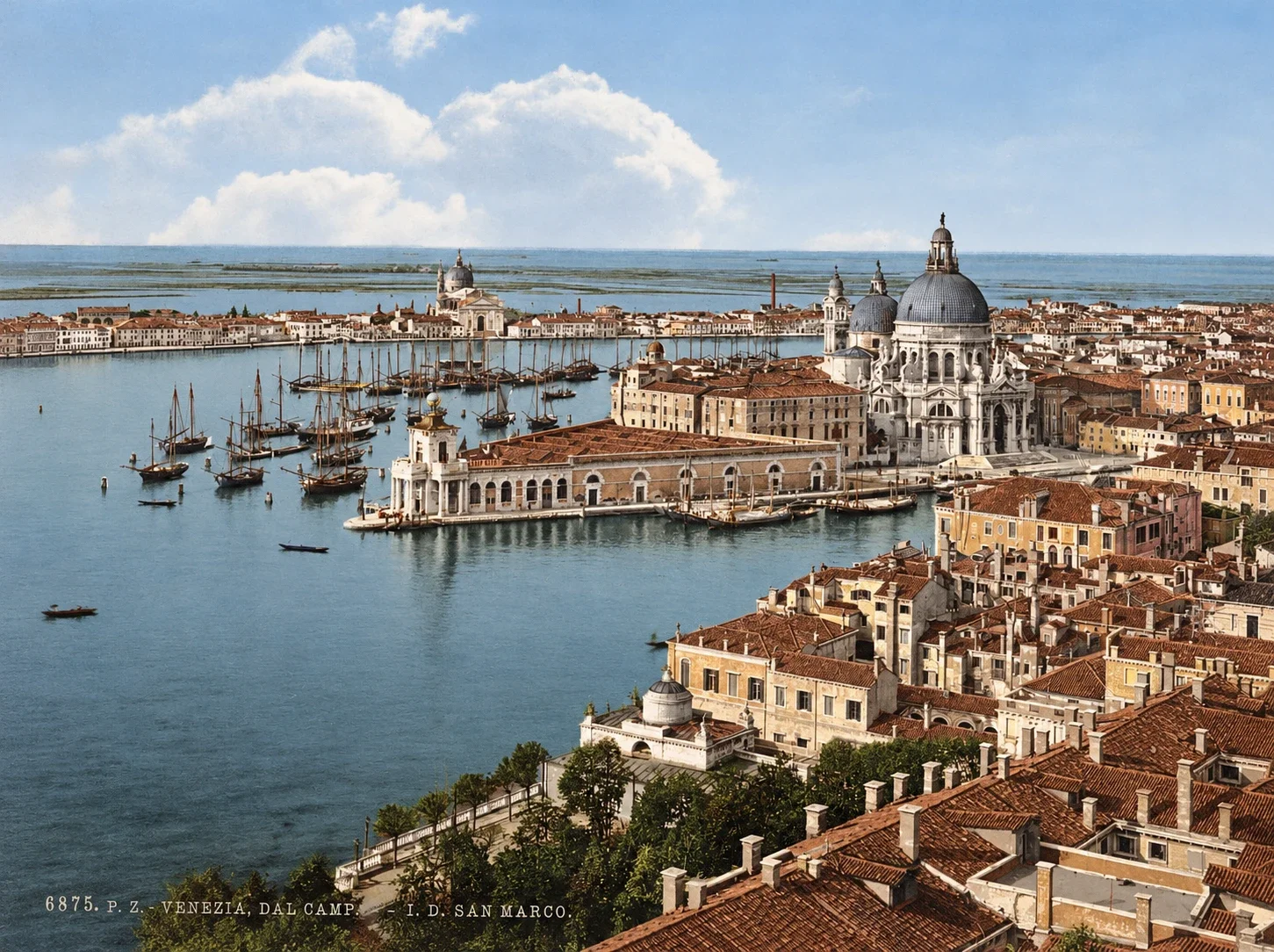
The first thing a nineteenth-century traveler might notice in Venice is how the water sets the pace. A boat glides past a doorway; a gondolier waits beside a stone landing; footsteps echo through a narrow passage and emerge into a sunlit campo. The city is already famous, yet these photographs invite us to pause, look across the lagoon and let the view unfold without being hurried along.
At the Piazzetta, the Doge’s Palace stands beside the basin of San Marco. Two granite columns frame the water: the winged lion of Saint Mark faces the lagoon, while Saint Theodore looks toward the city. Across the basin, San Giorgio Maggiore rises on its island. The view is composed like a stage, but it also belonged to daily life: boats arrived here, residents crossed the square and visitors came to see a place they already knew from paintings, books and travel accounts.
Venice was no undiscovered secret in the nineteenth century. It had long been a celebrated stop for travelers, and the Grand Tour had helped make its churches, palaces and art famous across Europe. What changed during the century was how visitors could keep and share a view. Photographic studios, including those of Carlo Ponti and Carlo Naya, sold images of the city as souvenirs. The Marciana National Library’s exhibition on Naya describes how souvenir photographs first appealed to an elite public and gradually reached a wider market as tourism grew. The photograph became part of the journey: a carefully chosen piece of Venice to carry home.
These images do not show a city without visitors. They show a different scale of travel from today’s mass tourism. A long exposure could soften moving people and boats; an empty-looking square is not proof that the city was always quiet. Still, the broad paving, the few figures and the open water invite us to imagine a slower encounter. A traveler could linger at the edge of the Grand Canal, watch the light change on a façade and continue on foot over the next bridge.
From Rialto, the Grand Canal bends between palaces whose doors open almost at water level. The stone bridge rises above boats and market traffic, linking two sides of the city as it has for centuries. Elsewhere, a narrow canal slips beneath Ponte Trevisan in Dorsoduro. Venice shifts in scale from public spectacle to neighborhood passage: the same water that carries a grand panorama also reaches a doorstep, a workshop or a small landing.
The originals are black-and-white photographs, colorized for this feature. The added hues are an editorial interpretation, not a record of the exact colors seen by the photographers. The captions identify each view and note what survives. Dates and attributions follow the supplied file names where stated; an undated file should not be assigned a precise year without a catalogue record.
Ten views of nineteenth-century Venice
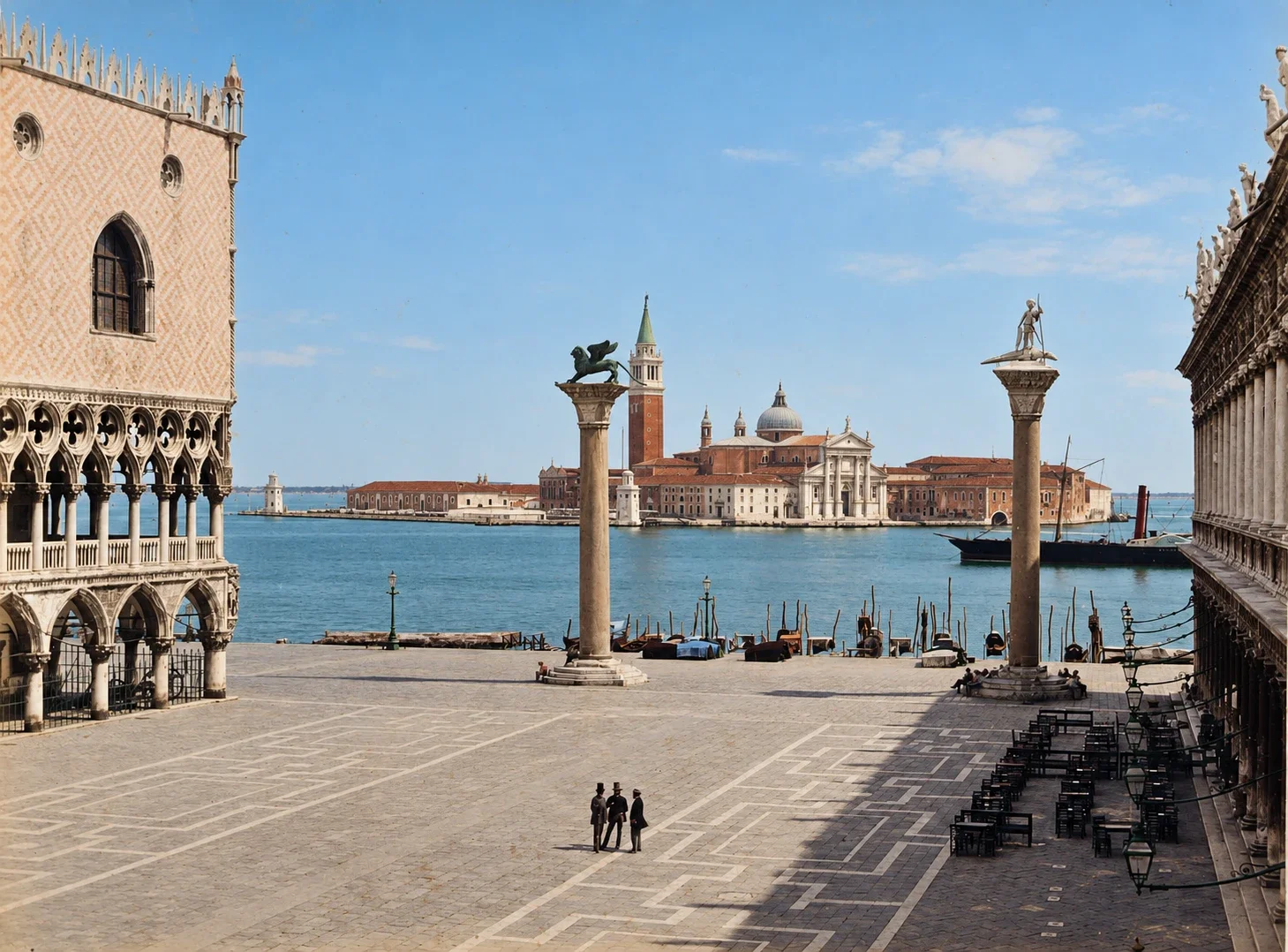
1. The Piazzetta and San Giorgio Maggiore — Carlo Naya. From the square, the Doge’s Palace and Marciana Library frame the basin and the island church. The columns and skyline remain; this is still one of Venice’s defining panoramas.
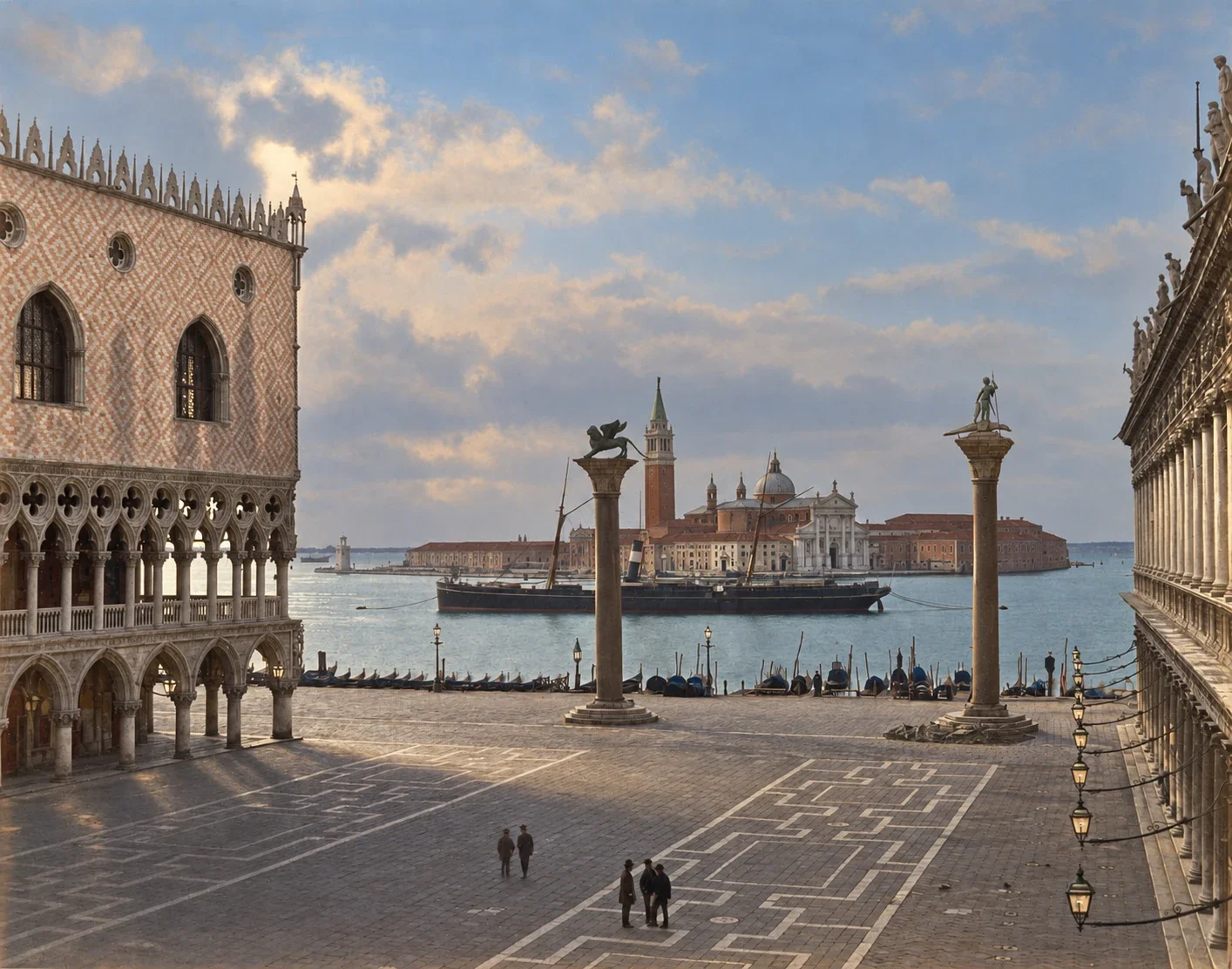
Sailing vessels on the Basin of San Marco. From the Piazzetta, boats and gondolas fill the foreground, with San Giorgio Maggiore across the water. The Doge’s Palace and its columns still frame the waterfront, while the island church marks the far edge of the lagoon. In the nineteenth century, this celebrated panorama was also a working harbor.
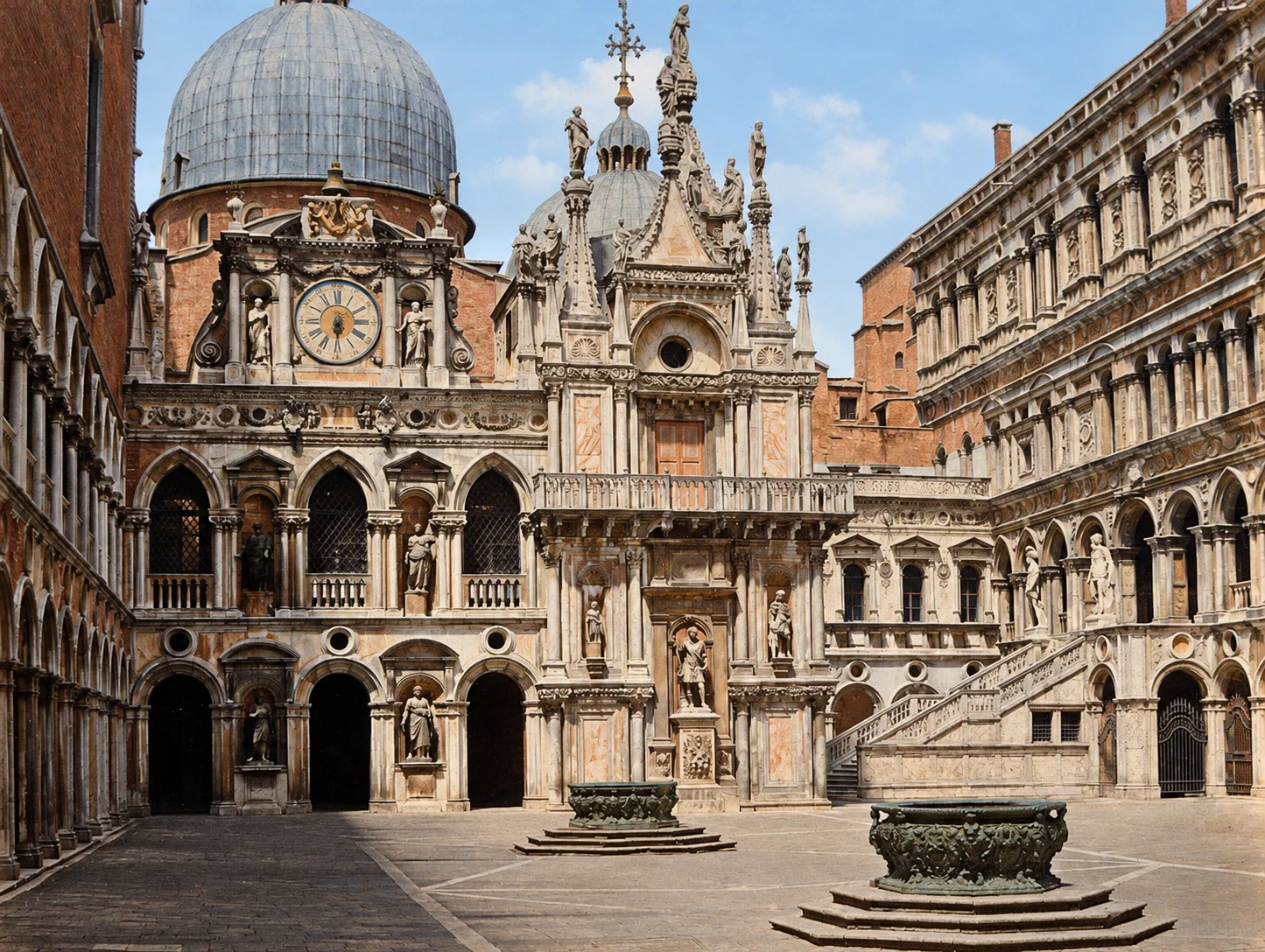
3. The Doge’s Palace courtyard — Carlo Ponti. The Giants’ Staircase, Renaissance loggias and bronze wellheads place the camera inside the palace, not in the square outside. The courtyard and staircase survive and are part of the museum route.
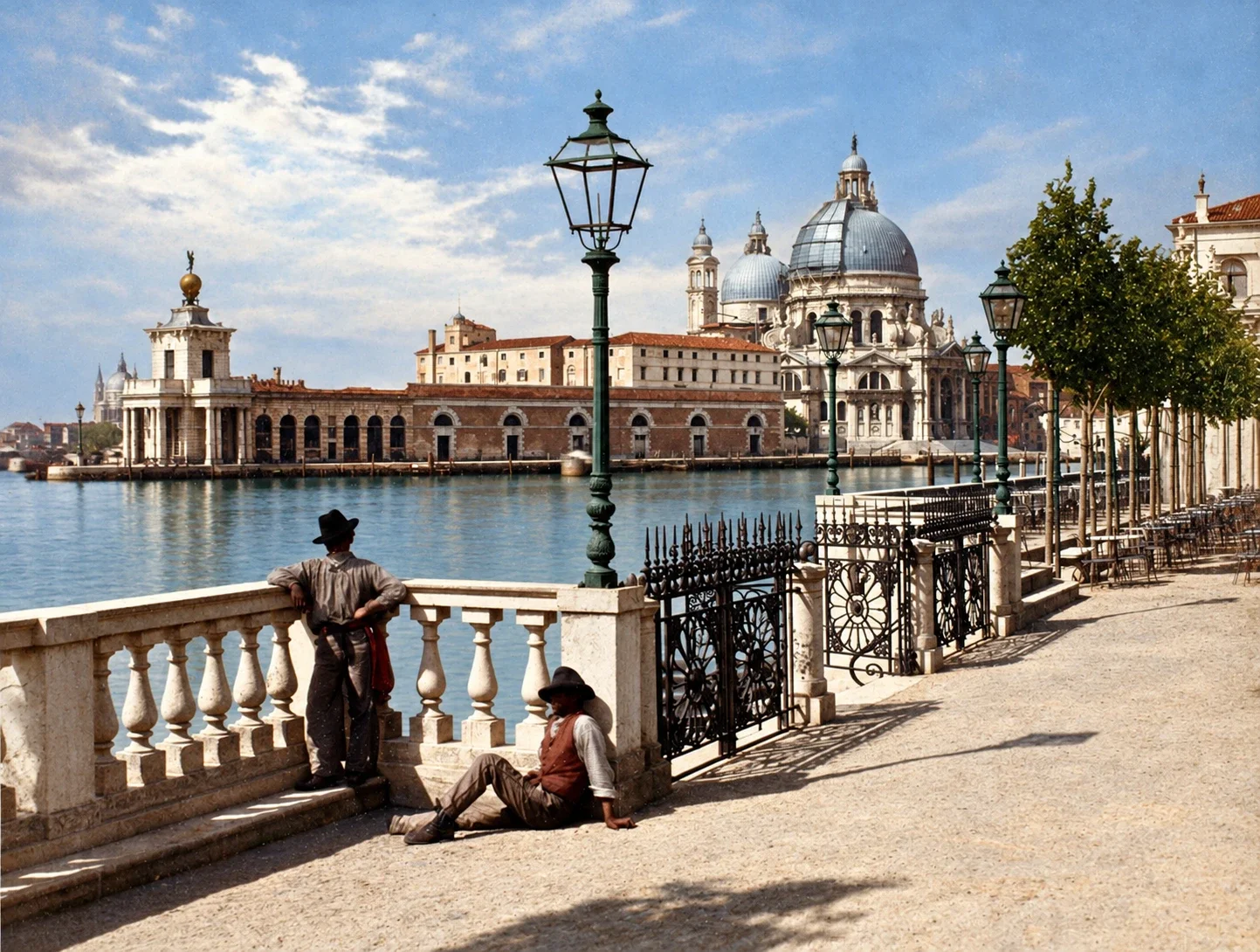
4. The Basin of San Marco and Santa Maria della Salute — 1870. Seen across the water, the domed church stands at the entrance to the Grand Canal. The basilica and Punta della Dogana remain; the filename dates the photograph to 1870.
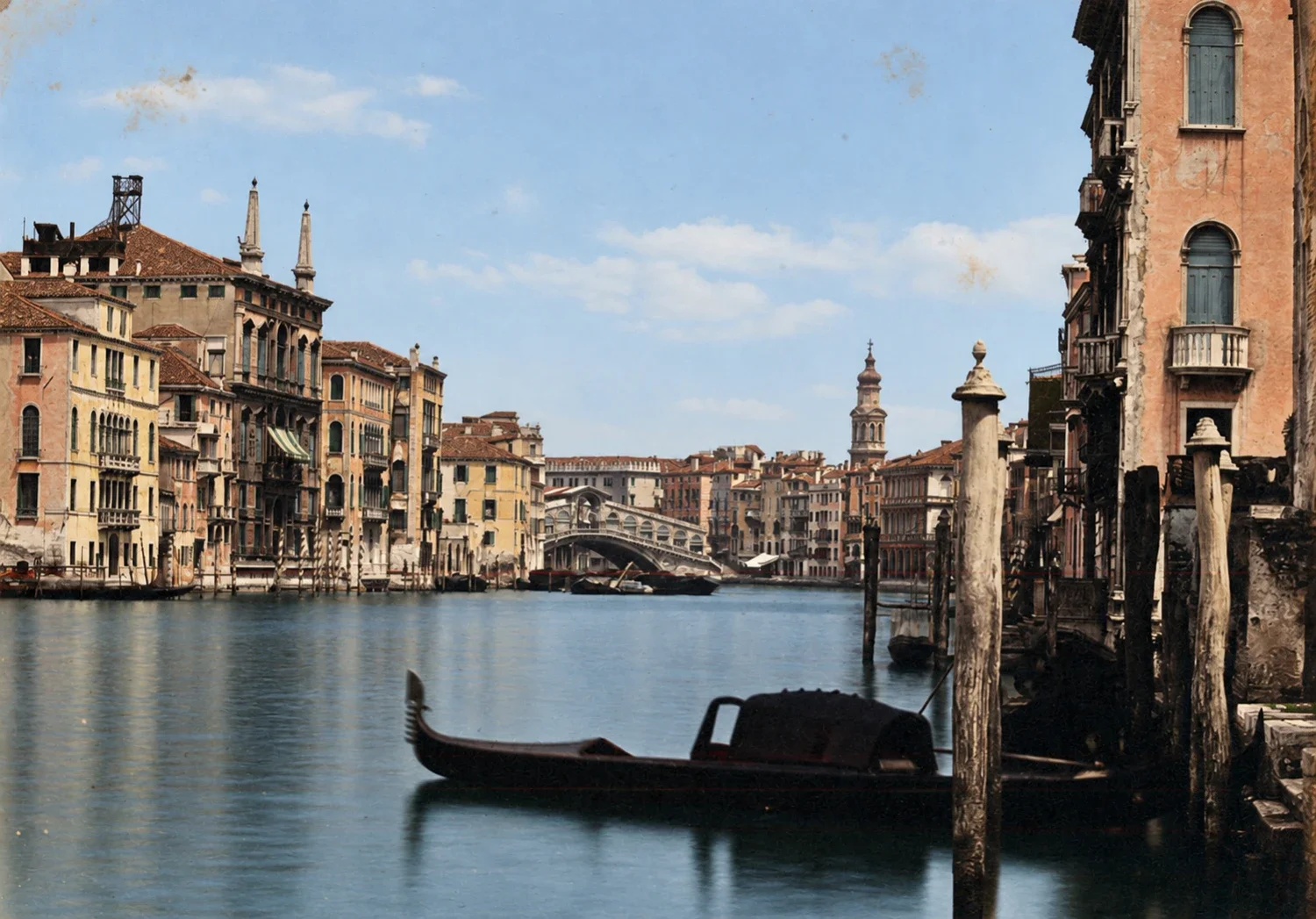
5. The Grand Canal and Rialto Bridge — Carlo Ponti. The bridge appears among canal-side buildings and moored boats. Rialto’s stone arch still spans the Grand Canal, though the traffic around it has changed considerably.
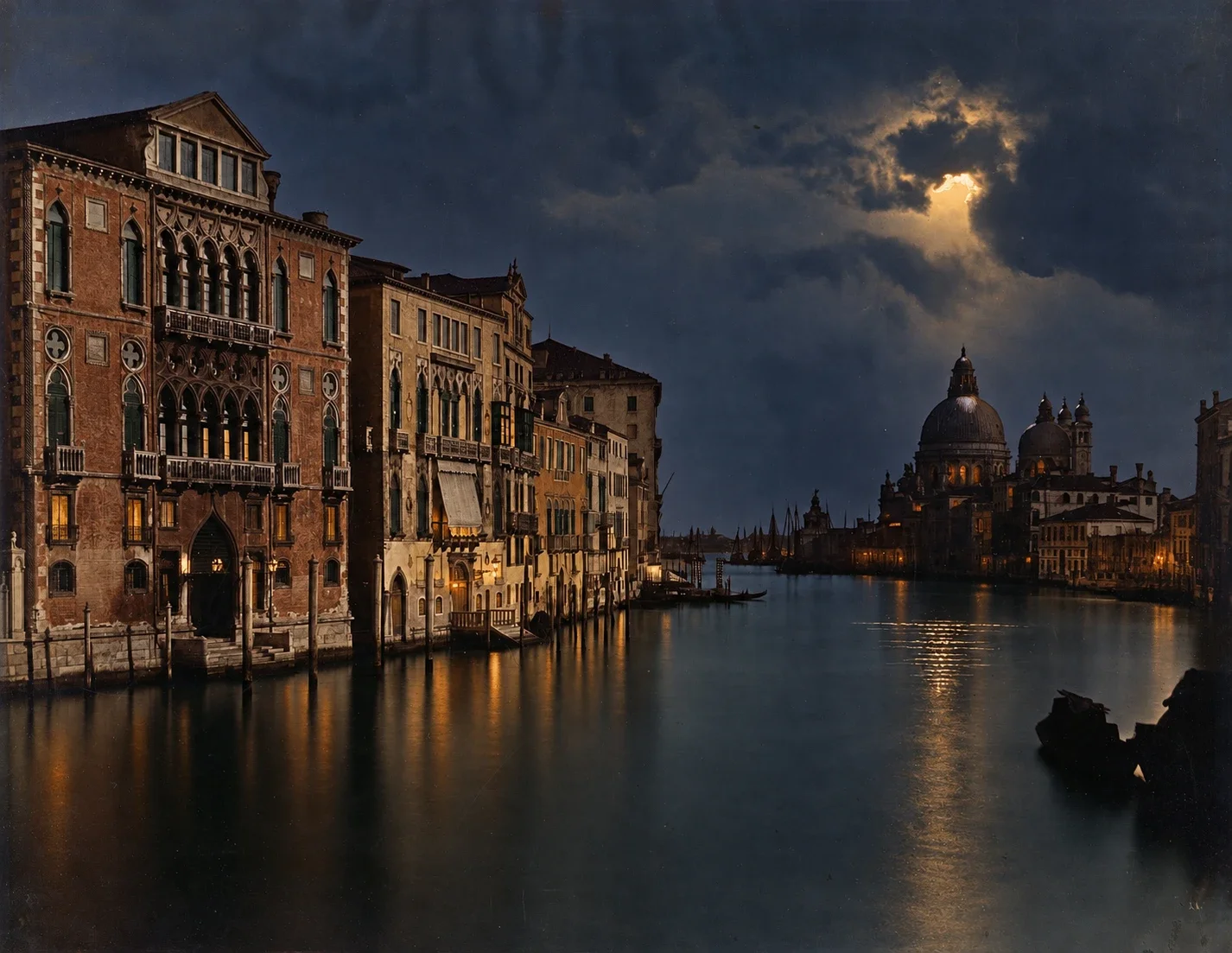
6. Night view of the Grand Canal — Carlo Naya, 1875. Palaces darken along the water while the domes of the Salute mark the far end of the view. The canal, church and historic buildings remain; the filename gives the date as 1875.
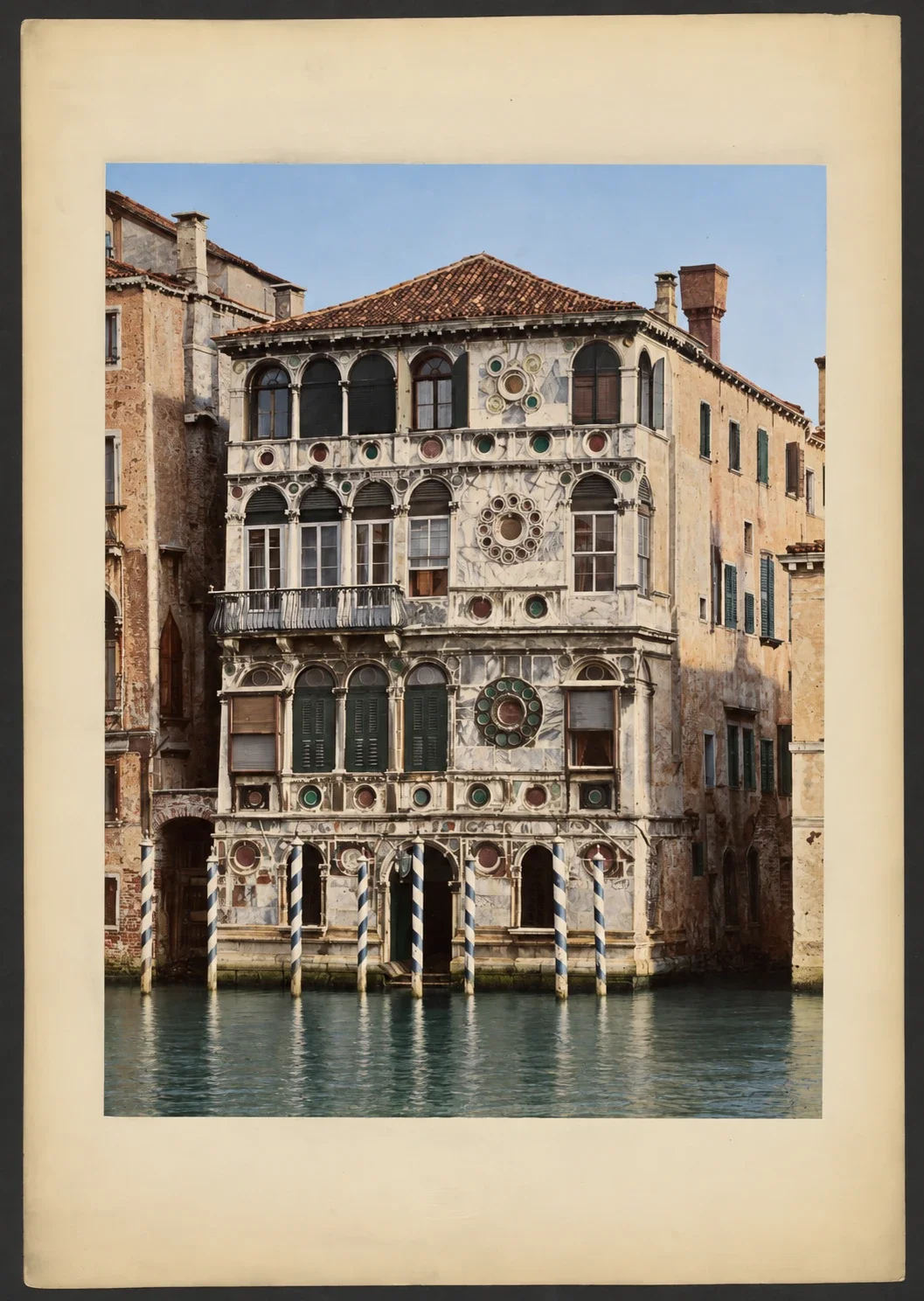
7. Palazzo Dario — Carlo Ponti, 1860–1870. Its circular marble inlays identify the palace on the Grand Canal in Dorsoduro. Palazzo Dario still stands, recognizable by the decorated façade recorded in the photograph.
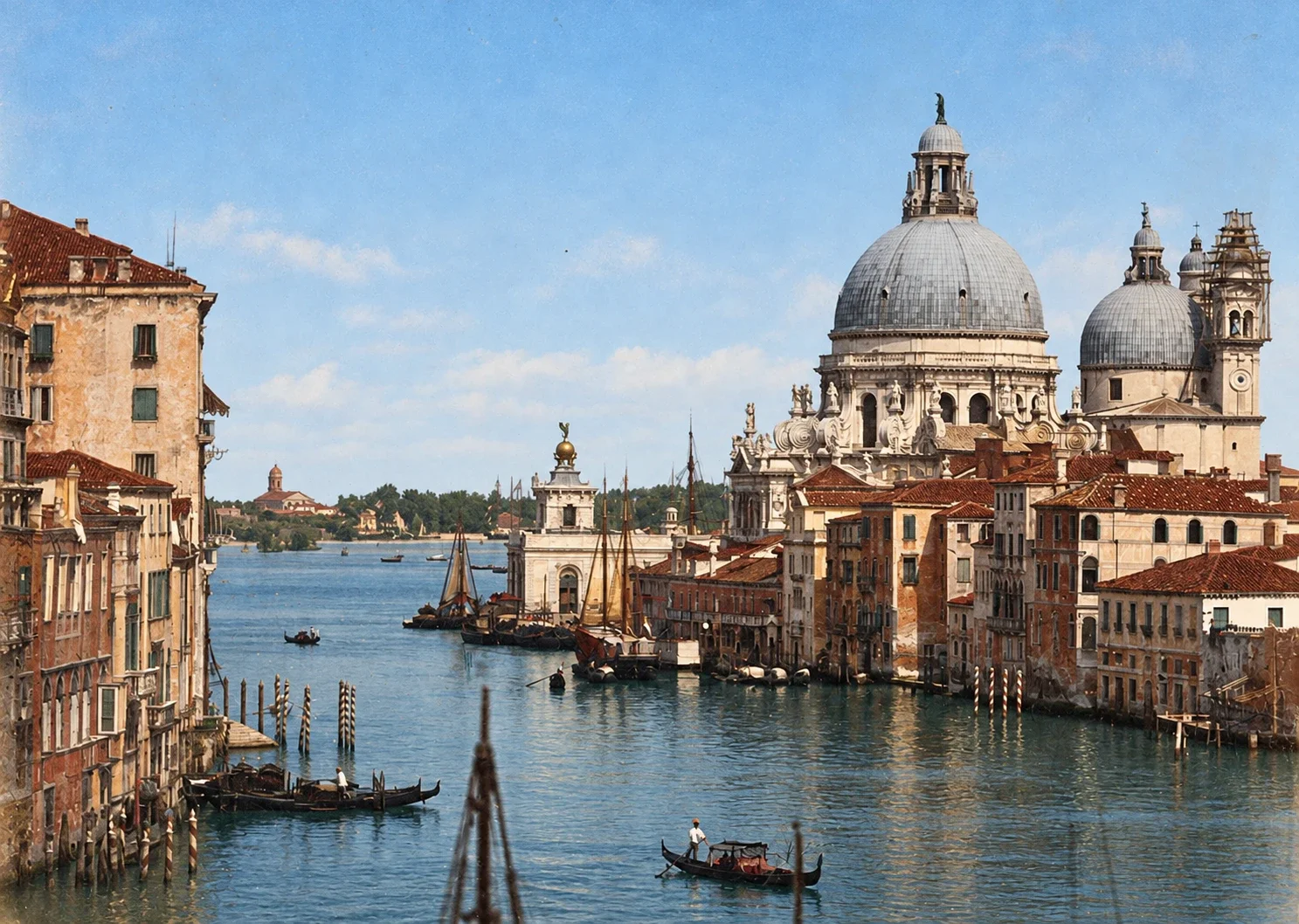
8. Santa Maria della Salute from the Grand Canal — Carlo Ponti. The church’s great dome rises over boats and rooftops near the canal entrance. The basilica remains; the supplied file identifies Ponti but gives no exact year.
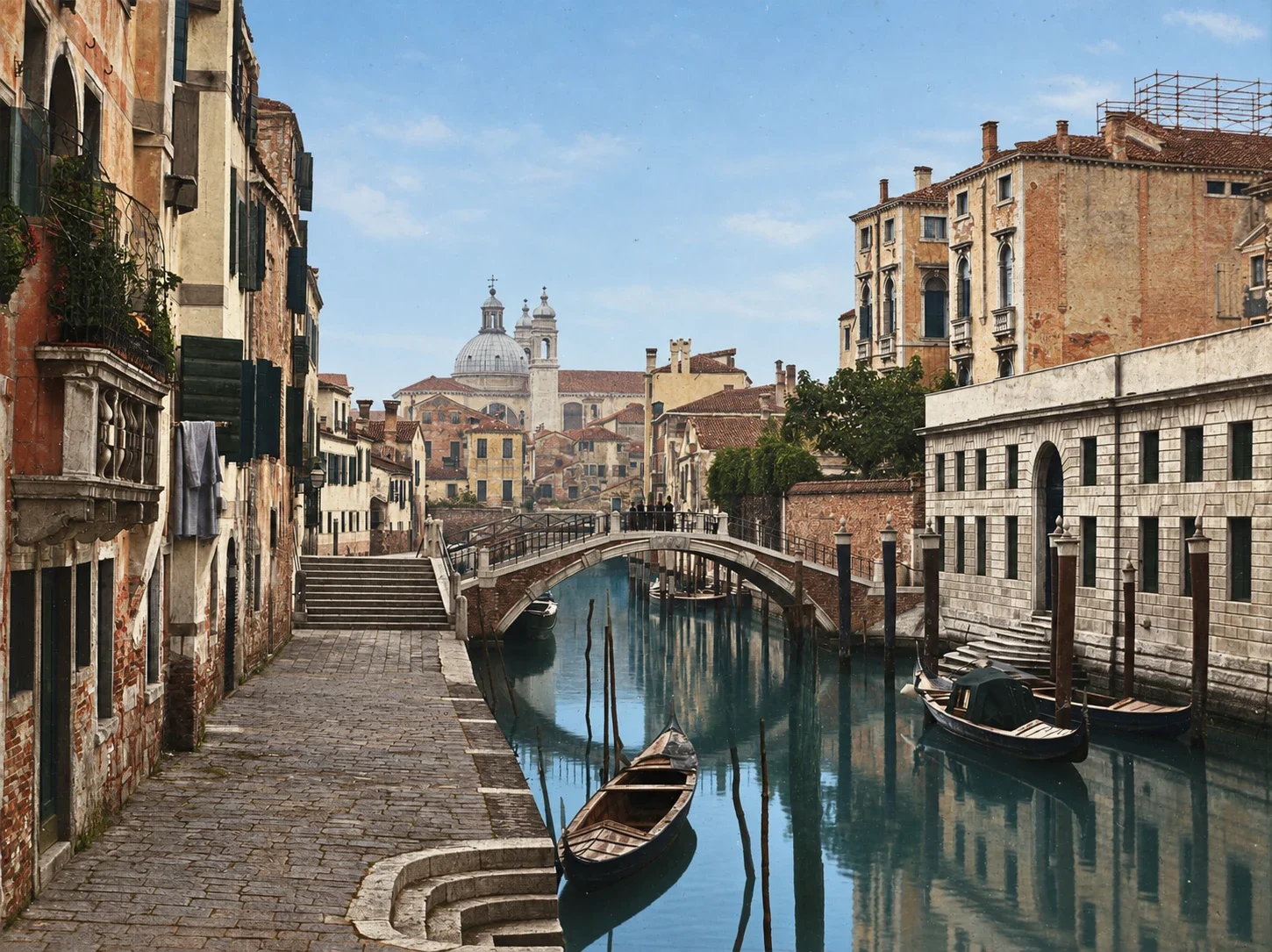
9. Ponte Trevisan and the Rio de Ognissanti — Carlo Naya. The bridge crosses a quieter canal in Dorsoduro, away from the ceremonial waterfront. Both bridge and canal remain. The supplied image title and catalogue listing identify the location and Naya attribution.
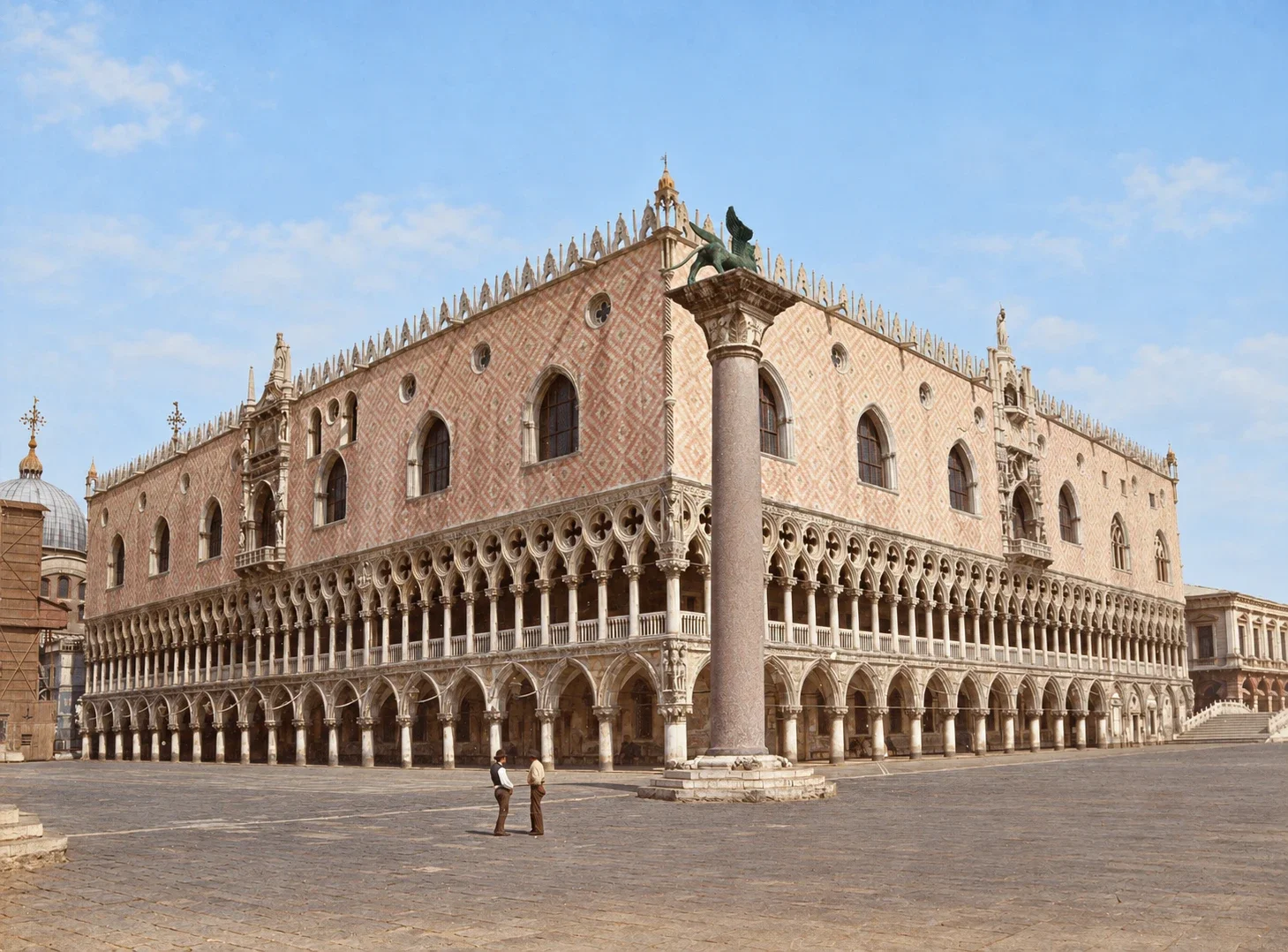
10. The Doge’s Palace and the column of Saint Mark — Carlo Ponti, circa 1865. The Gothic façade fills the frame, with the lion column in front. Both monuments remain in the Piazzetta, facing the same basin photographed here.
Venice has changed, but it has not vanished into its own postcard. The palaces, bridges and water remain part of a lived city, not merely a backdrop. These photographs let us meet it where travel, memory and a new technology came together: the moment a visitor could take Venice home in a picture.
Sources: Biblioteca Nazionale Marciana, Palazzo Ducale – MUVE, Venezia Unica – Basilica della Salute, Ministero della Cultura – Palazzo Dario, Ponte Trevisan – Wikimedia Commons).