A Notebook Entry in Boston
On March 10, 1876, Alexander Graham Bell recorded a test at 5 Exeter Place in Boston in his laboratory notebook. He recorded that he shouted into the mouthpiece, "Mr. Watson — Come here — I want to see you." His assistant, Thomas Watson, was at the receiver in another room and reported that he had heard and understood the words. The entry preserves one of the decisive tests in turning electrical transmission of sound into intelligible speech.
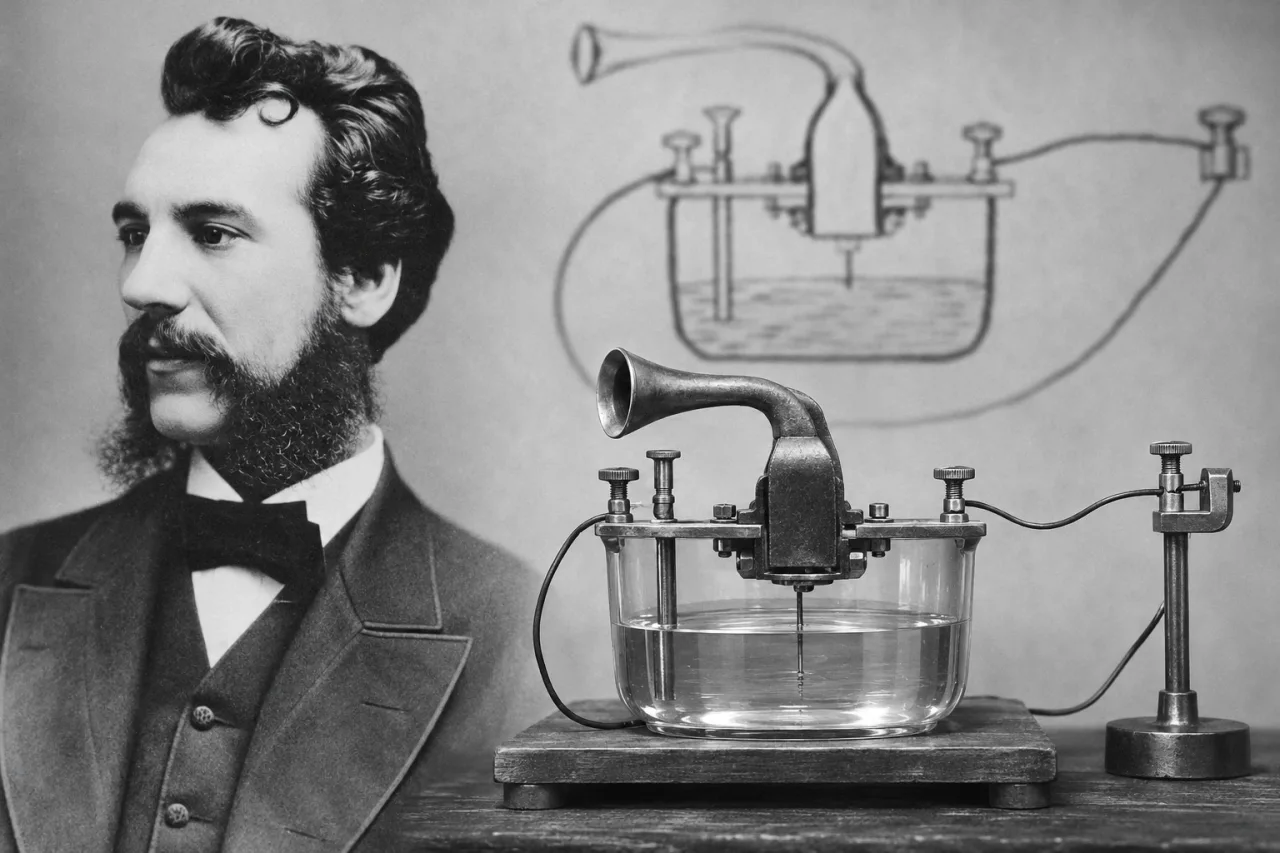
The experiment did not produce perfect transmission. After Watson confirmed the first sentence, the two men exchanged places, and Bell then listened while Watson spoke. Bell’s notebook is careful to record that some words on this reverse test were indistinct, a detail often omitted from later legend. The apparatus that carried the voice was a liquid transmitter, in which a vibrating diaphragm changed the depth of a needle in acidulated water, varying the electric current.
This method of transmission was fundamentally unlike the telegraph. A Morse telegraph sent coded pulses of electrical current by opening and closing a circuit, while the telephone varied a continuous current in proportion to the motion created by a voice. The change allowed not just signals but the complex waveform of speech to travel along a wire. Bell had been pursuing that possibility for years, though his original commission had pointed in a different direction.
The laboratory occupied rooms in a boardinghouse. Bell, a teacher of the deaf and an inventor, had hired Thomas Watson, a skilled mechanic and electrician, to help build experimental apparatus. Their partnership combined Bell’s work on acoustics with Watson’s skill at building and adjusting instruments. The Boston test was the product of months of experiments, with Watson often at one end of a wire and Bell at the other.
The March 10 test was significant but limited. The transmission occurred over a short distance within the same building, and the liquid transmitter was not robust enough for everyday use. Nevertheless, it demonstrated the essential principle that an electrical current could carry the nuanced waveform of speech.
From Telegraph Signals to Speech
Bell's initial work in electrical communication had been financed by investors who wanted a solution to a pressing commercial problem: sending multiple telegraph messages over a single wire simultaneously. In 1874 and 1875 he experimented with harmonic telegraphy, using tuned reeds to transmit different frequencies along the same line. This research taught him how sound could be converted into electrical signals, but his personal attention kept turning toward the possibility of transmitting voice.
A key encounter came in 1875, when Bell met Joseph Henry, the respected physicist and secretary of the Smithsonian Institution. The encounter is recorded in Bell’s papers. Henry, who had conducted his own experiments on electromagnetism, listened to Bell’s proposal and encouraged him to pursue it. At that point the backers were still pressing for a better telegraph.
Watson worked alongside Bell throughout these efforts, applying his skill as a mechanic and electrician to build tuned-reed transmitters and receivers, explore the properties of an undulating current, and test whether speech vibrations could be reproduced electrically. Their notebooks and letters show a steady movement from harmonic telegraphy toward the "speaking telegraph," a phrase Bell used to describe what he hoped to create. The March 1876 test was a direct outgrowth of that progression.
The liquid transmitter used on March 10 was not the only design the two men had tried. Earlier experiments had employed a membrane attached to a metal reed or a wire whose position varied with sound. The liquid version proved sensitive enough to carry intelligible words, but it was fragile and soon replaced. Still, its success gave Bell and Watson the proof they needed: speech could be transmitted electrically with sufficient clarity to be understood.
Patent, Caveat, and Contested Claims
Three days before the March 10 breakthrough, Bell had received a United States patent. U.S. Patent No. 174,465, titled "Improvement in Telegraphy," was issued on March 7, 1876. Although the title referred to telegraphy, the specification described a method and apparatus for transmitting vocal or other sounds telegraphically by causing electrical undulations similar in form to the vibrations of the air. The patent would become central to the legal battles that followed.
The same day that Bell's patent application was filed, February 14, 1876, Elisha Gray filed a caveat with the patent office covering a method for transmitting speech. A caveat was a notice of an invention in progress. It gave Gray a way to register his work while preparing a possible application. The two filings put the inventors’ competing work on the official record on the same date. It was Bell’s application that produced the patent granted on March 7.
The legal contest over the telephone did not end with the issuing of the patent. After years of litigation, the United States Supreme Court upheld Bell's patent claims in the Telephone Cases, decided in 1888. The decision upheld Bell’s claims in the cases before the Court and strengthened the position of the company using his patents. The testimony and arguments also recorded how many inventors and manufacturers had begun pursuing related devices.
The documents capture different moments. The patent specified how a useful device might convey the changing vibrations of the voice. The notebook showed what happened when Bell and Watson tried one version of the idea, with Watson understanding the call and Bell struggling to make out some words when they switched roles.
Public Proof and a Coast-to-Coast Call
The March experiment remained a private laboratory success until a wider audience could see the instrument. In June 1876, Bell exhibited the telephone at the Centennial Exhibition in Philadelphia, where judges and visitors heard speech transmitted over a line. The demonstration helped transform the telephone from a novelty into a commercial possibility. Bell and Watson continued to refine the apparatus, working to replace the fragile liquid transmitter with more robust designs.
The technological distance between the liquid transmitter of 1876 and the commercial telephone of the twentieth century was enormous. Long-distance service depended on developments in the lines and in the equipment that carried the voice over them. But the core principle remained the same: a voice moved a diaphragm, which varied an electric current, which reproduced the voice at the other end. That principle was first demonstrated convincingly in the Boston experiment recorded by Bell.
On January 25, 1915, Bell and Watson spoke again in a ceremonial call that opened the first transcontinental telephone line. Bell, in New York, repeated the sentence from 1876: "Mr. Watson — Come here — I want to see you." Watson, in San Francisco, acknowledged the call. In 1876 the distance between them had been a matter of rooms in a Boston boardinghouse. In 1915 it took a network stretching from New York to California to put the same two voices in touch.
Sources: Bell's 1875–1876 experimental notebook, Bell Family Papers, telephone and multiple telegraph, Library of Congress, historic press and patent chronology, U.S. Reports, the Telephone Cases, IEEE History, the telephonic Bell