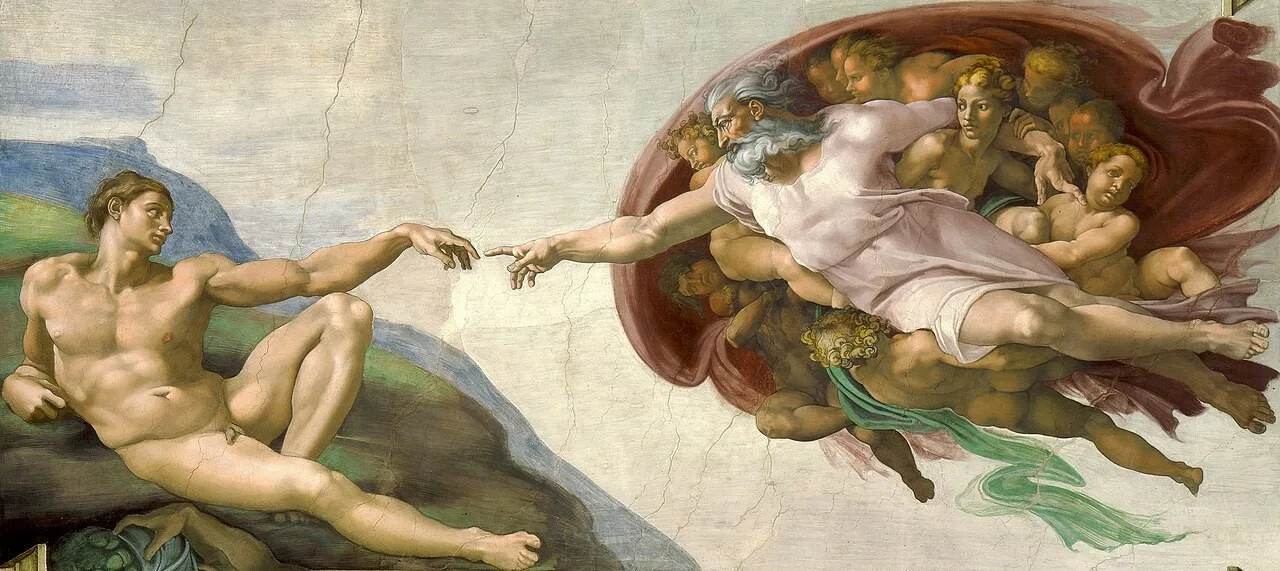
On November 1, 1512, Pope Julius II celebrated Mass in the Sistine Chapel beneath Michelangelo's newly completed ceiling. The date is often called the moment the painting was unveiled. It was not the opening of a new chapel to a modern museum crowd: the room had served the papacy for decades, and the painting had taken shape over years. What changed that All Saints' Day was the presentation of a vast painted world above a working place of worship.
The Vatican Museums date the last work to October 1512 and the inaugural Mass to November 1. The date marks the first Mass beneath the finished frescoes. The Creation of Adam, now the best-known scene, was one of nine episodes along the center of the vault. How did a commission for a damaged ceiling become an entire account of creation, human failure and hope?
A chapel that already had a history
The chapel takes its name from Sixtus IV, who had it restored in the late fifteenth century. Its walls were already filled with scenes from the lives of Moses and Christ, painted by a team that included Perugino, Botticelli, Ghirlandaio and Cosimo Rosselli. Pier Matteo d'Amelia had painted a starry sky overhead. Michelangelo did not enter an empty room. His work had to coexist with an established visual program and the chapel's continuing religious use.
A structural problem helped bring him there. A long crack appeared in the ceiling in 1504; the architect Bramante installed tie rods above the room. The Vatican Museums suggest that damage to the old decoration helped persuade Julius II to commission a new one. The wording matters: the museum presents the connection as a probable explanation, not a surviving statement of the pope's private thoughts. By May 1508, Michelangelo had a contract. Its original plan was comparatively restricted: twelve apostles in the curved corner areas and ornament elsewhere.
The plan grew at Michelangelo's request. The Vatican says the pope gave him much wider responsibility for the design, while noting that theologians at the papal court probably helped shape the program. That combination does justice to both artistic authorship and the chapel's purpose. The ceiling was not simply a sculptor painting whatever came to mind; nor was it a set of instructions copied mechanically onto plaster.
A story larger than one pair of hands
Nine scenes from Genesis run along the center. They move through the creation of the universe and of humanity, the loss of innocence, the flood and the story of Noah. In The Creation of Adam, the space between two approaching hands has become an image known far beyond the chapel. Yet the scene belongs to a sequence. The nearby creation of Eve, the expulsion from Eden and Noah's fate change its meaning: the gift of life is only the beginning of the story.
Around those scenes Michelangelo painted an architectural framework that appears to be built in stone, although it is pigment on plaster. Seated figures of seven biblical prophets and five sibyls, female seers from the classical world, occupy monumental positions. Below them, figures in the lunettes and triangular spaces above the windows represent Christ's ancestors. The four corners show episodes in which the people of Israel are saved from danger. A viewer looking up encounters multiple generations and forms of expectation, not a single isolated picture.
The Metropolitan Museum of Art notes that a few surviving sheets reveal Michelangelo working through the overall arrangement, while figure studies show how carefully he considered bodies and poses. Fresco, the technique used on the vault, requires painting onto fresh plaster; the colors become bound to the wall as it dries. Working at that scale meant planning images that would be read from the floor, while adapting the design to the curved surfaces above. The apparent ease of a figure's turn or gesture conceals decisions made before paint touched the ceiling.
What the date does and does not mark
The ceiling took years, from 1508 to 1512, and was made in stages. The Vatican Museums say that Michelangelo completed the first half by August 1510. The finished work was ready by the end of October 1512, in time for Julius II's Mass on All Saints' Day. November 1 is therefore best understood as the ceremonial presentation of the completed ceiling in the chapel for which it was made, rather than the date on which the entire work suddenly came into being.
It is just as easy to mistake what was present in the room in 1512. Michelangelo's Last Judgment, the immense fresco on the altar wall, was not there. Clement VII commissioned it more than twenty years later; Michelangelo painted it from 1536 to 1541 under Paul III. The new work displaced earlier images on that wall. A visitor today sees different generations of decoration together, but the Mass of 1512 belonged to an earlier chapter of the chapel's history.
A work that kept changing in view
Centuries of use also changed how the ceiling was seen. The Vatican Museums' documented restoration of the vault ran from 1984 to 1989 within a longer campaign for the chapel. Cleaning and conservation renewed attention to its color and to the material demands of preserving paintings inseparable from their walls. Those interventions did not return anyone to the exact experience of November 1512. They made the surviving work available for a new examination while raising questions about what later viewers had grown accustomed to seeing.
Five hundred and fourteen years after Julius II's Mass, the anniversary is not only a birthday for a masterpiece. It recalls an old chapel with decorated walls, a damaged starry ceiling, a limited first commission and an artist who expanded it into a demanding pictorial argument. The familiar hands of Adam and God are still there. So are the prophets, sibyls, ancestors and the stories of a world made and troubled. To look at the whole ceiling is to see why the date mattered: an image for a single room had become a sequence too large to take in at a glance.
Sources: Vatican Museums, Sistine Chapel history, Vatican Museums, ceiling, Vatican Museums, central Genesis stories, Vatican Museums, institutional chronology and restoration dossier, Metropolitan Museum of Art, Michelangelo drawings exhibition, Metropolitan Museum of Art, papacy and Vatican Palace, Holy See, Sistine Chapel overview.