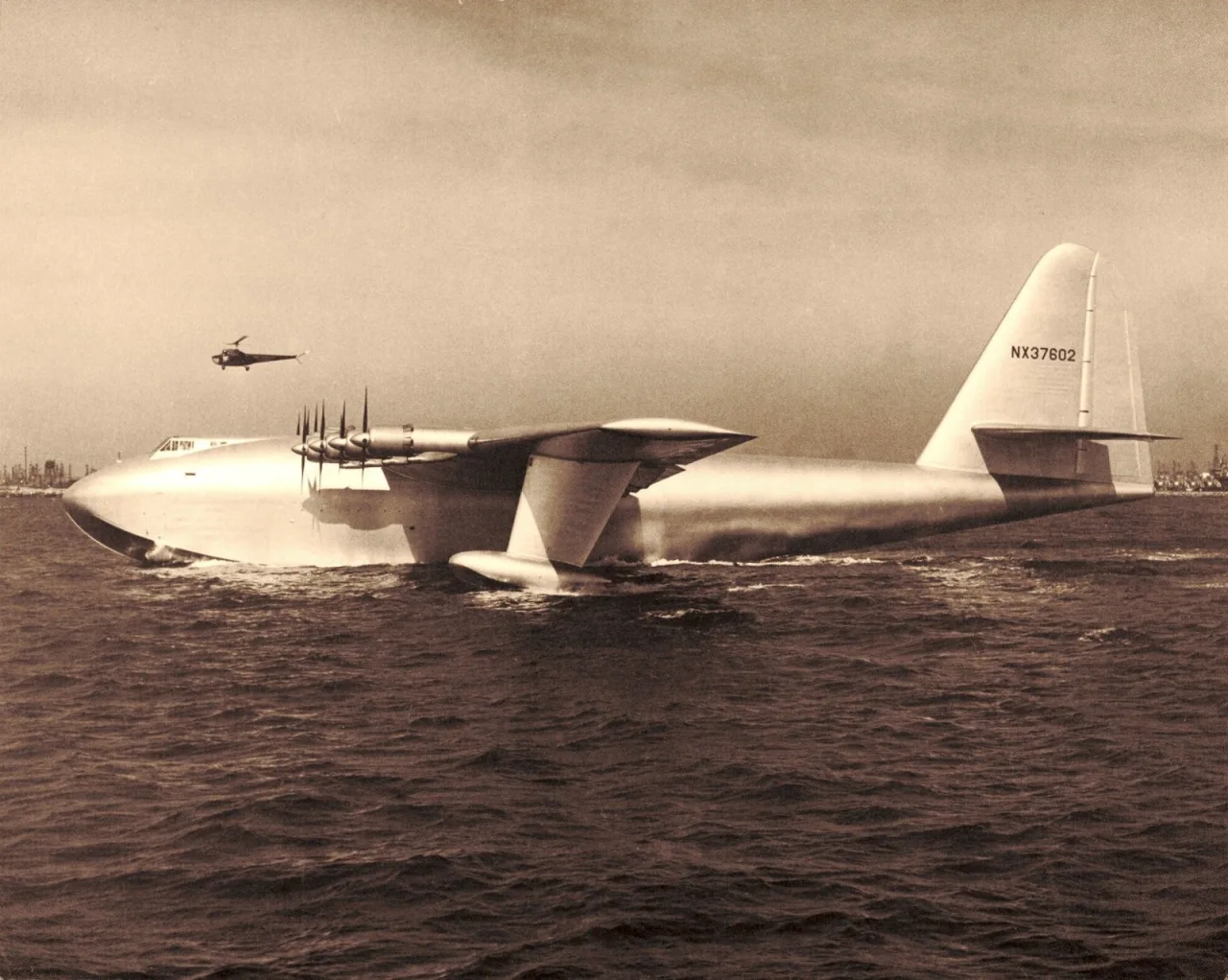
The flight log has room for many journeys, but this aircraft used one entry. On November 2, 1947, after several runs across the water at Long Beach, California, the Hughes Flying Boat rose into the air. The surviving entry records about 30 seconds aloft and a height of roughly 25 feet (7.6 meters). For an aircraft built to carry men and equipment across oceans, it was a very short trip. It was also the only time this extraordinary machine flew.
Its official name was the H-4 Hercules; the press preferred “Spruce Goose,” a nickname Howard Hughes disliked. The aircraft had taken years to build, the war it was meant to serve had ended, and a Senate investigation was examining Hughes's government contracts. Seventy-nine years later, the brief flight remains impressive, but it cannot answer every question about what the machine might have achieved. Its longer story begins with the Atlantic war and ends in a museum built around it.
A shipbuilder's proposal meets an aircraft designer
In 1942, Allied ships carrying troops and supplies faced German submarine attacks. Shipbuilder Henry J. Kaiser promoted a fleet of very large flying boats as a way to move cargo over water without exposing a convoy to the same submarine threat. He joined Hughes, an aviator and aircraft designer, in the Kaiser-Hughes Corporation. That November the venture contracted with a U.S. government agency to design and build three prototypes, including two intended for flight and one for structural testing.
The aircraft would have to operate from water and carry a heavy load. It also had to respect wartime restrictions on materials such as aluminum. Hughes and his engineers adapted a laminated-wood process called Duramold, originally developed by Fairchild. Thin layers of wood were shaped and bonded under heat and pressure. Birch made up much of the structure; other woods, including some spruce, were also used. Despite its nickname, this was not an airplane made principally of spruce, and engines and other components were not wooden.
Scale made nearly every step demanding. The completed flying boat had eight engines and a wingspan of about 320 feet (97.5 meters), greater than that of any aircraft then built. Carpenters shaped large curved sections and assembled the hull and wings. A National Register history says more than 800 members of the carpenters' union assisted on the project. The result was the product of designers, craftspeople, engineers and flight crews as well as the celebrated man whose name it carried.
Years of testing before a flight
Before the full-size aircraft entered the water, specialists tested models. In a wartime report dated June 1944, the National Advisory Committee for Aeronautics—the U.S. research agency that preceded NASA—described towing a one-sixteenth-scale hull model through a test basin. Its researchers measured resistance and estimated takeoff performance. Such experiments helped explore how the hull might behave; they were not a substitute for flying the completed aircraft.
The pace of development frustrated the original wartime ambition. Kaiser left the project in 1944, and the government reduced its requirement to one prototype. By the time Germany and Japan surrendered in 1945, the giant transport could not contribute to that war. Hughes continued with the aircraft. Its name changed from HK-1, reflecting Hughes and Kaiser, to H-4 Hercules; it remained an experimental flying boat rather than an operational fleet.
Even moving it was a project. In 1946, its major sections traveled from the Culver City factory to a prepared dock at Long Beach, a journey of about 25 miles (40 kilometers). Crews had to deal with trees and overhead utility lines. At the harbor, they assembled the wings, engines and control surfaces and checked the systems before the aircraft entered the water. Photographs in the University of Nevada, Las Vegas archives document construction, transport and testing, putting people and machinery beside the immense structure.
Thirty seconds over the harbor
By 1947, senators were investigating Hughes's wartime aircraft contracts, including the flying boat and a separate reconnaissance aircraft, the XF-11. Public spending and delays were under scrutiny. The two projects should not be treated as one aircraft or one test: the flying boat's appearance over the harbor offered a visible response to doubts about whether this particular machine could lift off, not a complete settlement of questions about the contracts or its military usefulness.
Hughes piloted the H-4 during water tests on November 2. According to the National Register documentation, engineers, government observers and members of the press were aboard during the early runs; some reporters left before the third. On that run the aircraft lifted clear of the water. The flight log, reproduced in the registration file, describes approximately 30 seconds in the air at about 25 feet (7.6 meters). Accounts differ: the American Society of Mechanical Engineers gives roughly 70 feet (21 meters) and a mile (1.6 kilometers). Those conflicting estimates should not be made artificially precise. The shared conclusion is that the flight was brief and close to the water.
A prototype with an afterlife
The Hercules never flew again. That did not mean work stopped immediately. The National Register history describes Hughes's team using the aircraft as a research platform through 1953, modifying controls and adding or improving backup systems. Hughes maintained it for years afterward; the Smithsonian's archival account says he kept it in flight-ready condition until his death in 1976. These later tests and preservation efforts are distinct from the single flight. They do not establish how the aircraft would have performed on a long voyage carrying its intended load.
After public display in California, the flying boat was dismantled and moved by water and road to McMinnville, Oregon, arriving in 1993. It was restored and reassembled for a museum that opened in 2001, where visitors can still see the prototype. Its wingspan record has since been surpassed. What remains is more revealing than a simple verdict of triumph or failure: a wartime answer that arrived too late for its original mission, a demanding collective engineering effort and a flight log recording half a minute in which a very large wooden aircraft left the water.
Sources: National Register of Historic Places nomination, Hughes Flying Boat, North American Aerospace Museum, H-4 collection page, Smithsonian National Air and Space Museum archive finding aid, American Society of Mechanical Engineers historical landmark, NASA Technical Reports Server, 1944 NACA test report catalog and abstract, University of Nevada, Las Vegas special collections, H-4 photo collection.