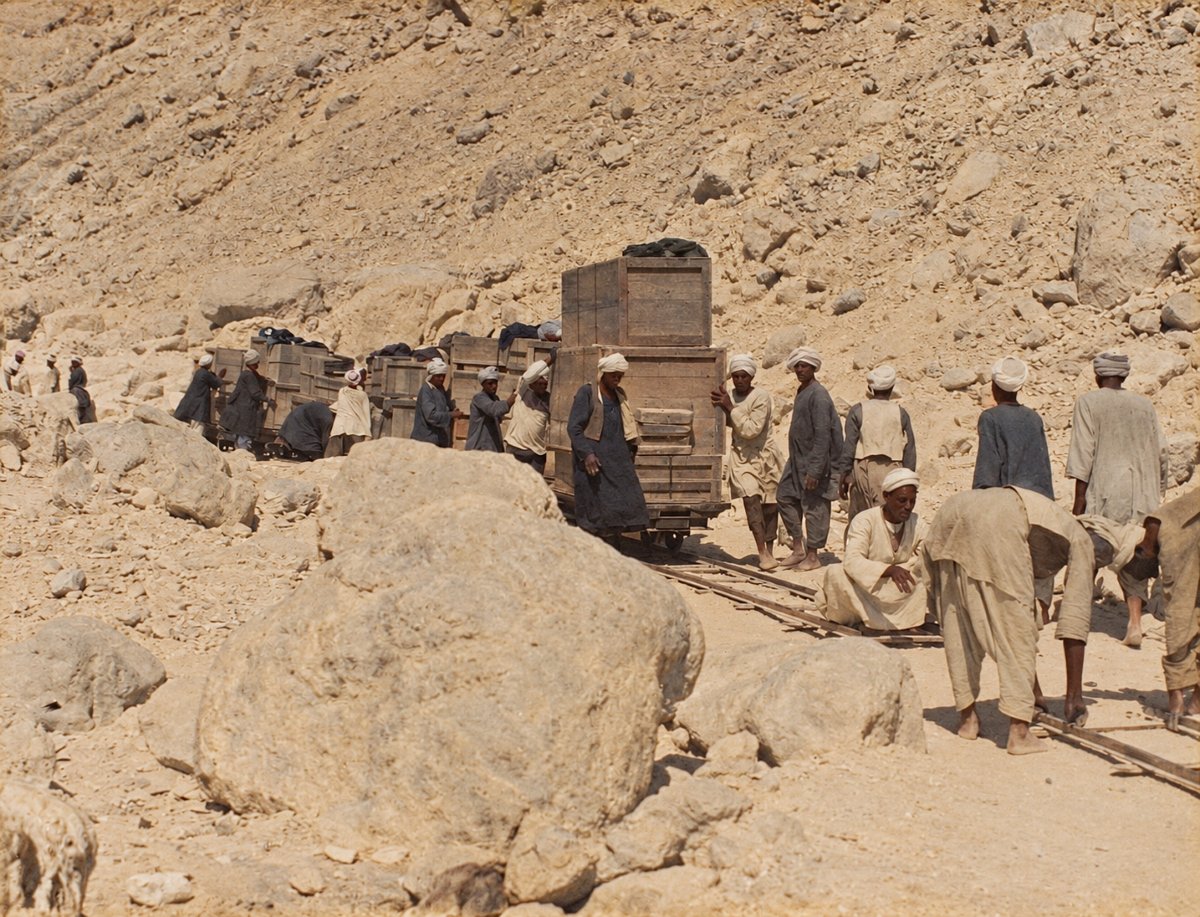
In one of Harry Burton’s photographs, Egyptian workers stand beside small wagons on a narrow railway. The cargo belongs to the excavation of Tutankhamun’s tomb. There is no golden mask in the picture. Its subject is the work required to move a royal burial out of the ground: men, containers, rails and an operation extending beyond the tomb’s doorway.
The discovery is usually compressed into a British archaeologist, a wealthy patron and an astonished glimpse of gold. Howard Carter and Lord Carnarvon belong in that account. But the photographs and excavation records preserve a larger enterprise, dependent on Egyptian workers and on the painstaking task of recording objects before their surroundings disappeared.
The discovery took more than one day
On 4 November 1922, the excavation uncovered the first step of a staircase beneath ancient workmen’s huts in Egypt’s Valley of the Kings. Carter’s journal records clearing, seals and uncertainty. A doorway was evidence of a tomb; it did not yet reveal whose burial lay beyond, or what condition its contents would be in.
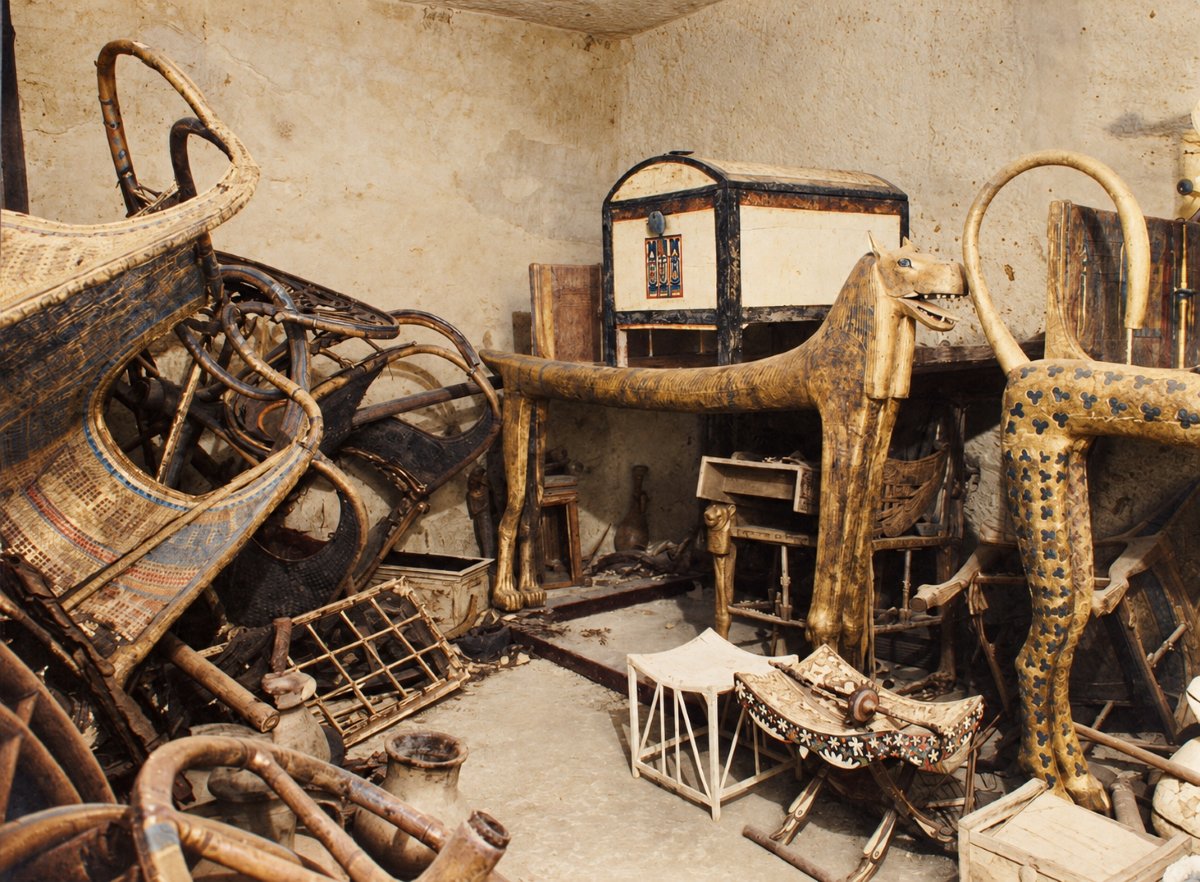
On 26 November, after opening the outer doorway and clearing a rubble-filled passage, Carter looked through a breach in a second sealed entrance. His journal describes furniture, chariots, chests and statues. The antechamber contained an extraordinary concentration of objects, but another sealed doorway separated the excavators from the king’s burial chamber.
That chamber was opened on 16 February 1923. The examination of the mummy followed in November 1925. Familiar images of discovery therefore belong to different stages of an excavation lasting about a decade. Treating them as photographs of a single afternoon turns years of work into an apparently instantaneous revelation.
Even the famous first look had a larger audience than the usual retelling suggests. Carter’s journal places the expedition’s Egyptian foremen, the reises, alongside Carnarvon, his daughter Lady Evelyn and Arthur Callender as Carter peered through the breach. The written record gives the foremen a place at the threshold without supplying their individual voices.
The people at the edge of the frame
The Metropolitan Museum of Art identifies four Egyptian foremen named in Carter’s published account: Ahmed Gerigar, Hussein Ahmed Said, Gad Hussein and Hussein Abu Awa. Spellings vary across publications. Their survival in print is exceptional: most of the Egyptian excavators, labourers and children who worked at the site remain unnamed in the photographic record.
One Burton photograph held by the Met shows two foremen and a young assistant dismantling the partition blocking the burial chamber. None is individually identified. The image establishes that they performed the work; it cannot, by itself, recover their names. That distinction matters when later captions try to turn anonymous figures into identifiable historical characters.
The railway photograph offers another part of the operation: transport. Objects had to leave their original positions, reach a place where they could be treated and packed, and eventually travel onward. The workers beside the wagons are evidence of that chain of labour. They were participants in the excavation, although the archive rarely allows us to follow their lives beyond it.
Restoring those people to the story does not require inventing a second lone discoverer. It requires changing the scale of the account. Carter directed the excavation; Egyptian crews made its daily progress possible. The uneven distribution of names in the surviving records reflects how the expedition described itself, rather than a reliable measure of each person’s contribution.
Why the photographer was indispensable
Burton was an experienced photographer working for the Met’s Egyptian Expedition when the museum made him available to Carter. Over the following years he produced roughly 1,400 glass-plate negatives of the tomb and its contents. The photographs that made Tutankhamun internationally familiar also formed part of a technical record of the excavation.
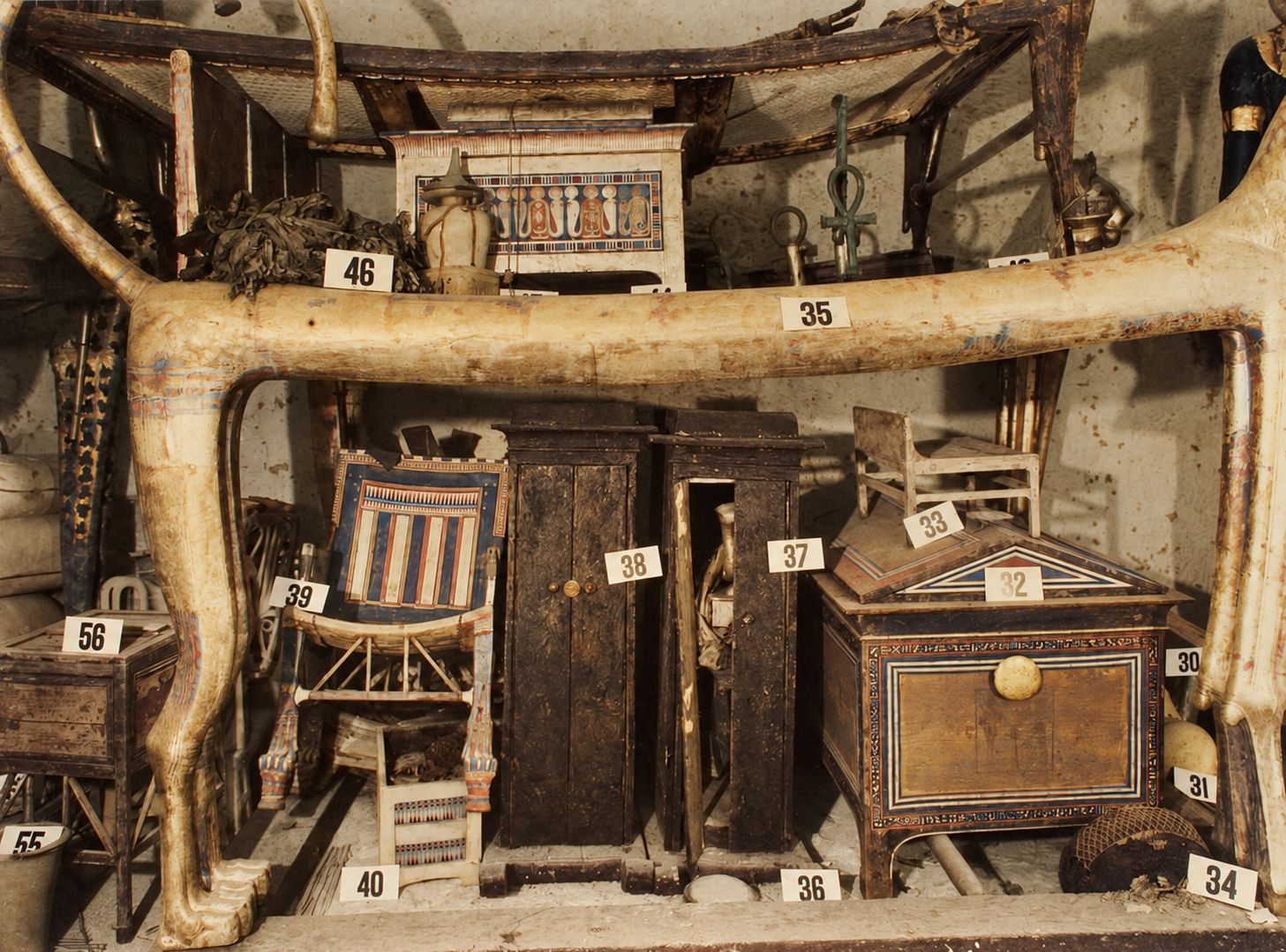
The most revealing pictures are sometimes those in which almost nothing has moved. In an antechamber view, dismantled chariots and furniture occupy the crowded space. In another, small cards bearing reference numbers sit among the objects. Those numbers connect the photograph to a system of identification, description and subsequent treatment.
Removing an object changes the evidence around it. A chest carried away cannot later be photographed in precisely the relationship it had with the neighbouring bed, vessel or chariot. Burton’s pictures retained those relationships. Combined with plans and object cards, they allowed individual finds to remain connected to the arrangement in which they had been encountered.
This is why an excavation photograph is more than an illustration of a beautiful antiquity. A museum display presents the object after selection, movement and conservation. The earlier photograph records a stage that no longer exists. It lets a researcher ask questions about placement and procedure that the isolated object cannot answer on its own.
A treasure that had to survive its removal
The task involved more than 5,000 objects, many made from combinations of materials with different conservation needs. Opening the tomb was the beginning of their recovery. Carter’s journal records the arrival of specialists, including the chemist Alfred Lucas and Burton, as the team prepared to document and clear the contents.
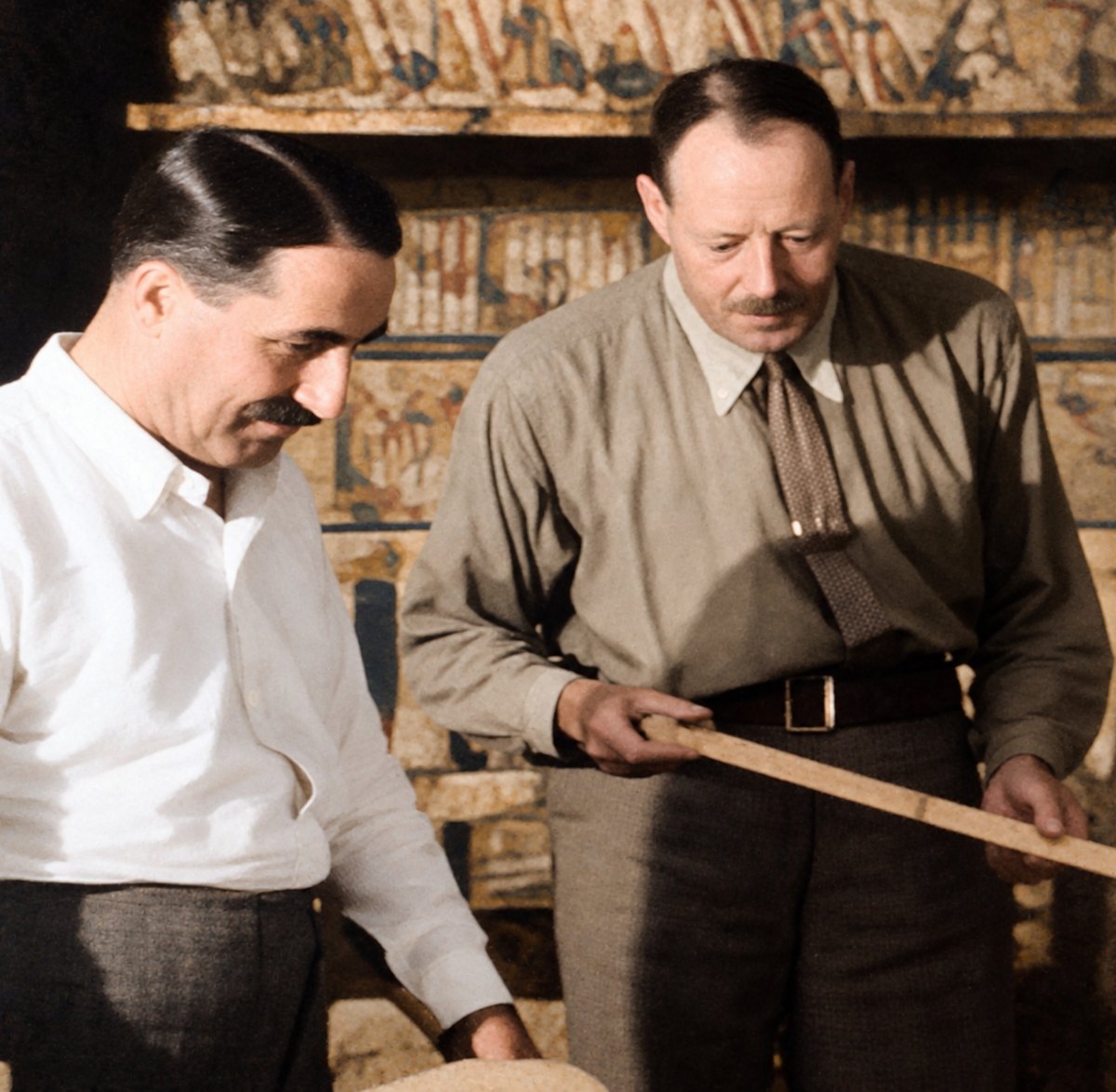
A photograph of Carter and Callender examining objects captures this less theatrical phase of the enterprise. The discovery had become a sequence of decisions about individual finds. Description, photography, treatment and packing were essential to the result that the public would eventually see. The prolonged clearance was part of the discovery’s history, rather than an interval after its conclusion.
The images also demand careful dates. A publication date may tell us when readers first saw a photograph, while an upload date tells us only when a digital copy entered a website. Neither automatically dates the camera exposure. Archival captions and excavation records are needed to distinguish the first season from later work on the burial and mummy.
An archive that can still change the account
Carter died in 1939. His niece Phyllis Walker donated the excavation archive to Oxford’s Griffith Institute in 1945. The surviving material includes journals, correspondence, drawings, plans, object cards and photographs. Together, they preserve both the extraordinary richness of the burial and the decisions made by the people who excavated it.
In November 2025, the institute launched the beta phase of its Tutankhamun Spatial Archive. The project connects records previously difficult to navigate together, beginning with material from the examination of the mummy and adding further documentation. It is a new route into an old excavation, not a newly discovered tomb or a finished reconstruction of every worker’s life.
Reading the journal beside the photographs makes the difference visible. The journal can establish a day or describe a procedure. A picture can show people omitted from the names attached to the expedition. Neither is a complete account; together they expose details that the familiar story of an individual triumph leaves outside its frame.
The reference cards among the chariots are small enough to overlook beside the gold. Yet they explain how the find became knowledge: an object had a position, a number and a record. The men beside the railway wagons deserve the same attention. Their names may remain missing, but their work has not vanished. Burton’s camera kept it in the picture.
Sources: Carter’s first-season journal, The Met: Taking Down a Wall, The Met: Burton’s photographs, Oxford: the excavation archive, Griffith Institute: Spatial Archive
Books and resources
- Explore the Tutankhamun Spatial Archive — Griffith Institute, University of Oxford
Free English-language archive linking photographs, plans, object cards and journals. The beta collection is being expanded.
Free resource - Read Carter’s first excavation journal — Howard Carter · Griffith Institute
Primary document in English from the 1922–1923 season, with a freely accessible transcription and original records.
Free resource